
Every copper plate you smelt carries a trace of something rarer.
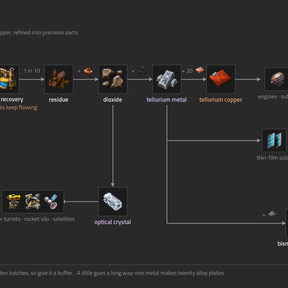
Tellurium turns part of your copper line into trace recovery: the copper keeps flowing, and every so often a batch leaves a little tellurium residue behind. Refine it, and a little goes a long way. One tellurium metal makes twenty plates of tellurium copper for electric engines, substations and beacons. Grow the dioxide into optical crystals for laser turrets, the rocket silo and satellites. Add Bismuth, and it becomes thermoelectric cooling for modules and laser defense. With compatible mods, tellurium also improves synthetic rubber production and goes into optical instruments and power regulators.
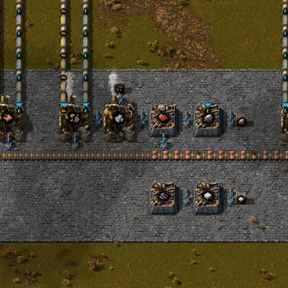
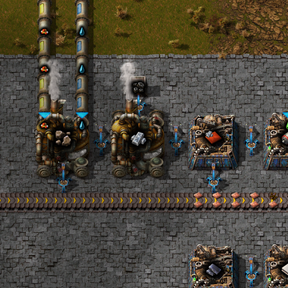
It starts after sulfur processing: convert part of a copper furnace column to trace recovery, keep the copper moving, and save the occasional tellurium residue. A recovery plant smelts as fast as a steel furnace, so you divert only as much copper as you need. There are no ore patches to find.
Factorio 2.1 only.
Recommended: Bismuth. It opens the thermoelectric branch, from bismuth telluride to cooling components. Tellurium also works without it.
What it adds
- Tellurium copper for electric engines, rocket-launcher contacts, substations and beacons, plus power regulators with Them Thar Hills. A little tellurium goes a long way: one metal makes twenty alloy plates. Rocket launchers add two alloy plates; their research requires Tellurium processing only where it fits the existing science tier. Rocket ammo and weapon effects stay unchanged.
- Thin-film solar: every ten solar panels need one tellurium metal (with Cadmium, cadmium telluride instead).
- Optical crystals for laser turrets, the rocket silo and satellites, plus scanners and spectroscopes with Lasing Around. Tellurium optics also makes laser weapons deal 10% more damage and fire 10% faster. Glass-producing mods give crystal growth a use for their glass, with bismuth glass preferred when available.
-
Thermoelectrics, with Bismuth: combine the two metals, then make cooling components for tier-3 modules and personal laser defense. Other mods can supply the solder, ceramics and heatsinks.
-
More rubber from the same feedstock, with BrimStuff: an optional synthetic-rubber recipe yields a third more rubber for the same upstream ingredients and crafting time. It uses one tellurium metal and returns it in 99% of batches, so the line needs only occasional top-ups.
There are also optional ways to recover and refine it: crushed-copper and trace-gold processing, K2 copper enrichment, Vulcanus ore and lava melting, and Fulgora scrap recovery. Chloride and peroxide improve extraction yield; coke, charcoal, graphite, hydrogen and electrolysis provide reduction options. Argon improves bismuth-telluride yield. Foundries and kilns can handle the alloys, and supported glass, ceramics, solder, heatsinks and cooling fans adapt the existing recipes to your factory.
With K2 and Bismuth, thermoelectric components also go into research servers and quantum computers. IntermediatesForYou moves the satellite's crystal requirement into its satellite body. Startup settings let you bypass individual recipe changes and list the recipes Tellurium modifies.
The research tree stays small: processing, optics, and thermoelectrics when Bismuth is installed. Better refining methods use the provider technologies and materials you already have; Tellurium does not add new prerequisites to broad upstream polymer, gold or atmosphere research. Material selection favors enabled, reachable earlier routes, so the thermal branch does not wait for unnecessary bismuth enrichment or a late argon technology.
With Space Age, the thermal assembly recipe remains usable in assemblers and can also run in an electromagnetic plant. Crystal growth remains usable in chemical plants and can also run in a cryogenic plant. Existing recipe bypasses leave the named host recipe unchanged, including its ingredients, outputs and unlocks.
Integration with other mods
The integrations give existing materials a job in the chain. Coke, charcoal or graphite replaces coal when a suitable production route is available. Peroxide improves extraction yield. Indium solder and tantalum heatsinks become part of the same thermoelectric recipe. Lasing Around uses one crystal per batch of twenty scanners or spectroscopes; Them Thar Hills uses one alloy per batch of ten HV power regulators. Shared laser emitters keep their existing inputs.
| Mod family | What changes |
|---|---|
| Vanilla | Copper trace recovery, tellurium copper and optical crystals. |
| Space Age | Recover tellurium from molten copper and lava on Vulcanus, or scrap on Fulgora. Cast the copper alloy in a foundry. |
| Space Exploration | Ship tellurium materials by delivery cannon. Pylon substations use two tellurium copper; energy-beam emitters and beam defence use optical crystals. With Bismuth, thermodynamics laboratories, space supercomputers and RTGs use thermoelectric components. |
| BZ and maintained legacy BZ | Use graphite, suitable smelting machines, solder and ceramic materials. Existing copper byproducts are retained. |
| Bismuth | Adds bismuth telluride and the thermoelectric branch. |
| Timeken / MetalsForYou | Peroxide refining with ChemistryForYou, argon-assisted alloying with GasGasGases, solder with Indium, heatsinks with Tantalite and satellite bodies with IntermediatesForYou. |
| Planetfall / Ashier | Copper trace recovery and power regulators with Them Thar Hills; optical instruments with Lasing Around; cooling fans with If I Had A Nickel; improved rubber with BrimStuff. |
| Krastorio 2 / K2 Spaced Out | Residue from the existing copper-enrichment recipe; crystals in the laser artillery turret; tellurium metal in advanced solar panels; thermoelectric components in research servers and quantum computers when Bismuth is present. |
| Industry mods | Crushed-copper recovery with Crushing Industry; coke and kiln recipes with Alloy Smelting; charcoal with Wooden Industry; acid and electrolysis options with pHactorio. |
| Cadmium | Solar panels take cadmium telluride (one cadmium plate and one tellurium metal) instead of tellurium metal, also in K2 advanced solar panels. Optional filter washes recover tellurium residue now and then. With Space Exploration, gamma-ray detectors and night vision need cadmium zinc telluride crystals. |
| Magnesium | Magnesium chloride leaching: extraction needs four residue instead of five. |
| Phosphorus | Tellurium copper is phosphorus-deoxidised, as the real alloy is: one red phosphorus per batch, twenty-five plates instead of twenty. Tellurium processing then comes after Phosphorus processing (both red and green science). |
| Gallium | Tellurium-assisted fabrication: one tellurium metal per double batch makes up to a quarter more semiconductors from the same wafers. With Bismuth, each thermoelectric batch takes one gallium as thermal contact (Galinstan when indium and tin are available), so thermoelectrics come after Gallium and arsenic recovery. Tellurium residue can be leached for arsenic instead of tellurium. With Cadmium and Space Exploration, gamma-ray detectors and night vision get gallium arsenide readout. |
| Neodymium | Electric engines take a neodymium magnet next to tellurium copper. Crystals can be polished for more crystals from the same residue. |
| Caesium | Atomic clocks take tellurium copper for their microwave cavity, atom traps take one tellurium crystal per ten for the laser optics, and the survey satellite takes tellurium metal for its detector. |
| Antimony | Tellurium-coated memory substrates widen Antimony's annealing window from 250–350 °C to 225–375 °C when tellurium is available at green science. |
| Rocket-Silo Construction | The excavation site that replaces the rocket silo carries its 20 crystals, once per silo. |
These integrations are optional. Choose the mods you want to play, using their Factorio 2.1 versions. Timeken and the legacy BZ collection exclude Space Age.
Getting started
Tellurium copper is made in machines: use any vanilla assembler, a compatible BZ foundry or a Space Age foundry. It cannot be hand crafted.
Research Tellurium processing and select Copper trace recovery in a chemical plant. Supply copper ore, sulfuric acid and water, and keep removing the copper plates. At vanilla defaults, each twenty-ore batch has a 10% chance of yielding one residue. Several empty batches in a row are normal.
Refine the residue into dioxide, then choose where it goes: metal for alloys, crystals for optics, or bismuth telluride for cooling components. Give the residue a small buffer; production comes in bursts.
You can add Tellurium to an existing save without exploring new terrain. Its recipe changes apply to that factory too. A startup setting lets you bypass individual recipe modifications.
For recipe-by-recipe changes and refining ratios, see the FAQ tab.
Credits
Tellurium is by fluffy_penguin. Its approach owes a lot to:
- Brevven, for BZ Mods and the idea that one extra material can make a familiar factory more interesting.
- trikop, for Bismuth and Manganese.
- Planetfall and AtelierAmber / Ashier, for the nickel, brass, sulfur, gold and laser mods this chain connects to.
- Timeken, for the original resource mods; cackling fiend, Morganite / Morganni and pla, for maintaining and porting the collections used in testing.
The thumbnail is original. The tellurium metal, crystal, bismuth telluride and thermoelectric icons were made with image-generation tools; some remaining icons reference tinted Factorio assets. No artwork from the credited mods is bundled. Code and original artwork use the MIT license; Factorio assets remain Wube’s.