
Your next batch of chips starts with a handful of ash.
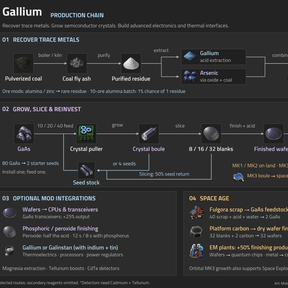
Recover gallium and arsenic from combustion ash, combine them into gallium arsenide, and grow the crystals that feed your electronics factory. Each crystal boule presents a choice: slice it into wafers for today's production, or cut it into seeds to expand tomorrow's crystal line.
Gallium adds a semiconductor industry with its own rhythm: bootstrap a seed stock, improve it, and keep enough in reserve to grow again. There are no new ore patches to find. With other material mods, the same factory connects to metal refining, radio electronics, detectors and liquid-metal thermal interfaces. With Space Age, it can take to orbit.
Factorio 2.1.23 or later in the 2.1 series. Space Age and other mods are optional.
What you build
- A recovery line. Collect coal fly ash in an ash-recovery boiler or electric ashing kiln. Purify it, then extract gallium and arsenic separately. Supported ash and metal mods add other sources.
- Other uses for arsenic. Arsenic oxide improves poison-capsule batches and, with a glass provider, glass yields. With Phosphorus, arsenic can replace phosphine in silicon doping.
- A seed economy. Grow crystals in a puller, then send each boule to wafers or seed stock. Wafer slicing sometimes returns a seed; cutting a whole boule gives four. Expanding the factory takes a deliberate investment.
- Better crystals. MK1, MK2 and orbital MK3 boules yield 8, 16 and 32 wafer blanks. Discover better seeds through inspection, or use guaranteed selection recipes. Higher-tier seeds also speed up ground production.
- Useful semiconductors. Finished wafers become processing-unit components and compact solar power. Supported packs use them in existing CPUs, integrated electronics, transceivers and detector assemblies.
- A use for the metal itself. Gallium becomes a thermal contact material for supported electronics and equipment. Add reachable indium and tin production and it becomes Galinstan, a liquid-metal alloy.
A reason to manufacture in space
Space Age gives the chain new sources, machines and customers:
- Vulcanus: recover gallium from local coal ash, synthesize GaAs in the foundry, and collect arsenic oxide from lava-copper flue dust. With Tellurium, one joint lava process supplies both byproducts.
- Fulgora: divert scrap into GaAs feedstock instead of its usual recycling products.
- Gleba: bioleach stone with iron bacteria and water into purified mineral residue. Carbon replaces coal for arsenic reduction, so local semiconductor production can supply rocket parts.
- Platforms: grow MK3 crystals, crush metallic asteroids for supplemental mineral residue, and dry-finish ordinary blanks with asteroid carbon. Bring bootstrap seeds and supplies; expand with asteroid feedstock.
- Specialist machines: foundries synthesize GaAs; EM plants finish wafers, package semiconductors and build both panels; cryogenic plants run Gallium chemistry. Original machines remain available.
- Infinite productivity: red, green, blue, space and electromagnetic science improve refining, GaAs synthesis, scrap recovery and all wafer finishing by 10% per level. Seeds and boules keep fixed yields.
- Aquilo: import gallium or Galinstan for the first cryogenic plant and semiconductor feedstock for quantum processors. Cryogenic machinery can process imports locally.
Space Exploration also provides orbital MK3 growth and uses the materials in its existing solar tiers. Ground-made wafers remain useful throughout the game.
Planet mods
- Paracelsin: Optional zinc purification gives a little purified mineral residue, and tetrahedrite processing gives a little arsenic oxide.
Grow a connected crystal industry
With BZ, Trikop, Timeken and Planetfall/Ashier materials, every crystal has a longer journey. Purify the ash, leach the metals and send gallium arsenide through a suitable foundry. Prepare growth charges, circulate crucibles through the pullers and supply polishing materials to wafer finishing.
Your electronics district now draws on glass, gases, ceramics, solder and mechanical parts from across the factory. The extra stages become part of ordinary production wherever the matching supplies are available.
Fluffy-only games keep their existing recipes, machines and progression, with or without Space Age.
Selector combinators
Selector combinators require one gallium semiconductor package each, alongside their existing decider combinators and advanced circuits. Advanced combinator research gains Gallium crystal growth as a prerequisite at the same blue-science tier. Constant, arithmetic and decider combinators keep their existing recipes. Existing selector factories need the new package supply after updating; research Gallium crystal growth if needed. Packs that hide the standalone package in favor of native electronics do not receive this direct ingredient, and early or cyclic research placements are skipped.
Fits into a larger factory
Integrations use the materials and production routes present in your pack.
| With… | Gallium adds… |
|---|---|
| K2 + Space Exploration, BZ and MDbob electronics | Wafers in the existing electronics and solar chains, including BZ Gold's replacement CPU route. Rare mineral residue from supported aluminium and zinc processing. |
| Alumina or silica providers | Optional recovery from purified mineral residue: choose 5 alumina or 10 silica per 10 residue, with acid and water. Each route follows the existing material's research and keeps fixed yields. |
| Them Thar Hills / Ashier | An optional GaAs transceiver recipe: four normal component batches plus wafers make five batches. The early recipe stays available. |
| ChemistryForYou / Timeken | Peroxide finishing with half the acid: 12 seconds with sulfuric acid, or 8 with the phosphoric route. It makes the same wafers. |
| Manganese (trikop) | Required manganese in ordinary arsenic extraction when reachable; the old boosted ID follows the same bill. |
| Crushing Industry | Pulverized coal is made from its crushed coal in the same crushers, instead of from raw coal. |
| Phosphorus | Phosphoric-acid extraction and faster wafer finishing, arsenic-doped silicon, and arsenic recovery from furnace dust. |
| Magnesium | Magnesia insulation for pullers and conditioning for material-pack leachate recovery. Family-only extraction alternatives remain. |
| Neodymium | High-temperature magnets take gallium and half the dysprosium; rare earths can be leached from purified ash; the crystal puller, slicer and ashing kiln get optional magnet recipes in family-only games; external packs use native motors in their required bills. |
| Caesium | Photocathodes made from gallium wafers (10 per caesium instead of 5); scintillator crystals grow in the crystal puller while a seed is installed. With Space Exploration, caesium goes into the detector assembly. |
| Tellurium | More efficient semiconductor fabrication, thermal contacts for thermoelectric components, and an alternative use for refining residue. |
| Cadmium + Tellurium | With Space Exploration, GaAs readout electronics for the detector assemblies in gamma-ray detectors and night vision. Loaded filters can also supply arsenic. |
| Antimony | Packs with early gallium wafers use them as memory-substrate backing, replacing copper and halving the plastic. With Caesium and Galinstan production, Antimony's clock quench station also uses Galinstan. |
| Molybdenum | Cleaning molybdenum catalysts in a chemical plant has a 1% chance of arsenic oxide, and hydrogen can reduce arsenic oxide instead of coal: 5 arsenic instead of 4. The gas turbine takes semiconductor packages. The crystal puller uses molybdenum steel, so Seeded semiconductor growth comes after advanced oil processing. |
| Indium + tin | Galinstan for supported thermoelectrics, advanced processing units, power regulators and cryogenic plants. Otherwise those consumers use gallium directly. |
Lasing Around's laser mills can cut ordinary seeds and wafers. Atan, QuirkyCat and supported BZ ash routes provide additional recovery options. Each integration activates only when its required content is available.
Start your first crystal line
- Research Gallium and arsenic recovery after sulfur processing. Collect and purify ash; give returned raw ash priority over fresh input.
- Research Seeded semiconductor growth and synthesize GaAs from the two recovered metals. With Molybdenum, this research needs advanced oil processing and the crystal puller needs molybdenum steel.
- Run Initial seed nucleation: 80 GaAs makes two MK1 seeds.
- Install one seed in the puller's module inventory. Feed the other with 10 GaAs. The first pull takes ten minutes.
- Cut that first boule into four seeds. Install three more and reserve one for the next pull: four matching modules reduce MK1 growth to four minutes.
- Build a seed reserve before diverting boules to wafers. In steady operation, roughly one boule in seven goes back to seeds; keep a buffer for unlucky returns.
For ratios, troubleshooting, orbital rules and recipe bypasses, open the FAQ tab.
Credits
Gallium is by fluffy_penguin, alongside Phosphorus, Magnesium, Cadmium, Tellurium, Neodymium, Caesium, Antimony and Molybdenum. Thanks to Brevven, trikop, the Planetfall/Ashier and Timeken collections, and their maintainers for the material chains this mod connects to.
The periodic-table logo is original vector artwork. Crystal and powder icons were made with image-generation tools. Selected industrial icons are by Malcolm Riley / Unused Renders, under CC BY 4.0, resized and repurposed with attribution. Machines and some supporting icons reference Factorio artwork. Code and original artwork use MIT; third-party artwork keeps its own license. Credits and licenses are included in the mod.