
Molybdenum
Molybdenum is a light overhaul of the oil chain. Advanced oil processing becomes a distillation tower that splits crude oil into four cuts, which you clean over a molybdenum catalyst and convert into each other; basic oil processing stays as it is. Molybdenum and rhenium come out of your copper ore and go into catalysts, molybdenum steel and superalloy, which late-game recipes require.
Factorio 2.1.22 or later. Space Age and all other mods are optional. Recommended: Valves for overflow valves and Flare Stack for getting rid of surplus fluids.
How it plays
- Basic oil processing stays. 100 crude oil still makes 45 petroleum gas in an oil refinery. Use it for small batches.
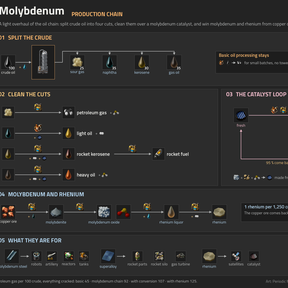
- Split the crude. At advanced oil processing, the distillation tower splits 100 crude oil and 50 water into 25 sour gas, 35 naphtha, 30 kerosene and 35 gas oil.
- Clean the cuts.
- Sour gas is washed into petroleum gas and hydrogen sulfide.
- Naphtha is reformed over a molybdenum catalyst into light oil, hydrogen and a little petroleum gas.
- With that hydrogen, gas oil is hydrotreated into heavy oil and kerosene into rocket kerosene.
- Run the catalyst loop. Reforming hands its catalyst back coked. A furnace burns the coke off and 95 % come back, so you belt the catalysts between the reformers and the furnaces.
- Win molybdenum and rhenium. Flotation pulls molybdenite out of copper ore with a splash of naphtha, and 48 of every 50 copper ore come back. Roasting gives molybdenum oxide and roaster gas; scrubbing that gas gives sulfuric acid and rhenium liquor, which hydrogen or hydrogen sulfide turns into rhenium. One rhenium takes about 1,250 copper ore through flotation, or 625 with pressure leaching.
- Convert. Kerosene cracking comes with advanced oil processing. The oil conversion research adds hydrocracking (gas oil into kerosene, naphtha and petroleum gas), slurry hydrocracking (heavy oil into light oil and naphtha), steam cracking (naphtha into petroleum gas and hydrogen) and alkylation (petroleum gas and sulfuric acid back into light oil).
- Upgrade to rhenium. Rhenium reforming makes 54 light oil from 40 naphtha instead of 33. Each reformer keeps 20 rhenium catalysts in circulation, and 99 % survive each cleaning.
Petroleum gas per 100 crude oil, everything cracked: basic oil processing 45, advanced oil processing 92 (vanilla: 97.5), with oil conversion 107, with rhenium reforming and pressure leaching 125.
Buildings
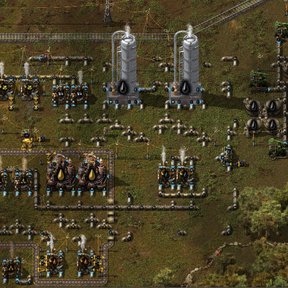
- Distillation tower (5×5). It can't be rotated, so all six connections stay visible: crude oil goes in on the west side and water on the east; sour gas and naphtha come out at the bottom of the west and east sides, kerosene and gas oil from the bottom edge. Press R on a placed tower, or H while holding it, to swap west and east. A vapour plume and an amber glow show when it is working. It is built from 40 steel, 20 stone bricks, 10 advanced circuits, 4 pumps and 10 pipes, plus magnesia, cadmium-plated hardware and tellurium copper when those mods are installed.
- Gas turbine (3×5, its own research after superalloy). It makes 5 MW from refinery fuels, refuses crude oil, heavy oil and other fuels, and needs air, so not on space platforms. Fuel values per unit: hydrogen 150 kJ, petroleum gas and sour gas 400 kJ, naphtha 500 kJ, light oil 600 kJ, kerosene 700 kJ, rocket kerosene 900 kJ, gas oil 500 kJ. Gases burn cleanest, liquids pollute more, and raw sour gas pollutes three times as much as petroleum gas. One turbine runs on the sour gas from about 50 crude oil per second.
Everything else runs in oil refineries, chemical plants, furnaces and assembling machines.
Hydrogen sulfide and sour gas
- 10 hydrogen sulfide make 1 sulfur, or with 10 water 15 sulfuric acid, without iron.
- Sulfiding: 2 molybdenum oxide, 1 stone and 10 hydrogen sulfide make 2 catalysts. Without hydrogen sulfide, an assembler makes 1.
- 50 rhenium liquor and 20 hydrogen sulfide make 1 rhenium, instead of using 20 hydrogen.
- 20 sour gas and 20 steam make 35 hydrogen and 5 hydrogen sulfide.
- Sour gas can also go straight into the gas turbine: simpler, but dirtier than washing it first.
What the metals are for
- Molybdenum steel (5 steel and 1 molybdenum oxide make 5, or 6 with magnesium) is required in flying robot frames, artillery turrets and wagons, power armor, exoskeletons, combat shotguns, cannon shells, explosive cannon shells, tanks, nuclear reactors, heat exchangers, centrifuges and the gas turbine. Nuclear power, uranium processing and the tank therefore come after advanced oil processing.
- Superalloy (1 rhenium, 4 molybdenum oxide and 15 steel make 20) goes into the rocket silo, every rocket part and the gas turbine. Its research is a prerequisite of the rocket silo and uses the same science packs. A rocket launch costs 10 rhenium.
- Rhenium also goes into satellites (5 each) and rhenium catalysts.
- Molybdenum oxide also makes catalysts and the heating elements of electric furnaces (2 oxide, half the steel).
- Molybdenite gives 50 % more lubricant, feeds slurry hydrocracking and catalytic coal liquefaction (35 light oil instead of 20), and greases the spidertron's legs (20).
Fire
- Flamethrower turrets also burn gas oil (+5 % damage), kerosene (+10 %), rocket kerosene (+15 %) and naphtha (+20 %; napalm is thickened naphtha).
- Flamethrower ammo can be made from 50 naphtha instead of 100 crude oil.
- Rocket fuel: 60 rocket kerosene make 1 rocket fuel in a chemical plant, no solid fuel needed. Surplus rocket kerosene can also become solid fuel.
Space Age
- Crude oil on Nauvis and Aquilo goes through the tower. Fulgora's heavy oil and Vulcanus's coal liquefaction stay as they are.
- On Vulcanus, flotation also gets molybdenite from tungsten ore, big volcanic rocks give enough for the first big mining drill, and the foundry casts molybdenum steel from molten iron.
- Every ordinary rocket silo needs 100 superalloy. Vulcanus, Gleba and, slowly, Fulgora can make it locally; elsewhere, bring superalloy or rhenium from those planets or Nauvis.
- Thrusters take superalloy instead of rocket parts. Asteroid collectors take 2 superalloy, crushers take 2 molybdenum steel, and big mining drills keep 10 molybdenite. Recycling returns their final ingredients.
- Kerosene rocket fuel shares the rocket fuel productivity research.
- Skarn flotation can use 50 steam instead of water on Vulcanus. Metallurgic science unlocks tungsten superalloy in the foundry: 25 superalloy per rhenium instead of 20.
- Agricultural science unlocks bioleaching in the biochamber: 5 molybdenite + 1 bioflux + 50 water make 4 oxide, 8 rhenium liquor and 20 sulfuric acid before the machine's bonus.
- On Fulgora, spent-catalyst recovery leaches scrap with sulfuric acid in a chemical or cryogenic plant after recycling research: 50 scrap + 20 acid make 1 molybdenum oxide and 1 rhenium liquor. Electric furnaces, production science, molybdenum steel, centrifuges, tanks and nuclear reactors can be made there. Superalloy works too, slowly: one rhenium takes 2,500 scrap.
- On Gleba, copper ore flotation uses 1 jelly instead of naphtha after jellynut research: 50 copper ore + 1 jelly + 50 water give 2 molybdenite and return 48 ore. Bioleaching turns it into oxide, so molybdenum steel and the buildings that need it are made locally. Bioleaching also unlocks rhenium bioreduction: 50 rhenium liquor + 1 bioflux make 1 rhenium in 10 seconds in a biochamber. Gleba can make rhenium, superalloy, silos, thrusters and power armor MK2 locally.
- Foundries roast molybdenite and make alloys; electromagnetic plants scrub roaster gas; cryogenic plants run gas chemistry; biochambers crack kerosene and naphtha. The corresponding family variants use those machines too.
- Infinite superalloy productivity costs red, green, blue, space and metallurgic science and adds 10 % per level to ordinary, tungsten and available lanthanum recipes.
- Molybdenite weighs 2 kg and stacks to 50; molybdenum steel weighs 2.5 kg, like steel. Fluid-only processes do not accept quality modules.
- Space platforms need imported molybdenum materials. Aquilo continues to need imported catalysts and alloy parts; gas oil can become solid fuel without catalysts.
Planet mods
- Corrundum: Chalcopyrite flotation gives molybdenite, and platinum makes a longer-lasting catalyst.
- Rubia: Build the rocket silo with the planet's own recipe, no superalloy needed.
- Muluna: The big rocket silo needs no superalloy.
The element family
Molybdenum loads after its siblings and adds these links when they are installed:
- Neodymium: its rare-earth catalyst cracks gas oil, its ceria goes into kerosene rocket fuel, and its high-temperature magnets into the gas turbine. Lanthanum oxide makes 25 superalloy instead of 20.
- Caesium: its catalyst gives 20 % more sulfuric acid from roaster gas and from hydrogen sulfide, its photocathode is the turbine's flame detector, and pegmatite sorting can turn up molybdenite.
- Phosphorus: phosphoric acid and hydrogen sulfide make 3 catalysts instead of 2; moly lubricant keeps Phosphorus's additive; tributyl phosphate gets 1 rhenium out of 40 rhenium liquor instead of 50; the preservation cabinet takes molybdenum steel.
- Gallium: catalyst cleaning in a chemical plant recovers a little arsenic oxide, and hydrogen reduces arsenic oxide instead of coal (5 arsenic instead of 4); the turbine takes semiconductor packages and the crystal puller molybdenum steel (with Neodymium, the magnet crystal puller too).
- Cadmium: roasting with a scrubber filter gives 20 % more rhenium, with an impregnated filter 40 % more; cadmium-plated hardware goes into the tower and the turbine.
- Magnesium: magnesium makes 6 molybdenum steel instead of 5; magnesia lines the tower and magnesium goes into the turbine; an optional heated evaporator recipe takes 10 molybdenum steel instead of 20 steel.
- Antimony: the gas turbine takes antimony bearings, and antimony trioxide makes 25 % more moly lubricant.
- Tellurium: tellurium copper goes into the tower and the turbine; roaster gas reduces tellurium dioxide instead of coal, and gives its sulfuric acid and rhenium liquor on the way.
With Cadmium and Tellurium installed, cadmium plating and tellurium processing (red and green science) become prerequisites of advanced oil processing.
Compatibility
- Works alone, with Space Age and with the whole element family.
- Loads and runs with Krastorio 2 and Krastorio 2 Spaced Out, alone and with the element family.
- Integration with BZ, Timeken, trikop, Planetfall, Krastorio 2 and Space Exploration is planned for later versions.
- Not compatible with Angel's Petrochem, Pyanodon's Petroleum Handling or James Oily Extravaganza, which replace oil processing themselves.
Adding it to a running game
Oil refineries that already run advanced oil processing keep running. If advanced oil processing is researched, the distillation tower and the new recipes unlock right away and one chat message explains the change. Research that Molybdenum puts in front of research you have finished is completed too: superalloy for a researched rocket silo, advanced oil processing for researched nuclear power, cadmium plating for researched advanced oil processing. Completed research stays completed.
Settings
- Leave recipes unchanged (startup): recipe names, separated by commas, that Molybdenum should not touch.
- Log recipe changes (startup): writes every change Molybdenum makes to the Factorio log.
Credits
- Periodic Madness by MrSmoothieHuman1 (MIT): item, fluid and research icons, and the gas turbine.
- Pure It by Bery0za (Apache 2.0): the distillation tower, repainted.
The artwork is resized, recoloured or re-sheeted; no endorsement is implied. Some graphics reference Factorio's own artwork. Code and original artwork are MIT; third-party artwork keeps its own license. Credits and licenses are included in the mod.