
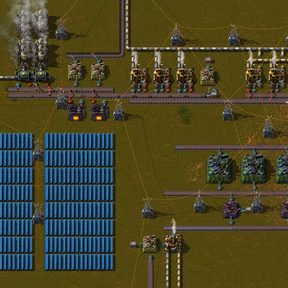
Very Fluffy is a modpack. It installs the ten fluffy_penguin material mods and
recommends trikop's Bismuth, which three of them use. Each mod adds its own
industry: a new material, the buildings that make it, and recipes that use it.
The mods are built to work together, so materials from one industry turn up in
the others. The pack itself adds no recipes or setting changes; its only
script adds a Bismuth section to Milestones.
Factorio 2.1.23 or later. Play it in the base game or with Space Age;
Quality is optional. You need to own Space Age either way, because Phosphorus
and Radioactive Elements use spoiling.
Start a new game. Expect more buildings and production steps than in the base
game, at normal science costs and with each mod's default settings.
Included mods
| Mod | What it adds |
|---|---|
| Antimony | Antimony metal, bearing alloys and a temperature-controlled memory workshop |
| Cadmium | Fume scrubbers that recover cadmium from smelter air; plated hardware |
| Caesium | A hidden ore found with survey stations; catalysts, scintillators and atomic clocks |
| Gallium | Gallium and arsenic from ash; crystal growing for wafers and seeds |
| Magnesium | Solar evaporation ponds, heated evaporators and light metal |
| Molybdenum | A crude oil distillation tower, catalysts, molybdenum steel and superalloy |
| Neodymium | Rare-earth separation from stone, magnets and wind turbines |
| Phosphorus | White phosphorus that ignites when left waiting; combustion heat and stable red phosphorus |
| Tellurium | Trace recovery from copper smelting; tellurium copper and optical crystals |
| Radioactive Elements | Isotope cartridges from reactors and hot cells for science, rockets and modules |
| Bismuth, by trikop | Bismuth ore and metal; solder, thermoelectrics and polonium targets with the mods above |
Antimony
Mine stibnite, refine antimony metal and trioxide, and use them in bearing
alloys and existing recipes from red science on. At green science, build the
phase-change memory workshop: an annealing chamber holds a temperature for a
set time, then a quench station heats each batch briefly and must cool it
before its deadline. Electricity, cold water and coolers set how fast the
workshop runs. The machines run the sequence themselves; circuits are optional.
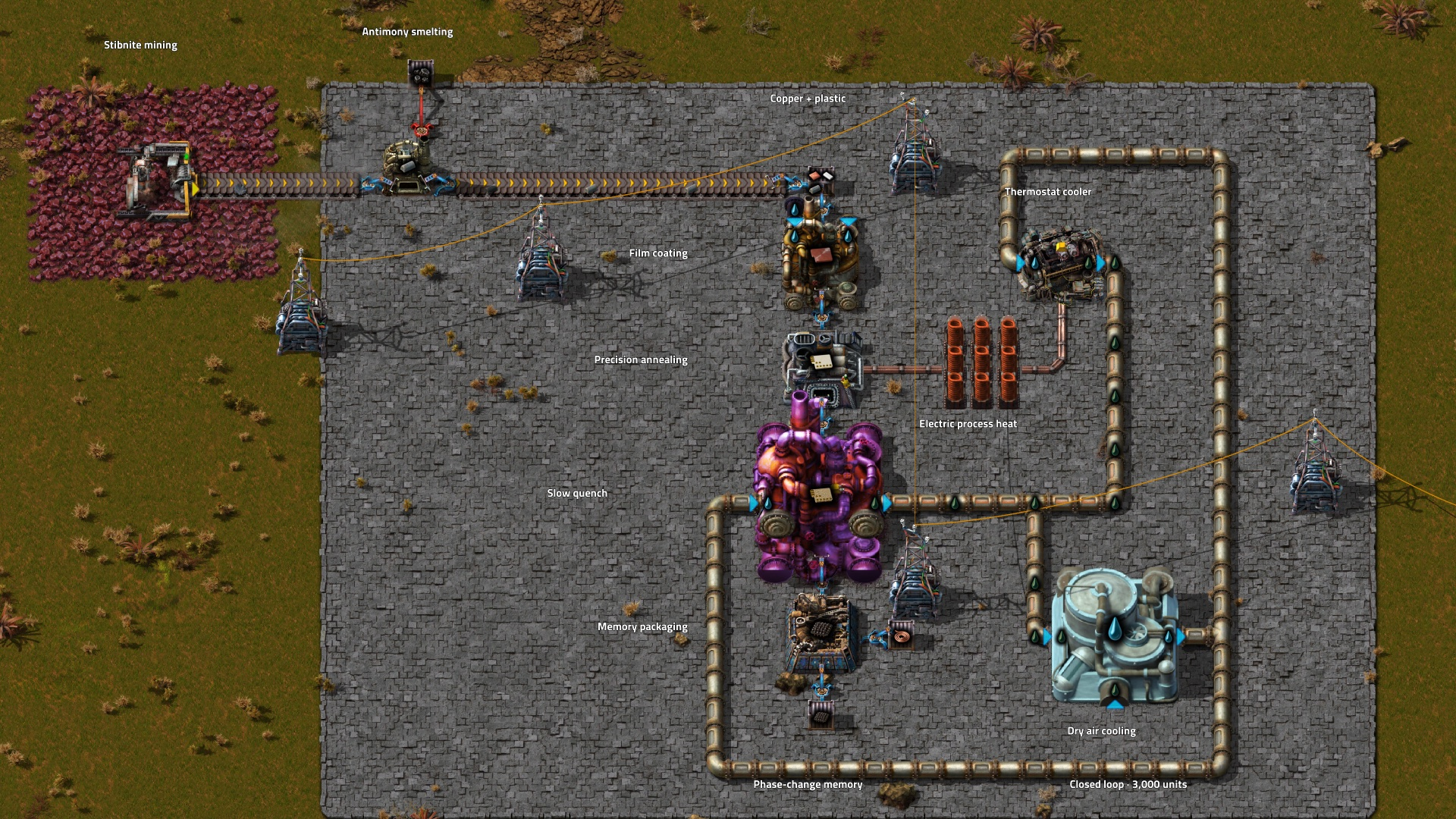
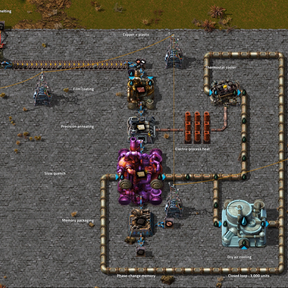
Antimony's demonstration line, from the mine to the finished memory.
Cadmium
Fume scrubbers placed among your furnaces and boilers catch cadmium dust in
filters. Wash the loaded filters for cadmium and return the clean filters. A
scrubber works faster in dirtier air and still works at its base rate with
pollution turned off. Cadmium plates steel parts for engines, rockets and
reactor neutron absorbers. It starts after sulfur processing.
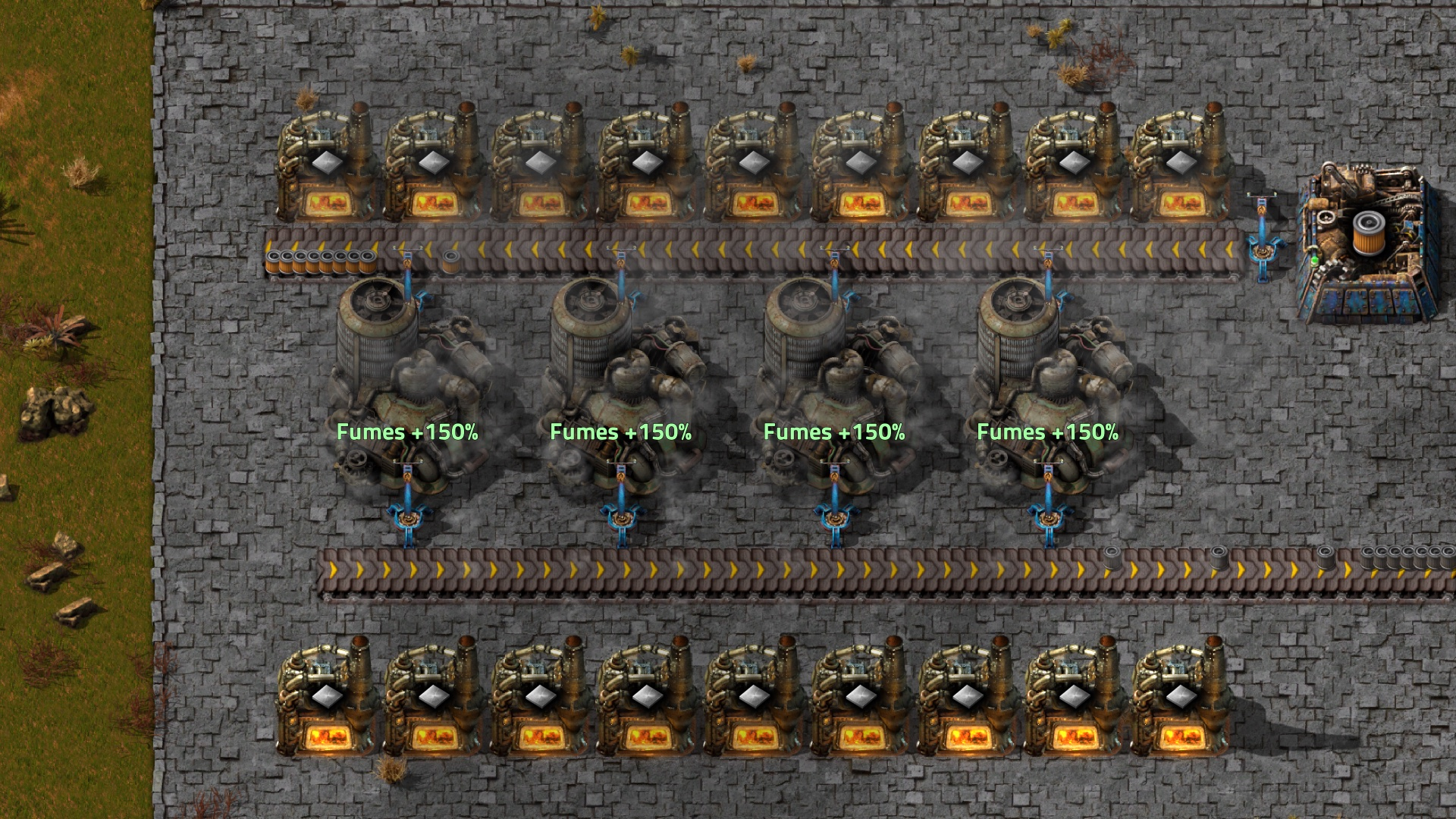
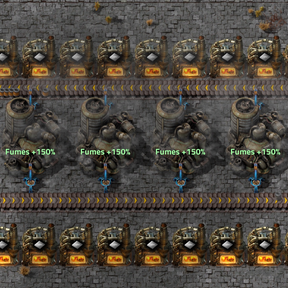
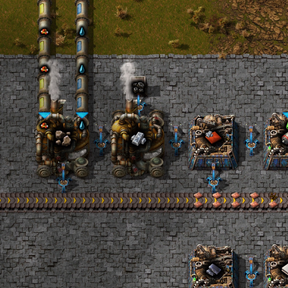
Scrubbers between furnace rows, showing their current speed bonus.
Caesium
Pegmatite, the caesium ore, isn't placed by map generation and doesn't show
on the map. Survey stations find it; later magnetometers, seismic charges and
satellite surveys search farther. Mine it at small outposts, sort the
pollucite out of the rock, and refine it into catalysts, photocathodes,
scintillators and atomic clocks.
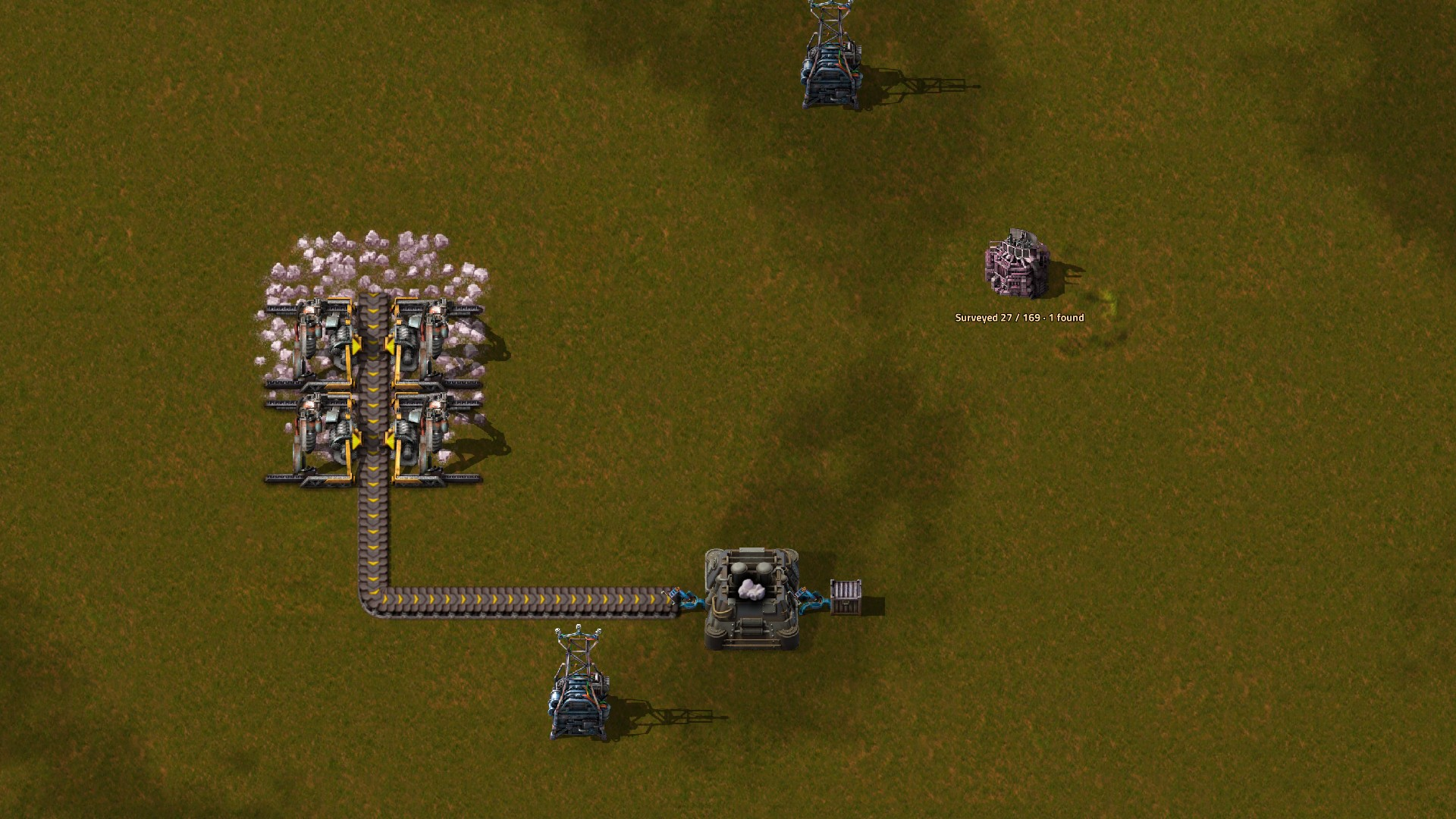
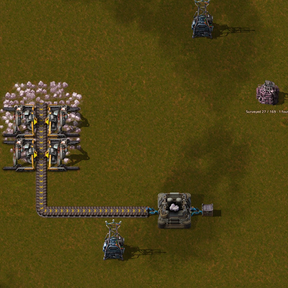
A survey station next to a pegmatite outpost and its ore sorter.
Gallium
Recover gallium and arsenic from combustion ash, make gallium arsenide and
grow crystal boules. Slice a boule into wafers for electronics and solar
panels, or cut it into seeds for the next boules. Keep enough seeds in
reserve, or the crystal line stops growing.
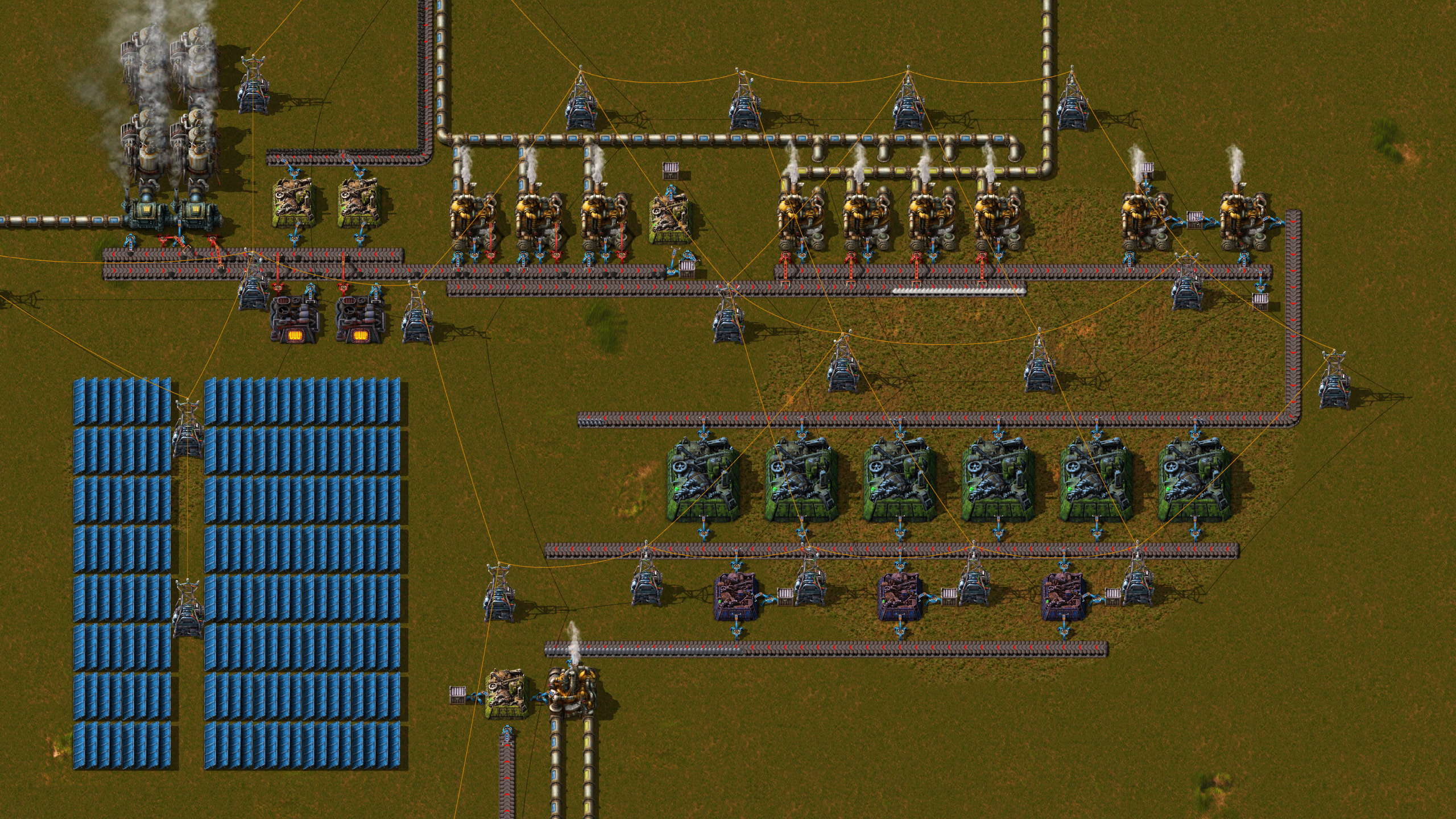
Ash recovery, crystal pullers and wafer processing.
Magnesium
Evaporation ponds turn water into bittern in sunlight. They slow down at dusk
and stop at night, so you need tanks, more ponds or heated evaporators that
run on heat pipes. Chemical plants make magnesia and magnesium metal for
robots, low density structures and electric furnaces.
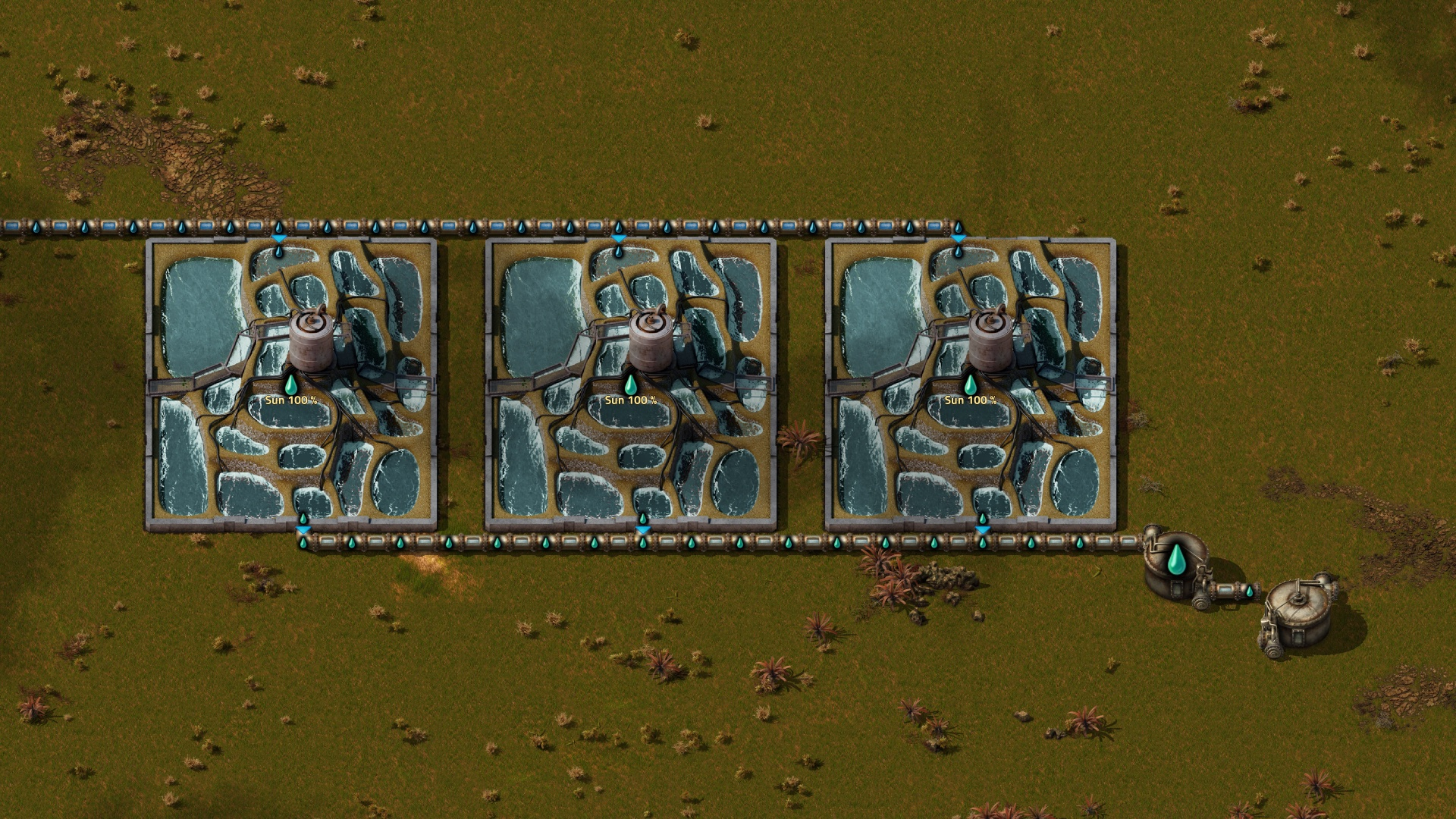
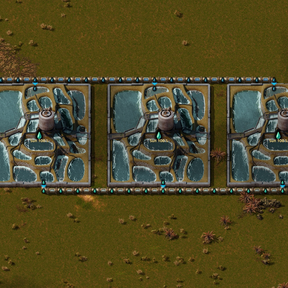
Evaporation ponds at noon, feeding one bittern line.
Molybdenum
Advanced oil processing becomes a distillation tower that splits crude oil
into four cuts, which you clean over a molybdenum catalyst and convert into
each other. Basic oil processing is unchanged. Molybdenum and rhenium come
from copper ore and go into catalysts, molybdenum steel and superalloy for
late-game recipes. Molybdenum recommends Flare Stack and Valves, and so does
the pack.
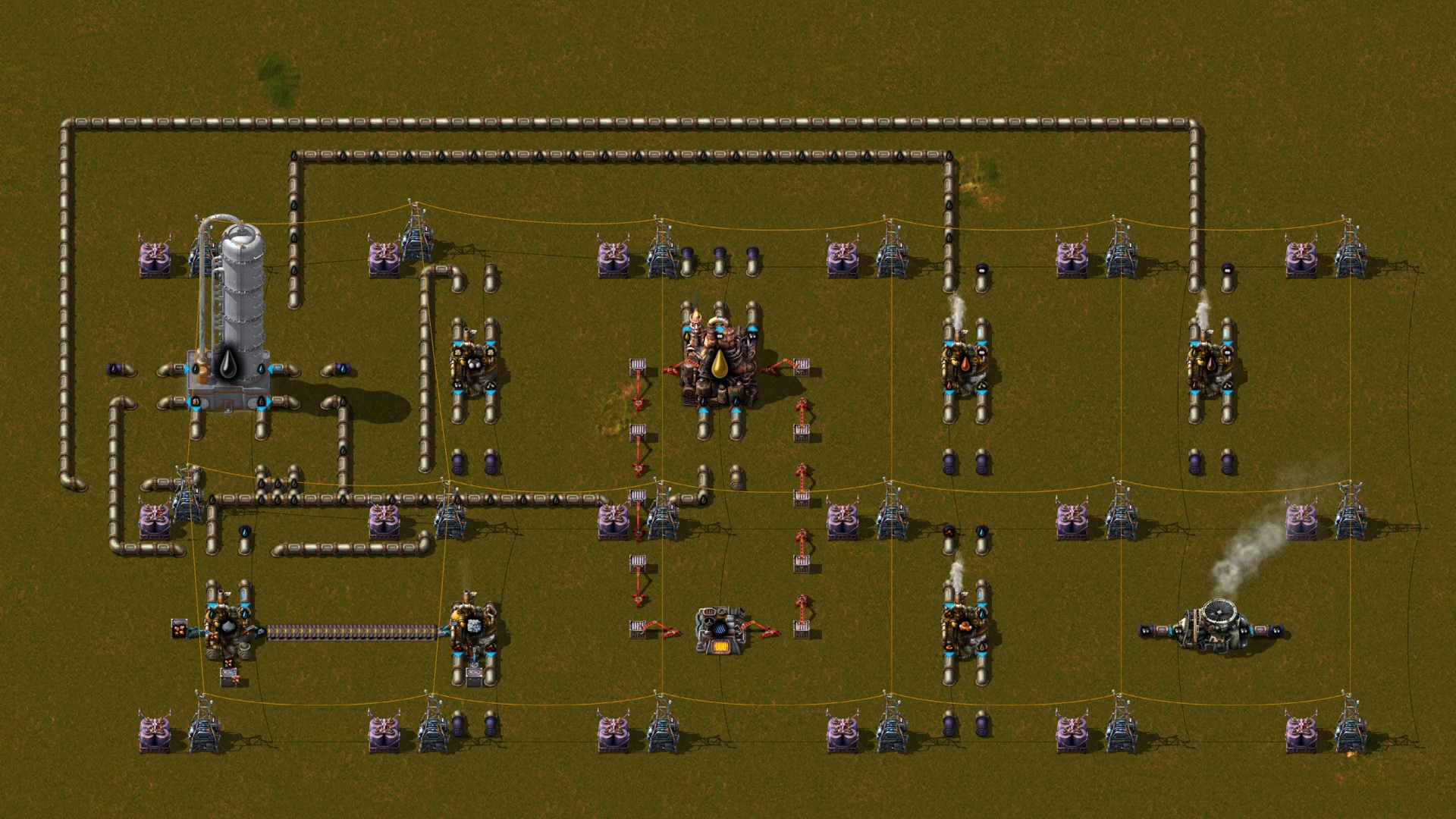
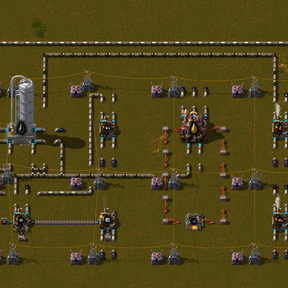
The distillation tower and the plants that clean and convert its cuts.
Neodymium
Wash stone into heavy mineral sand, sort out the monazite, dissolve it and
separate the liquor in separator banks. Neodymium magnets go into electric
engines, express belts, assembling machine 3 and other later machines, and
give earlier machines optional cheaper recipes. Cerium and lanthanum make
precision optics; dysprosium makes high-temperature magnets. Direct-drive wind
turbines use the magnets for power.
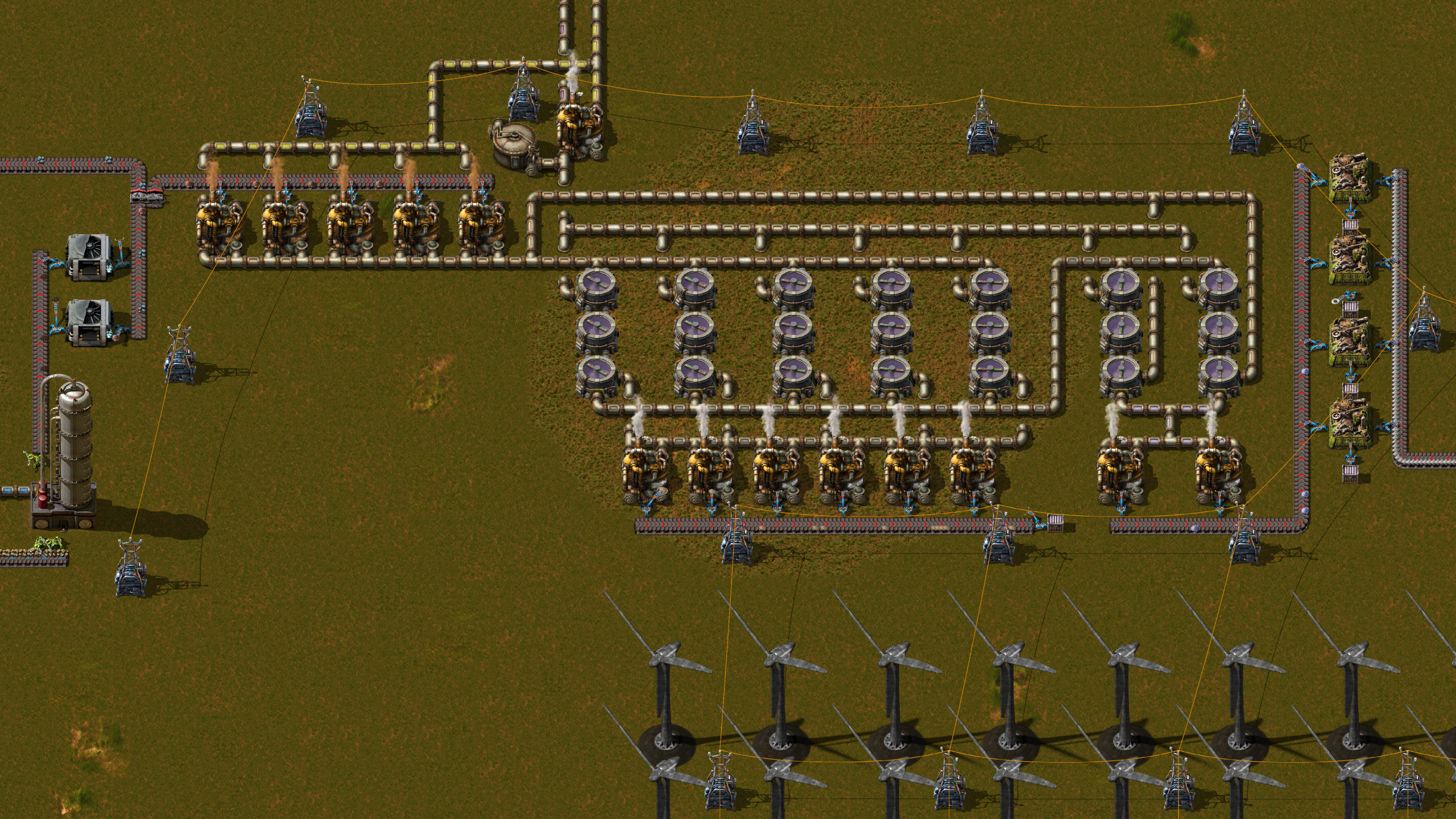
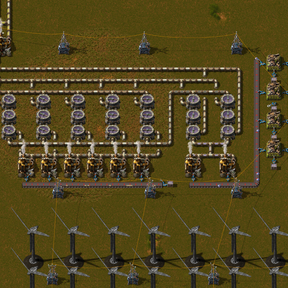
Stone processing, separator banks, magnet manufacture and wind turbines.
Phosphorus
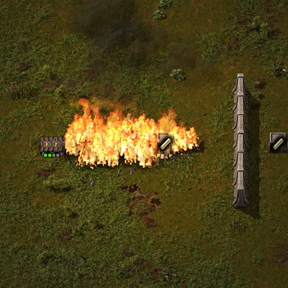
White phosphorus ignites after 15 minutes at the default setting, in a chest,
on a belt, in a train or in your inventory, and the fire spreads to nearby
stacks. Use it right away in plastic, lubricant, batteries and processing
units; burn the surplus in a combustion tower for heat and ash; or convert it
to red phosphorus, which never ignites, and turn it back into white in a retort
where you need it.
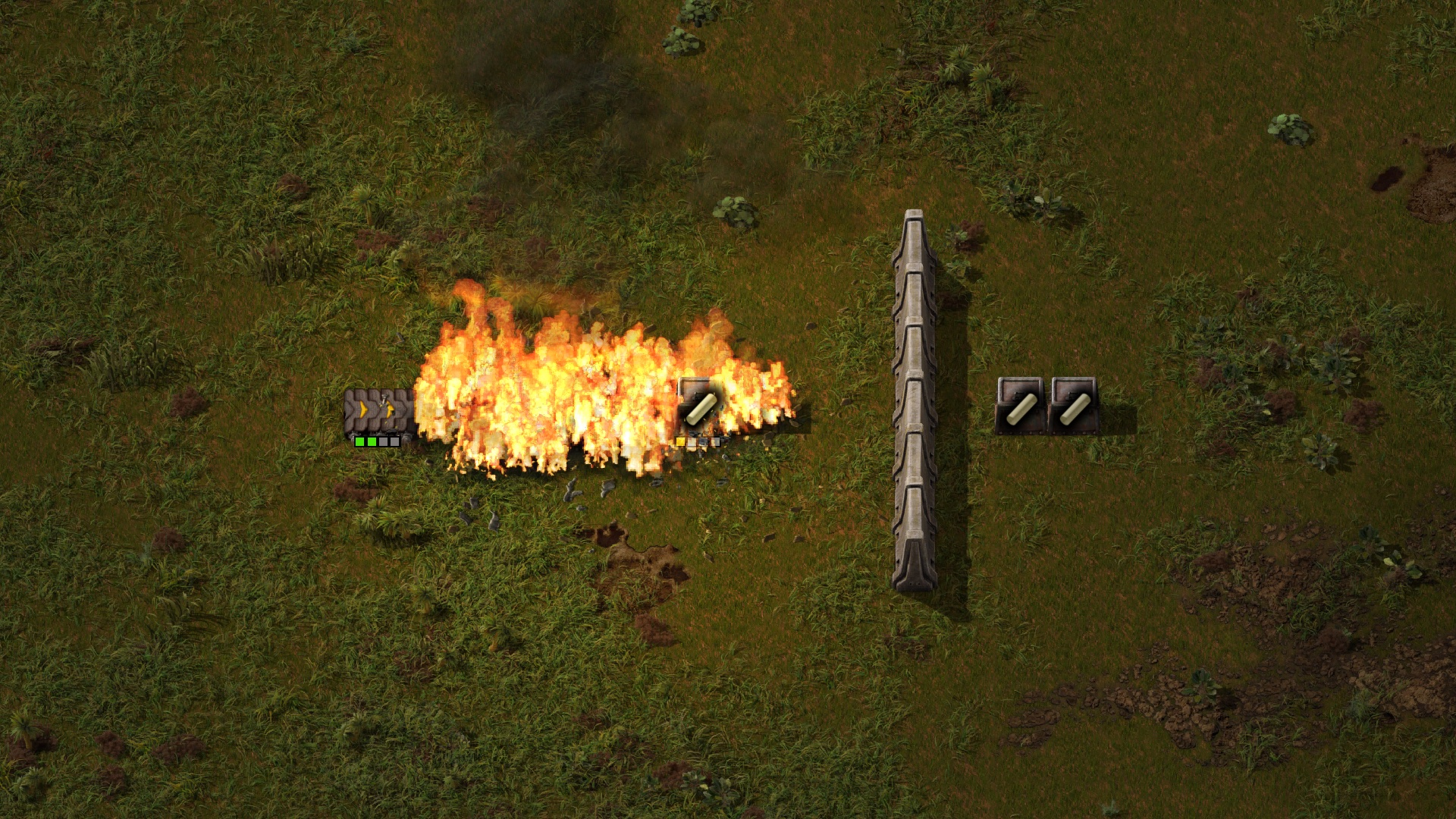
A fire spreading between white phosphorus stocks; the walled-off chest survives.
Tellurium
Convert part of a copper furnace column to trace recovery. The copper keeps
flowing, and some batches leave tellurium residue. Refine it into tellurium
copper for electric engines, substations and beacons, and into optical
crystals for laser turrets, the rocket silo and satellites. With Bismuth it
also makes thermoelectric cooling components.
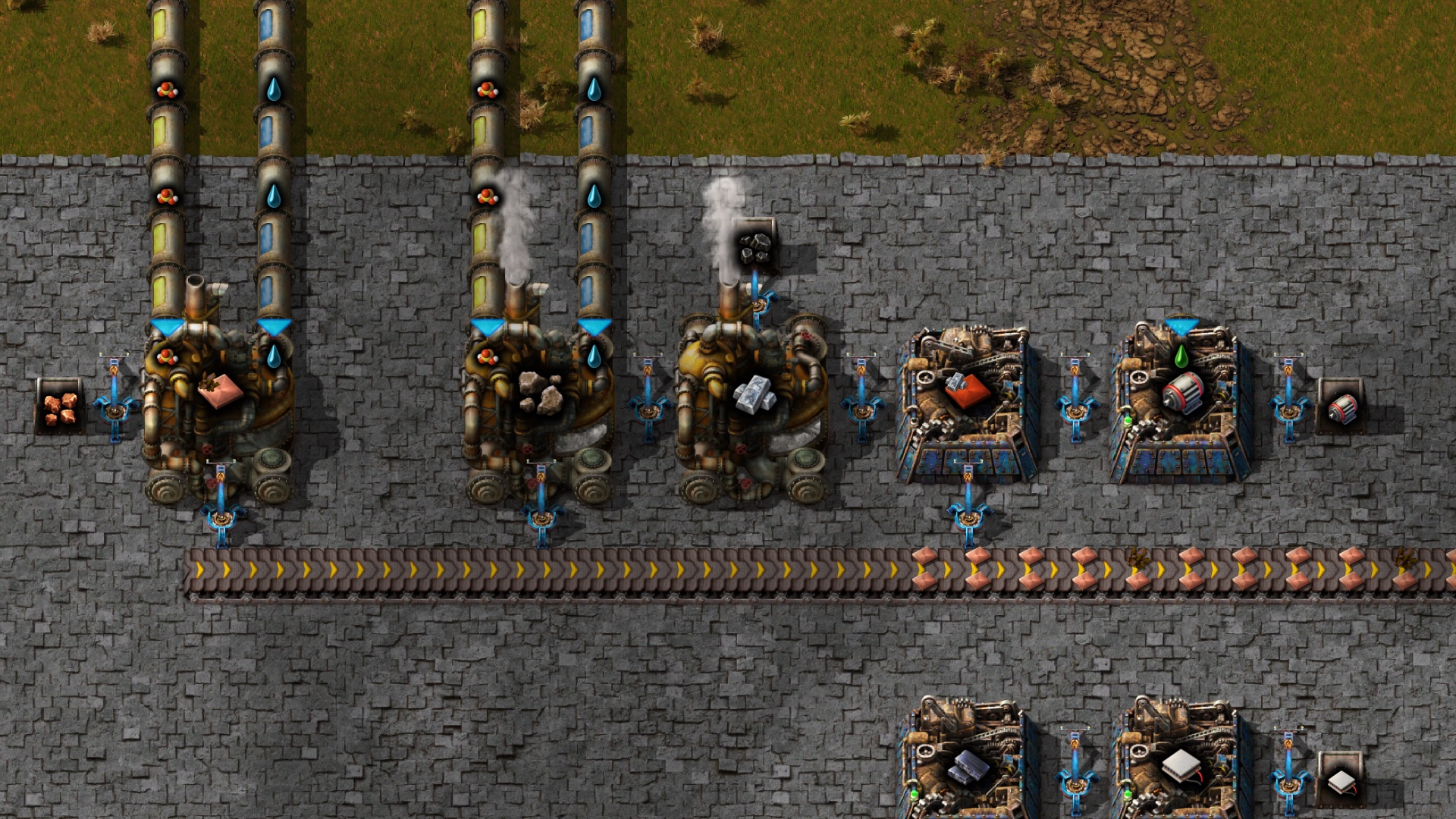
Trace recovery and refining beside a copper smelting line.
Radioactive Elements
Irradiate targets in reactors, separate them in hot cells, and use the isotope
cartridges in new machines. Cartridges lose activity over time, so each line
runs on a steady supply rather than a stockpile.
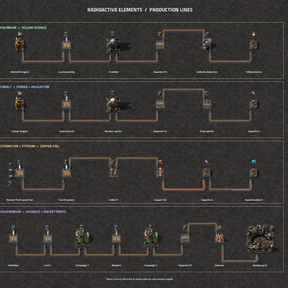
- Polonium: irradiate bismuth targets in an isotope reactor. Polonium
calibrates detectors for yellow science. - Cobalt: load cobalt targets into uranium fuel cells and burn them in a
normal nuclear reactor. Cobalt turns plastic into insulation. - Strontium and yttrium: recover strontium from spent fuel. Its yttrium
goes into precision copper foil for capacitors. - Californium: run actinides through two reactor campaigns. Californium
builds avionics for the rocket silo and rocket parts.
In the base game a rocket needs all four lines. With Space Age the first
rocket needs none of them, and the later science packs each need one.
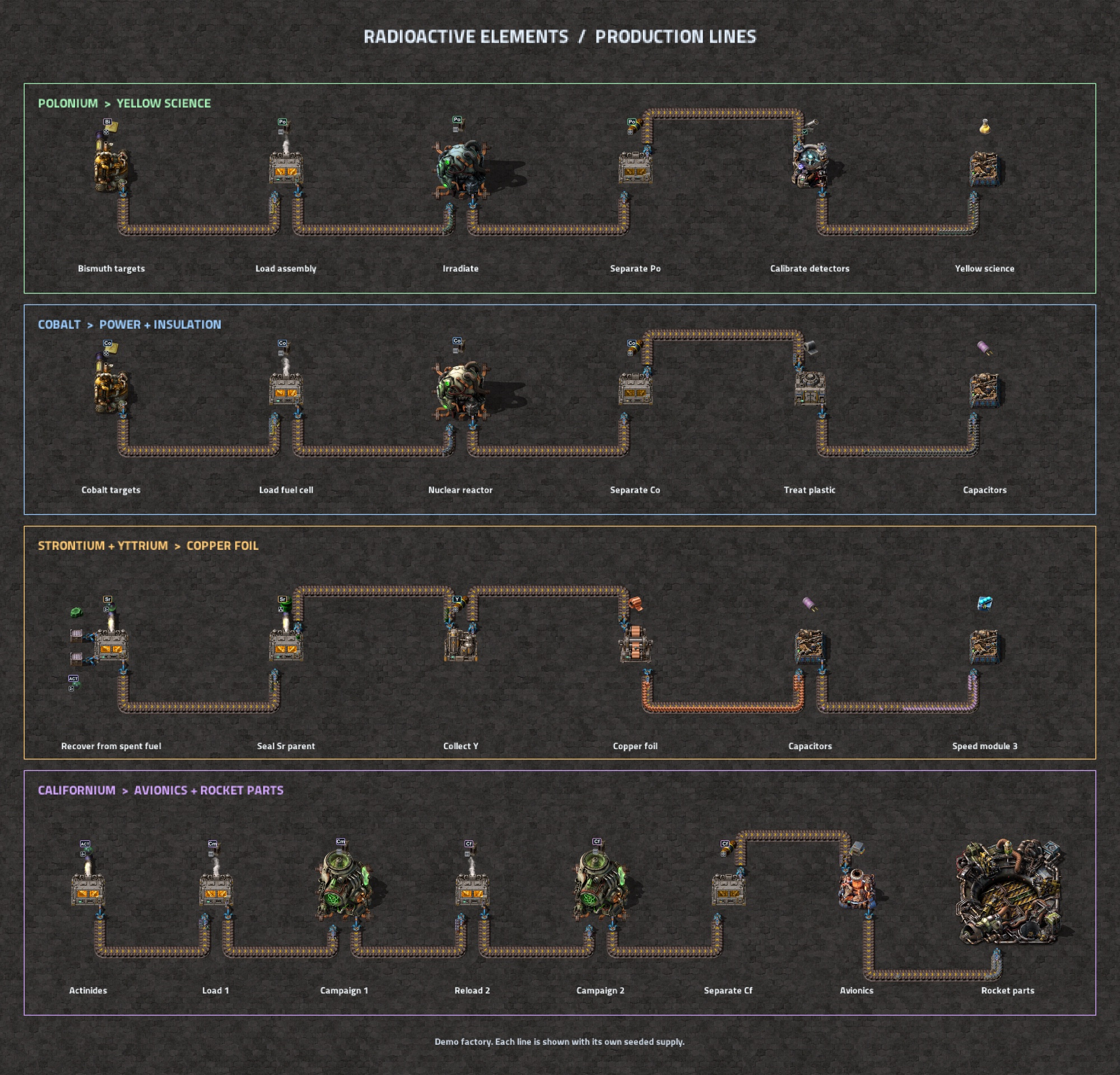
The four isotope lines in a demonstration factory, each with its own supply.
Bismuth
Bismuth by trikop adds bismuth ore
and metal. The pack recommends it because three of the mods use it: Antimony
uses bismuth solder in its workshop, Tellurium makes bismuth telluride for
thermoelectric cooling, and Radioactive Elements irradiates bismuth targets
for polonium. All of the mods also work without it; Radioactive Elements then
makes its bismuth targets from copper ore.
How the mods connect
These connections are available once the recipes and research are unlocked.
Many of them are alternative recipes or upgrades, not requirements.
| From | Into |
|---|---|
| Phosphorus combustion heat | Magnesium's heated evaporators |
| Magnesia | Gallium's crystal equipment and Cadmium's filters |
| Cadmium + Tellurium | Cadmium telluride for solar panels |
| Tellurium + Bismuth | Thermoelectric materials and cooling components |
| Gallium crystals and wafers | Caesium scintillators and photocathodes |
| Caesium atomic clocks | Faster Antimony memory qualification |
| Cadmium scrubber filters | More rhenium from Molybdenum's roasting |
| Tellurium copper | Molybdenum's distillation tower and gas turbine |
| Molybdenum steel | Gallium's crystal puller |
| Bismuth | Radioactive Elements' polonium targets |
| Materials from the other mods | Radioactive Elements' reactors, hot cells and machines |
Space Age
The pack loads with Space Age and Quality enabled. The mods add Space Age
routes, for example recovering materials from Fulgora's scrap, using Vulcanus
foundries or growing Gallium crystals on space platforms. Isotopes are made on
Nauvis and shipped: yellow, cryogenic and promethium science and
supercapacitors need them. The individual mod pages describe the details.
Recommended and optional mods
The pack recommends Bismuth, Milestones (each mod adds its own
section, and the pack adds one for Bismuth: bismuth plate, bismuth glass and
solder), and Flare Stack and Valves for Molybdenum's surplus fluids.
Factorio installs recommended mods by default, and you can turn them off.
Optional: Factory Planner, Rate Calculator, Factory Search, Bottleneck Lite,
Informatron (it includes Antimony's workshop guide), Elevated Rails, Manganese
and Even Pickier Dollies. These load with the pack; they are not needed for
it.
The pack does not include the BZ mods, Krastorio 2 or Space Exploration.
Starting a game
- Start a new map; the pack is not meant to be added to an existing save.
- Leave room around the starting area for extra production districts.
- Start surveying for Caesium before you need it.
- Give the salt works tank storage for the night.
- Plan phosphorus handling before a large stock builds up.
- Keep a seed reserve before you expand wafer production.
- Use Factoriopedia, or the optional Factory Planner, to follow the combined
recipes.
Credits
The material mods are by fluffy_penguin; Bismuth is by trikop.
Thanks to Brevven for BZ Library and the material-mod groundwork, and to the
authors of the recommended and optional mods.
Screenshots are Factorio captures from the included mods' demonstration
factories. Factorio artwork belongs to Wube Software. Each included mod lists
its own credits and licenses, including work by Hurricane, Periodic Madness,
Malcolm Riley / Unused Renders, Sosciencity and the wind-turbine artists. The
thumbnail and banner show the included mods' own tiles; the Bismuth tile is by
trikop (MIT). This pack does not redistribute the other mods.