
Your smelters are full of cadmium. Right now it goes up the chimney.
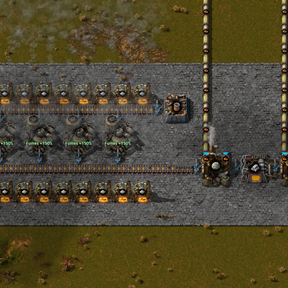
Fume scrubbers pull that metal-bearing dust out of the air around your furnaces and boilers into filters, and clean up a little pollution while they're at it. Wash the loaded filters for cadmium, plate steel parts with it, and you get cheaper engines, and the hardware your rockets and nuclear reactors need. The dirtier the air around a scrubber, the faster it works, so the smokiest corner of your factory becomes your best cadmium mine.
It starts after sulfur processing. There are no ore patches to find: put scrubbers among your furnaces and boilers, keep them supplied with filters, and wash what comes back.
Factorio 2.1.23 or later. Space Age is optional.
What it adds
The starter recipes below describe a Fluffy-only game. With external material packs, the filter loop grows into the refinery described below.
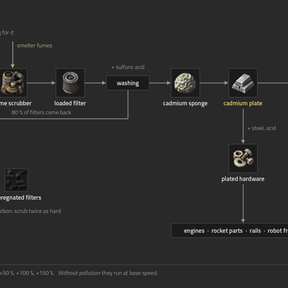
- Fume scrubbers, with red and green science. A scrubber turns a filter (steel and coal) into a loaded filter every 24 seconds and removes a little pollution while it runs.
- Filter washing in a chemical plant with sulfuric acid: one cadmium sponge per filter, and the filter comes back 80% of the time. Smelt the sponge into cadmium plates.
- Cadmium-plated hardware: one plate, one steel and a little acid make four.
- Engine with plated bearings: 2 steel, 2 gears, 2 pipes and 1 hardware make 3 engines, about a third less iron per engine. The ordinary engine recipe stays.
- Rocket parts need plated hardware: two per part without Space Age, one with it.
- Rails with plated fasteners: twice the rails per steel and iron stick. The ordinary rail recipe stays.
- Flying robot frames need one plated hardware; roboports, centrifuges, Space Age's big mining drill and, without Space Age, steam turbines need a few. Only buildings whose research already comes after sulfur processing are charged.
- Nuclear reactors need 50 neutron absorber assemblies, each made from 2 cadmium plates, 2 steel, 2 ceramic lining and 1 plated hardware. Fusion reactors (Space Age, Krastorio 2) need 50 too, Krastorio 2's nuclear locomotive 10, and portable fission reactors (and Space Exploration's portable fusion reactor) 5.
- Electrostatic precipitators, with blue science: a 4×4 scrubber with three times the throughput and four times the pollution removal.
- Impregnated filters, with purple science: treated filters that scrub twice as hard and yield one or two sponge per wash.
- Cadmium refining productivity: repeatable research adds 10% plate productivity per level. Without Space Age it follows impregnated filters and costs red, green, blue and purple science. With Space Age it follows electromagnetic science and fume scrubbing and costs red, green, blue, space and electromagnetic science. Starts at 1,500 of each, then costs 50% more each level. Five levels turn 100 sponge into 150 plates before module bonuses. Research and modules share a +300% cap.
Fume bands
With pollution enabled, a scrubber works faster the dirtier its chunk is. The chunk's pollution is shared among all scrubbers in it. Below 50 per scrubber they run at base speed; from 50, 150 and 400 they gain +50%, +100% and +150% speed, and use that much more power. Alt-mode shows the bonus above each scrubber.
With pollution disabled, scrubbers simply run at base speed, so cadmium production works in every game.
Early scrubbers barely dent pollution: on steam power, their own electricity cancels most of what they remove. Real cleanup needs precipitators, impregnated filters and clean power.
Space Age
Only Nauvis has airborne pollution, so scrubbers can only be built where the air pressure matches Nauvis (1000 hPa). That keeps them off the other planets and space platforms. The other planets have their own sources:
- Vulcanus: foundry fume capture. 2,000 lava, 4 calcite and one scrubber filter make 1,000 molten copper, 60 stone and one loaded filter in 64 seconds. Wash the filter for sponge. Unlocked with Foundry and Fume scrubbing, before the big mining drill. Acid neutralisation remains an optional source.
- Fulgora: scrap leaching. 20 scrap and 40 sulfuric acid give one sponge, two iron and one copper in 4 seconds. Unlocked with recycling. Electromagnetic plants plate hardware with their built-in productivity bonus: six hardware per plate before modules.
- Gleba: biosorption in the biochamber. 10 spoilage, one bioflux and 10 sulfuric acid make one sponge in 8 seconds. Unlocked with Bioflux processing and Fume scrubbing, before agricultural science. Biosulfur supplies local sulfuric acid.
- Aquilo and space platforms import cadmium and plated hardware. Hardware weighs 1 kg, so one rocket carries 1,000.
Foundries also smelt cadmium plates, and cryogenic plants run cadmium chemistry. Furnaces and chemical plants remain available. An in-game Space Age tip lists the sources when you reach another planet.
Planet mods
- Paracelsin: Zinc purification also recovers cadmium sponge.
Turn the filter loop into a refinery
With BZ, Trikop, Timeken and Planetfall/Ashier materials, washing filters opens a longer production line. Leach the captured dust, prepare dry reduction charges, reduce the metal in furnaces or suitable foundries, then mix plating electrolyte for your hardware.
Alkalis, filter media, polymers, gases and native machine parts tie the scrubber district into the rest of your base. Keep the filter returns moving and give the chemical works room to grow.
Fluffy-only games keep their existing recipes, machines and progression, with or without Space Age.
Other mods
| Mod | What changes |
|---|---|
| Tellurium | Optional filter washes use 20 acid instead of 10 and recover tellurium residue now and then. They return 70% of plain filters or 85% of impregnated filters, requiring 50% more replacements than ordinary washing. The ordinary washes keep working. When Tellurium puts tellurium metal into solar panels (and K2 advanced solar panels), Cadmium replaces that ingredient with cadmium telluride, made from one cadmium plate and one tellurium metal. |
| Krastorio 2 | Fume scrubbers and electrostatic precipitators are available as usual. K2's own air purifier stays K2's pollution cleaner, and its used filters can be leached with sulfuric acid for cadmium. With Brass Tacks, zinc enrichment gets an optional cadmium-recovery variant. |
| Space Exploration | Cargo rocket sections need plated hardware, and cadmium sponge, plates and hardware fit the delivery cannon. With Tellurium, gamma-ray detectors and night vision need cadmium zinc telluride crystals. |
| Brass Tacks | Zinc purification: refine zinc in a chemical plant with sulfuric acid and recover cadmium — a byproduct source alongside zinc production. Ordinary smelting stays. |
| Magnesium | Magnesia replaces the stone-brick lining in absorber assemblies when available at their tier. Magnesium also offers magnesia scrubber filters, a third more filters per steel. |
| Phosphorus | Phosphate rock carries cadmium: a phosphorus furnace recipe that also collects cadmium-rich dust, washed into cadmium sponge. Filters can also be washed with phosphoric acid instead of sulfuric acid. |
| Gallium | Loaded filters can be washed for arsenic instead of cadmium: one arsenic oxide per filter, two per impregnated filter, and the filter comes back as often as usual. Brass Tacks zinc purification now and then leaves mineral residue for gallium. With Tellurium and Space Exploration, gamma-ray detectors and night vision take a gallium detector assembly in place of the crystal: the same crystal with gallium arsenide readout. |
| Neodymium | Optional yellow-science Dysprosium-assisted absorbers: one oxide saves 20 cadmium plates per 20 assemblies. The early route stays. Neodymium also offers magnet scrubbers and, with If Nickel, lanthanum batteries. |
| Caesium | Caesium's well treatment station is built with cadmium-plated hardware. |
| Antimony | Cadmium-plated hardware goes into Antimony's shoreline coolant outlets when available at the thermal workshop's research tier. |
| Molybdenum | Cadmium-plated hardware goes into Molybdenum's distillation tower and gas turbine. Roasting molybdenite with a scrubber filter gives 20% more rhenium, with an impregnated filter 40% more; both halve the roasting pollution and return the loaded filter for washing. Advanced oil processing then comes after Cadmium plating (red and green science). |
| If Nickel | Nickel-cadmium batteries: nickel and cadmium instead of lead, zinc, graphite and acid. The ordinary recipe stays. |
Getting started
Research Fume scrubbing after sulfur processing. Build a few scrubbers in your smelting and boiler area, feed them filters and take out the loaded ones. Wash those in a chemical plant, send the returned filters back and smelt the sponge.
At base speed a fume scrubber supplies 2.5 sponge per minute; at +50% it supplies 3.75, and at +100% it supplies 5. Two basic scrubbers keep 45 chemical science per minute supplied when every engine uses plated bearings, or one at +50% or better. Spread scrubbers across polluted chunks to sustain the bonus. Then research Cadmium plating. The research for robots, roboports, centrifuges, the rocket silo and nuclear power requires it. Adding Cadmium to an existing save? Robot frames and rocket parts need plated hardware from then on; the FAQ explains how to ease in.
Startup settings let you change how much pollution scrubbers remove, or leave individual recipes unmodified. Map settings control the fume bands.
For recipes, numbers and settings, see the FAQ tab.
Credits
Cadmium is by fluffy_penguin. Thank you to the artists whose work it uses:
- Fume scrubber building and icons: Hurricane046, from Hurricane Graphics (MIT © 2023 Nicholas Gower). The precipitator is the same building, tinted and scaled up.
- Scrubber filter icons: Byzzee, from Better Ecology (MIT).
- Cadmium sponge icon: MrSmoothieHuman1, from Periodic Madness (MIT).
- Activated carbon badge on the impregnated filters: tirisabella, Johanna Spieker and _traum, from Sosciencity Graphics (CC BY 4.0). The badge is layered over the tinted filter icons; the image itself is unchanged.
The thumbnail is original. The cadmium plate, plated hardware, neutron absorber and cadmium telluride icons were made with image-generation tools. Cadmium's code and original artwork use the MIT license; the credited artwork keeps its own license, and the full texts ship in THIRD-PARTY-NOTICES.txt inside the mod. Factorio assets remain Wube's.
Integrates with Brevven's BZ mods.