
Antimony adds stibnite ore, antimony metal and trioxide, bearing alloys, and phase-change memory, together with new thermal machinery and cooling equipment. Mine and refine the metal, use it in your existing manufacturing, then build a temperature-controlled production line for the memory your processors and advanced machines need.
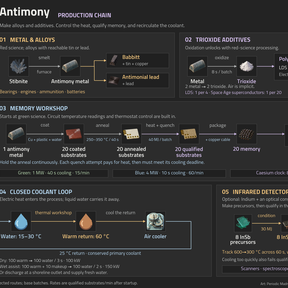
It starts at red science with metal and additives. The memory workshop opens at green science: hold an annealing temperature, pay for a heating pulse, and cool each batch before its deadline. Built-in temperature readings and circuit controls let you tune the process.
Factorio 2.1.23 or later in the 2.1 series. Only the base game is required. Space Age, Quality and other material mods are optional.
New materials and production chains
- Stibnite ore and antimony metal. A new mineable ore on Nauvis, smelted in ordinary furnaces. Metal goes into existing fast inserters, assembler-2 and red-logistics bearing linings, piercing ammunition and batteries.
- Red logistics: one bearing material per belt, two per underground endpoint, four per splitter and two per lane splitter. Use antimony metal, or Babbitt alloy with supported early BZ tin. Existing costs and crafting times are preserved; red logistics stays before oil at red/green science in base and the current family pack. Supply bearing material to existing belt factories after updating.
- Antimony trioxide. Oxidize the metal into a white powder for existing low-density structures, electrical insulation and supported modded polymers. It carries antimony into rockets, platforms and late equipment.
- Gate mechanisms: one antimony metal per gate, or one Babbitt alloy with supported early BZ tin. Gates retain their original ingredients, crafting time and behavior and remain before oil in base and the current pack. Walls are unchanged; existing gate assemblers need the new material after updating.
- Flamethrower turret bearings: one antimony metal per turret, or one Babbitt alloy with supported early BZ tin. Require Antimony processing within the current science tier, retain existing inputs and crafting time, and supply bearing material to existing turret assemblers after updating.
- Phosphorus kiln bearings: two antimony metal per conversion kiln, or two Babbitt alloy with supported early BZ tin. Preserve existing construction materials and time, keep the kiln at its current science tier, and supply the bearing material to existing kiln factories after updating.
- Train controls: one trioxide per train stop, or per five rail signals / chain signals. Original costs and time per item are retained, and automated rail transport stays before oil in base and the current pack.
- Phase-change memory. A new chain of coated, annealed and qualified substrates, finished into memory for processing units, assembler 3, tier-3 modules and supported controllers.
- Babbitt and antimonial lead, with compatible tin or lead providers. Babbitt supplies bearings. Antimonial lead supplies piercing magazines (two per magazine), piercing shotgun shells (one each), advanced cable (one per five), and replaces existing lead in Caesium ore-sorter shielding, storage tanks and lead-lined Neodymium separator banks. It remains useful with Phosphorus iron-phosphate batteries. Basic ammunition and starter lead parts stay independent; existing lead-bearing batteries retain their alloy substitution.
- InSb detector materials, with Indium and supported optics. Sealed precursors, conditioned dies and infrared detectors for existing scanners, spectroscopes and space telescopes.
New buildings and equipment
| Added equipment | What it does |
|---|---|
| Electric process heater | Converts electricity into heat for the annealing line. |
| Process heat conduit | Carries heat between workshop machines and exposes its temperature to circuits. |
| Annealing chamber | Holds coated substrates inside a temperature window for a continuous dwell. |
| Quench station | Heats and cools substrates on a deadline to qualify them for memory. Also conditions optional InSb detector stock. |
| Process cooler | Regulates the heat network with an automatic thermostat, transferring excess heat into water. |
| Air cooler | Cools the warm-water return so it can circulate again. Wet assistance adds capacity to the same building. |
| Shoreline outlet | Discharges warm water, for layouts using fresh coolant supply. |
With Caesium, a clock quench station upgrades the ordinary station with timing hardware for faster memory qualification. Compatible material packs add their parts to one construction recipe per building.
The Fluffy family gives the process heater magnesia insulation, tellurium-copper terminals and cadmium-plated mounts, replacing bricks, copper plates and gears where those materials are reachable. The family workshop remains at green science. Heater status and coil glow follow power availability; disconnected heaters retain stored heat but stop producing heat when their electrical buffer empties.
A new cooling loop
The workshop turns cold inlet water into 60 °C warm water. An air cooler returns it at 25 °C for reuse. Wet cooling consumes additional makeup water; a shoreline outlet supports discharge and fresh supply. Heaters and qualification consume electricity, and the cooling equipment removes the resulting heat.
Build a line that keeps its cool
The annealer preheats near its start target (300 °C by default), then needs fifty uninterrupted seconds inside its temperature window at 1 MW per active chamber. Going outside the window or interrupting an active chamber ruins its loaded batch; the chamber waits for recovery before taking another. Queued inputs and finished output survive. The quench station then pays 40 MJ per memory batch and has a deadline to shed that heat. Cold-water stock, return capacity and a dependable electric supply become part of the production line.
Automatic controls handle the dwell, heating and quench sequence. Your job is to supply and size the heat network, electric grid, coolant stock and cooling equipment. Include idle periods: stopped annealers no longer consume heat, while enabled heaters keep adding it.
The station waits if starting coolant stock or return space is insufficient. Losing coolant, return capacity or control power during an attempt can force a paid retry; loaded material stays in the station while it recovers. A correctly sized workshop runs without circuit wiring.
Start before nuclear power, then decide how much of your grid to give it:
| Qualification | Heating power | Nominal qualification rate |
|---|---|---|
| Green science | 1 MW | 15 substrates/min |
| Blue science | 4 MW | 60 substrates/min |
| With Caesium clock hardware | 8 MW | 120 substrates/min |
These are rates after startup. Faster profiles tighten the cooling deadline. Precision stages keep their timing across modules and machine quality, so expansion rewards a well-supplied workshop.
Tips for a workshop that keeps running
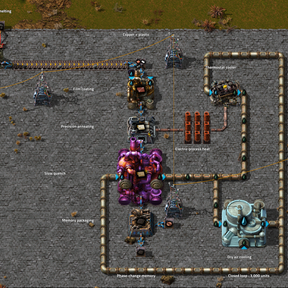
- Start with one of each. One heater, annealer, process cooler, quench station and dry air cooler support the green profile on a short, well-stocked loop.
- Plan for idle heat. Three enabled blue-line heaters still add 3 MW when annealers stop. Use two dry air coolers or one wet cooler, plus two process coolers. Tanks absorb bursts; they cannot solve a permanent cooling deficit.
- Keep separate water supplies. Charge the whole primary loop, including idle machine stock. Feed coating wash water and wet-cooler makeup separately from a finite coolant tank.
- Let an overheated line recover. Restore cooling, turn off the heaters in their panels, wait for the cold side and annealing temperature to recover, then restart. Circuits are optional.
The FAQ explains normal ratios and common stalls. With optional Informatron installed, Informatron → Antimony brings the starter, ratios, cooling and troubleshooting guide into the game.
Give optics their own challenge
With an Indium source and a supported optical consumer, the same quench station can condition InSb detector stock. Follow 600→300 °C over sixty seconds, within ±10 °C. Cooling too quickly also misses the curve.
The infrared detectors feed existing scanners, spectroscopes and supported space telescopes. Tune a new thermal process with the equipment you already built.
Planet mods
- Paracelsin: Tetrahedrite processing also gives a little stibnite.
- Secretas: Spaceship scrap sometimes contains antimony metal, like Fulgora's scrap. Recyclers get an extra result slot.
Take antimony into Space Age
- Nauvis: mine stibnite and begin the thermal workshop.
- Vulcanus: mine stibnite in the highlands outside the landing area. Foundries precipitate 12 metal from 10 ore and 30 molten iron in 6.4 seconds, with native productivity on top.
- Fulgora: recover antimony metal independently from 1% of scrap and oxidize it locally.
- Space platforms: research Asteroid stibnite and crush metallic chunks into iron ore and stibnite for local smelting and ammunition. Import finished memory.
- Gleba and Aquilo: import antimony. Aquilo can use its native fluoroketone for local qualification, with native heating and coolant regeneration costs.
The workshop works wherever pressure is at least 100, including all five planets. Platforms lack air for its coolers. Charge a closed water loop from offshore water, condensed steam or melted ice; coating wash water and wet-cooling makeup remain ongoing supplies. Cryogenic plants coat substrates and electromagnetic plants package ordinary memory. Dense packaging retains its later productivity upgrade. Other material mods can add imported coating and construction ingredients.
Metallurgic science unlocks the one infinite antimony refining research: +10% per level to smelting, oxidation and iron precipitation, up to +300%. Its cost uses red, green, blue, space and metallurgic packs. Existing Vulcanus saves get ore in future chunks; generated terrain and disabled controls are preserved.
Fits into your material pack
Give the thermal workshop a steady flow of supplies from the rest of your base. Bearing alloys, solder, refractory linings and nylon parts connect its drives, housings and electronics to BZ, Trikop, Timeken and Planetfall/Ashier factories. Antimony additives travel back into native circuit boards and polymers, carrying the workshop into larger production chains.
Fluffy-only games keep their existing recipes, machines and progression, with or without Space Age.
Antimony changes the recipes you already use. Compatible parts combine into one construction recipe per building. Your pack's frames, drives, piping, solder and refractory materials become part of the workshop when their production is reachable.
| With… | Antimony connects to… |
|---|---|
| BZ / Brevven | Bearing and lead alloys, PCB laminate additives, structural metals and composite routes, including nanotubes. |
| Timeken | Stainless housings, springs, molded nylon parts and eligible process chemistry. |
| Planetfall / Ashier | Drives, valves, nickel hardware and late synthetic rubber. |
| Bismuth and Manganese | Equipment and packaging solder, and mangalloy wear liners. |
| The fluffy_penguin material family | Tellurium widens the annealing window; Caesium adds clock qualification. Magnesium, Cadmium, Gallium, Neodymium and Phosphorus add compatible workshop materials. Molybdenum's gas turbine takes antimony bearings, and antimony trioxide makes 25% more molybdenum lubricant. |
| Krastorio 2 / K2 Spaced Out | Native stibnite enrichment and dirty-water return, ore/metal matter conversion, machine beams and cores, and electronic encapsulation. |
| Space Exploration | Resource and core-fragment supply, ore/metal/oxide delivery-cannon transport, beryllium composites and radiator cooling. |
Electronic components carry their additives into finished machines. Small doses use whole-item batches while retaining the host's original material ratios and crafting time per product. Providers keep their own dependencies and conflicts; SE and Space Age are separate configurations.
Start your first workshop
- Research Antimony processing at red science. Mine stibnite, smelt metal and put it into your early manufacturing.
- At green science, research Antimony thermal processing and coat substrates in a chemical plant.
- Connect a process heater, conduits, annealer and process cooler. Hold the annealer at 250–350 °C; compatible early Tellurium widens that window.
- Feed annealed substrates to the quench station. Supply cold water, remove the warm return, close the cooling loop and package the qualified substrates into memory.
For batch sizes, coolant reserves, circuit controls, quality and troubleshooting, open the FAQ tab. The station's status panel helps you see what your line needs next.
Credits
Antimony is by fluffy_penguin, alongside Cadmium, Tellurium, Magnesium, Phosphorus, Gallium, Neodymium, Caesium and Molybdenum. Thanks to Brevven, trikop, the Planetfall/Ashier and Timeken collections, and the K2 and SE maintainers for the production chains this mod connects to.
Artwork uses credited industrial renders from Periodic Madness, Malcolm Riley / Unused Renders, Hurricane and Sosciencity Graphics, with the licenses and attribution included in the download. The violet quench station references Factorio's own chemical-plant artwork. The periodic-table logo is original vector artwork; the trioxide icon was made with image-generation tools. Code and original artwork use MIT; third-party artwork keeps its own license.