
Requires Factorio 2.1.23 or later in the 2.1 series.
Phosphorus
The element that punishes buffers.
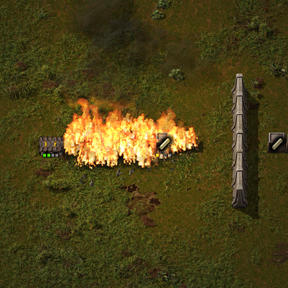
White phosphorus ignites in air. Leave it waiting for 15 minutes, in a chest, on a belt, in a train or in your pocket, and it bursts into flame: the chest takes the damage, fire spreads to every stack of white phosphorus nearby, and all that's left is ash. Your usual answer to everything, a bigger buffer, is now a fire hazard.
Initially you have three choices:
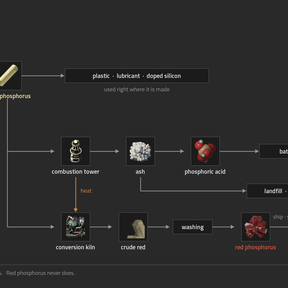
- Use it right away. Plastic, lubricant, processing units and batteries all need phosphorus. Build the furnace next to the consumer and keep the belt short.
- Burn the surplus. The combustion tower burns white phosphorus into heat for your heat pipes and leaves ash, which you dissolve into phosphoric acid, pour into concrete or ship to Gleba as fertilizer.
- Make it safe. Convert it to red phosphorus in a kiln running on the tower's heat, wash it, and ship it anywhere. Red phosphorus never ignites. A retort turns it back into white right where you need it, with two slots for speed or efficiency modules.
Every one of these costs something, and working out which one each part of your base should use is the puzzle.
Later, production and utility science unlock powered preservation cabinets and two research lines: stronger phosphorus weapons and safer buildings. Space-science protection eventually cuts building damage by 99%, while preserving the spoilage and logistics problem.
Requires Space Age to be owned (for the spoiling feature), not enabled. Plays in vanilla, with Space Age, and with Brevven-style material packs up to Krastorio 2 and Space Exploration.
What you build
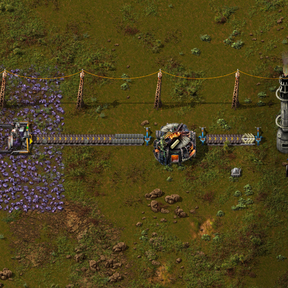
- Phosphorus furnace: phosphate rock, coal and stone into white phosphorus (coke, graphite electrodes and silica with material mods). Phosphate rock is a new violet ore, found away from your starting area.
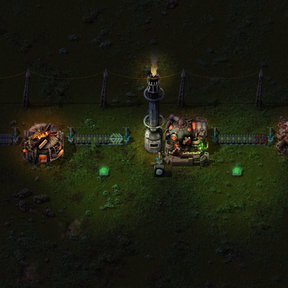
- Combustion tower: burns white phosphorus into 2 MW of heat and ash. White phosphorus in its fuel slot is safe. Idle towers cool by 1 °C per second toward 15 °C; connected heat storage keeps them warm longer.
- Conversion kiln: turns white into crude red phosphorus in batches of 50, heated by the tower next to it. Reachable Magnesium supplies its lining; Antimony supplies drive bearing material.
- Phosphorus retort: turns red back into white next to the consumer. Two module slots accept speed and efficiency modules; ten red still yields nine white. Its own small red/green research follows Phosphorus processing and eligible Tellurium processing. Construction uses condenser metal and pipes, with magnesia lining and tellurium copper where available. Existing saves retain earned retort access.
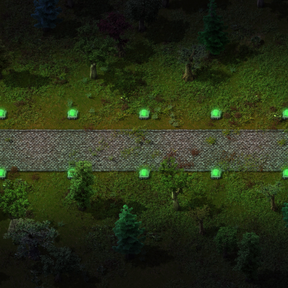
- Glow marker: an unpowered green lamp that burns for 24 hours, dims, and leaves a little ash. Point at it to see how long it has left.
- Preservation cabinet: late 2×2 storage for white phosphorus only, with one input slot, one output slot and a separate ash-removal slot. Five items become five fresh items in five seconds, retaining quality. It keeps stored contents fresh for 250 kW continuously and one water per second while occupied. Power loss, water loss or circuit disablement resumes ageing. Moving water, bubbles and status lights show whether it is working.
The fire
- Without late protection research, a burning full stack destroys an iron chest. Inherent fire resistance helps, but only up to 50 %; walls keep theirs, so walls and gaps make firebreaks.
- Fire jumps to white phosphorus in neighbouring inventories, a few hops at most. Wooden buildings burn better.
- In vacuum, on thin-air worlds and under water there is no fire. It still turns to ash.
- Nothing destroys white phosphorus for free: other mods' incinerators, crushers and recyclers can't take it.
- Too harsh? The time before it ignites is a startup setting, from 2 to 120 minutes.
- Late building protection reduces the remaining phosphorus damage by 25%, 50%, then 75%. Space-science tiers reach 90%, 95%, then 99%; the final finite tier costs 20,000 of each required science pack. Contents still spoil and fire can still spread. Vehicles, characters, trains and robots do not receive building protection.
- Late weapon research gives 20%, 40%, then 60% extra phosphorus burn damage against hostile forces; infinite space-science research adds 20 percentage points per level. Accidental and friendly burns stay unchanged.
What needs it
Plastic, lubricant, processing units (doped silicon), batteries (phosphoric acid), and heat pipes and heat exchangers (red phosphorus). Each can be switched off in the startup settings.
Explosives manufacturing requires one phosphorus ash per four explosives. The normal vanilla batch makes four explosives from two coal, two sulfur, 20 water and one ash in eight seconds. Supply ash from a combustion tower. The former ash-dried alternative is removed; existing plants migrate to the normal recipe. This change has its own startup setting and recipe bypass.
Land mines also need one red phosphorus per four mines for primer components, retaining their other ingredients, crafting time per mine and combat effects. Research stays at the existing science tier. This use has its own startup setting and recipe bypass.
The rewards are optional: red phosphorus primers for more ammunition, incendiary magazines, grenades and flamethrower ammo, doped advanced circuits, etched processing units, phosphate concrete, landfill from ash, fertilized Gleba nutrients, and uranium from phosphoric acid.
Planet mods
- Arig: Sand sifting sometimes yields phosphate rock.
- Muluna: Regolith digging sometimes yields phosphate rock.
- apia: Phosphoric acid works in both mods' recipes.
- Muria: Acidthrowers use phosphoric acid.
- Maraxsis: White phosphorus spoils without fire underwater.
- Rubia: Crapapults can't take white phosphorus.
- Paracelsin: Macerators can't take white phosphorus.
- Panglia: Crushers can't take white phosphorus.
Flare Stack's incinerators can't take white phosphorus either.
Build a chemical district around the furnace
With BZ, Trikop, Timeken and Planetfall/Ashier materials, phosphorus reaches further into your factory. Prepare furnace charges, clarify phosphate leach slurry and manufacture chlorinated solvents. Turn the resulting chemistry into battery cathodes, electronics, plastics and explosives.
Foundries, filters, native reagents and mechanical parts connect the phosphorus works to the industries around it. White phosphorus still rewards keeping things moving: now there are more useful places to send it.
Fluffy-only games keep their existing recipes, machines and progression, with or without Space Age.
Compatibility
Phosphorus reads the recipes your mods already made and builds on them, with adapters for the supported material packs. Its four processing buildings copy the recipes of the vanilla buildings they resemble, so a material pack's invar, zirconia or tungsten carbide show up in them too. The late preservation cabinet uses steel, bricks, processing units, pumps and plastic, with optional materials below. Everything below switches on by itself when the mod is installed.
Space Age
- Fire follows the planet: no fire on space platforms or thin-air worlds; heat pipes on Aquilo run on red phosphorus shipped in.
- Vulcanus makes its own phosphorus: big volcanic rocks drop phosphate rock, and the foundry turns lava and calcite into molten iron with basic slag (phosphate rock).
- Cargo landing pads and cargo bays resist phosphorus fire like chests.
- Fulgora: scrap leaching supplies phosphoric acid for local batteries; a phosphorus furnace reduces it with solid fuel into white phosphorus.
- Gleba: spoilage becomes phosphorus ash; ash boosts bacteria cultivation and bioflux/yumako nutrients, and its acid is reduced with carbon into white phosphorus.
- Space platforms: carbonic asteroids supply phosphate and carbon. Carbon-fed arc furnaces keep the coal route; stone flux comes from a planet.
- Vulcanus black phosphorus saves half the holmium plates in phosphorene supercapacitors.
- Cryogenic chemistry, electromagnetic doping and infinite metallurgic phosphorus productivity scale the factory. Washing cannot multiply phosphorus; black phosphorus gains foundry productivity but has no route back.
- Recycling heat pipes, heat exchangers and processing units returns their phosphorus ingredients; the five buildings return construction materials.
- A Space Age tip explains sources and shipping. Aquilo still needs imports.
- Recyclers can't destroy white phosphorus.
Brevven's mods (both lines)
- BZ Carbon: coke and graphite electrodes in the furnace. BZ Silicon: silica flux, and silicon for doping.
- BZ Tin: phosphor bronze, twice the plates for 4 red phosphorus.
- BZ Gold: the doping goes into the CPU. BZ Aluminum: aluminum cable in the furnace.
- BZ Chlorine: flame-retardant epoxy, and tributyl phosphate from red phosphorus and chlorine.
Planetfall legacy mods (ashier)
- Brim Stuff: wet-process phosphoric acid from sulfuric acid, NPK fertilizer slurry, and ash as the drying agent for separate TNT nitration recipes.
Timeken
- ChemistryForYou: phosphine with sodium hydroxide, the real route. Glass for glow markers.
trikop's Manganese: lithium manganese iron phosphate batteries, a quarter more batteries for one manganese plate.
MDbob electronics: doped electronic components.
Krastorio 2
- NPK fertilizer (with Space Exploration), lithium iron phosphate batteries, incendiary rifle magazines, tributyl phosphate from K2's chlorine, K2 glass for glow markers, matter conversion.
- K2's crusher can't destroy white phosphorus.
Space Exploration
- Phosphate rock on SE planets and in core mining; the delivery cannon carries the stable forms, never white phosphorus.
- Orbits and asteroid fields are fireproof.
- SE heat shielding takes ash instead of sulfur; heat-resistant low density structures take ash.
Wood mods (Lignumis, Wooden Logistics, Wooden Industry, Wood Walls, big wooden poles): wooden buildings burn better and can carry a fire along.
The family
- Cadmium: cadmium from phosphorus furnace dust, filter washing with phosphoric acid, and five cadmium-plated hardware for the preservation cabinet's wet-service fittings.
- Tellurium: tellurium copper is deoxidised with red phosphorus, including molten casting (25 alloy instead of 20). With Cadmium too: phosphorus-doped cadmium telluride.
- Magnesium: a magnesia-lined phosphorus furnace, magnesium phosphate cement, and phosphorus in catalysed plastic. Twenty magnesia replace the preservation cabinet's bricks for insulation. Magnesium's heated evaporators run on combustion tower heat.
- Gallium: phosphoric acid finishes GaAs wafers in 12 seconds instead of 20. With Cadmium too, phosphorus furnace dust can be washed for arsenic instead of cadmium.
- Neodymium: phosphoric acid comes out of the monazite leach, the extractant is made from phosphorus ash, and tributyl phosphate works in the separation steps.
- Caesium: the retort distils prepared caesium reduction mixtures, saving half the magnesium or coal compared with direct chemical-plant production.
- Antimony: when phosphoric acid is available at green science, it replaces water in Antimony's memory-substrate coating and shortens coating time. The preservation cabinet uses two antimony trioxide for flame-retardant components.
- Molybdenum: phosphoric acid and hydrogen sulfide make three molybdenum catalysts instead of two, molybdenum lubricant keeps Phosphorus's white phosphorus additive, and tributyl phosphate extracts one rhenium from 40 rhenium liquor instead of 50. The preservation cabinet and primed cannon shells take molybdenum steel instead of steel.
Kiln and retort construction use reachable magnesia instead of bricks. Retorts add five tellurium copper (five ordinary copper without an eligible provider) and four pipes. With Antimony, kilns add two antimony metal or two Babbitt alloy with supported early BZ tin. The kiln stays at its original unlock, supplying the red phosphorus needed for tellurium copper.
Credits
Art: Hurricane046, Periodic Madness (MrSmoothieHuman1), Malcolm Riley, snouz, GotLag and pepoluan. See the bundled art credits.