
Radioactive Elements
Radioactive Elements adds a nuclear isotope industry. You irradiate targets in reactors, separate them in hot cells, and use the resulting isotope cartridges in new machines. In the base game, launching a rocket takes all four production lines. With Space Age, the first rocket needs none of it, and the later science packs each need one line.
There is no new science pack and no new ore.
Factorio 2.1.23 or later. It works with or without Space Age and Quality enabled. You need to own Space Age either way, because cartridges use spoiling.
The production lines
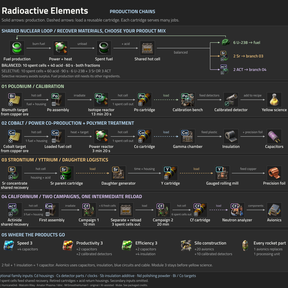
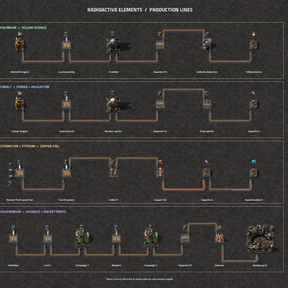
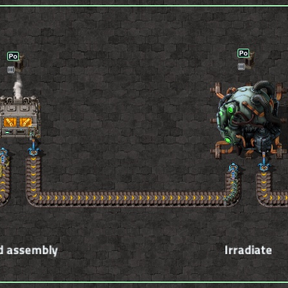
- Polonium: calibrated detectors. Irradiate a bismuth target in an isotope reactor and separate a polonium cartridge in a hot cell. A calibration bench uses it to calibrate detectors.
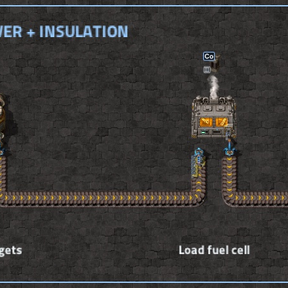
- Cobalt: insulation. Load a cobalt target into a uranium fuel cell and burn it in a normal nuclear reactor, which still makes full power. A gamma chamber uses the separated cobalt cartridge to turn plastic into insulation.
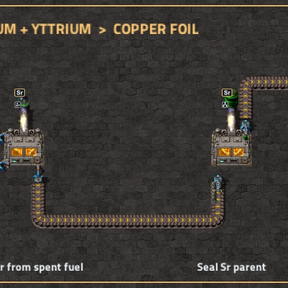
- Strontium and yttrium: copper foil. Recover strontium from depleted fuel cells and seal it into a parent cartridge. A daughter generator slowly builds up yttrium, about one cartridge every 12 minutes from a fresh parent. A rolling mill uses that to make precision foil, which goes into capacitors along with insulation.
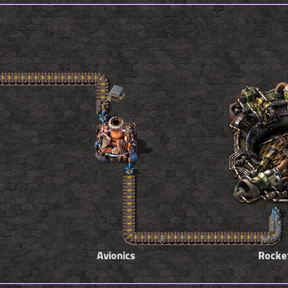
- Californium: avionics. Recover actinides from depleted fuel cells and run two campaigns in an advanced reactor, 10 and 20 minutes long. A neutron analyzer uses the californium cartridge to build avionics from capacitors, insulation, processing units and copper cable.
What changes without Space Age
| Item | Added |
|---|---|
| Yellow science | 1 calibrated detector per 3 packs |
| Rocket silo research | Needs Materials qualification, the last new technology |
| Rocket silo | 20 avionics and 10 calibrated detectors |
| Rocket part | 1 avionics replaces 1 of its 10 processing units |
| Speed module 3 | 4 capacitors |
| Productivity module 3 | 2 capacitors and 2 calibrated detectors |
| Efficiency module 3 | 2 capacitors and 4 insulation |
Blue circuits, satellites, normal uranium fuel and normal reprocessing are unchanged. Polonium and cobalt need red, green and blue science. Strontium and yttrium add purple. Californium adds yellow.
What changes with Space Age
Uranium only exists on Nauvis, so isotopes are made there and shipped, and cartridges keep weakening on the way. The rocket, rocket silo and level 3 modules stay as they are.
| Item | Changed | How you supply it |
|---|---|---|
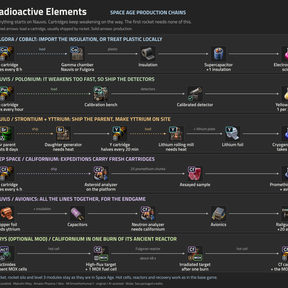
| Yellow science | 1 calibrated detector per 3 packs | Polonium weakens too fast to ship, so make the detectors on Nauvis |
| Supercapacitor | +1 insulation | Import insulation, or ship cobalt cartridges and treat Fulgora's plastic there |
| Cryogenic science | Lithium foil replaces the lithium plate | Yttrium can't survive the trip, so ship a strontium parent and make yttrium on Aquilo |
| Promethium science | Assayed samples replace the chunks, plus 1 avionics per 10 packs | Assay chunks on the platform, using californium cartridges your expedition carries |
| Railgun turret | +20 avionics | Build avionics on Nauvis |
Electromagnetic plant research needs Gamma processing, so you'll build nuclear power and the polonium and cobalt lines before making electromagnetic science.
On Aquilo, the daughter generator and lithium rolling mill need heat like other machines.
With Cerys
Cerys is Fulgora's nuclear moon, and the two mods connect. We recommend it if you want more nuclear play. It's a demanding moon of its own: you have to keep the base heated, and dropping cargo onto it needs late research.
Research High-flux irradiation on Cerys. It needs Neutron sources and Cerys's own mixed-oxide waste reprocessing and advanced structure repair. Then:
- A hot cell packs 2 actinide concentrate, a housing and a mixed-oxide fuel cell into a high-flux target.
- The repaired Fulgoran reactor burns it like a mixed-oxide cell, with the same heat, in about 48 seconds at full power. That one burn replaces both californium campaigns.
- A hot cell separates the result into a californium cartridge and a depleted mixed-oxide cell.
- For actinides on the moon, a hot cell turns 5 depleted mixed-oxide cells and 100 nitric acid into 20 U-238, 5 Pu-239 and 2 actinide concentrate. Cerys's own reprocessing gives more plutonium and some U-235 instead.
Empty the reactor's output with an inserter: while a finished target waits there, the reactor stops after its next fuel cell. Cerys allows only its own reactors, so our reactors stay elsewhere, and our machines need heat there like any other. Nothing in Cerys itself changes, and the normal californium route still works.
How cartridges work
One cartridge serves many jobs. It sits in the machine's input slot and recipes use it without consuming it, like U-238 in Kovarex.
Cartridges weaken all the time, including in chests and on belts, and the machine slows down with them:
| Cartridge | Strength halves every | Expires after |
|---|---|---|
| Polonium | 1 hour | 4 hours |
| Cobalt | 8 hours | 32 hours |
| Strontium parent | 48 hours | 8 days |
| Yttrium | 20 minutes | 80 minutes |
| Californium | 4 hours | 16 hours |
Each machine has a setting for when to return its cartridge: at 75%, 50% or 25% strength, or at expiry. A higher setting keeps the machine fast but uses more cartridges. Copy-paste and blueprints carry the setting to other machines.
For automation:
- Give cartridges their own input inserter.
- Old cartridges leave through the same output as the product, so use filtered output inserters.
- Keep cartridge belts short. A cartridge that expires on a belt stays there as a spent cartridge, and enough of them can block the belt.
- A hot cell recovers the housing from old and expired cartridges, using sulfuric acid.
Buildings
- Isotope reactor: burns polonium assemblies, 13 minutes 20 seconds each. It makes 10 MW of heat, which you can use or ignore, and needs no cooling.
- Advanced campaign reactor: the same for californium campaigns, at 40 MW.
- Hot cell: assembles and separates targets, recovers materials from depleted fuel cells and retires cartridges.
- Calibration bench, gamma chamber, rolling mill, neutron analyzer: use a cartridge to make one product each.
- Daughter generator: collects yttrium cartridges from a strontium parent.
- Lithium rolling mill and asteroid neutron analyzer: Space Age only, for lithium foil and assayed samples.
Getting started
Research Nuclear power and Processing unit, then Isotope processing. Build an isotope reactor, a hot cell and a calibration bench. Then research Gamma processing, Isotope recovery, Neutron sources and Materials qualification.
Other mods
None of these are required. When you have them, they connect like this:
| Mod | What changes |
|---|---|
| Cadmium | Plated hardware in source housings, hot cells, gamma chambers and daughter generators; neutron absorbers in the reactors. |
| Caesium | Photocathodes and scintillators in detectors and instruments; atomic clocks in the neutron analyzer and avionics. |
| Tellurium | Crystals in the calibration bench and neutron analyzer. |
| Magnesium | Magnesia in hot cells and advanced campaign reactors. |
| Antimony | Antimony trioxide in insulation and antimony metal in rolling mills. Each module 2 takes 1 antimony memory, and module 3 no longer takes its own 2. |
| Neodymium | Polishing powder in precision copper foil. |
| Gallium and Phosphorus | Their parts arrive through processing units, which avionics and the new buildings use. |
| Molybdenum | Molybdenum steel in isotope reactors, molybdenum-rhenium in advanced campaign reactors, and superalloy in the rocket silo and rocket parts. |
| Bismuth and Cobalt2 | Their metals can supply the targets. |
| Cerys | Its Fulgoran reactor makes californium in one burn, and its spent fuel supplies actinides. See With Cerys above. |
Milestones
If you use the Milestones mod, it gets a Radioactive Elements section: each cartridge, detectors, insulation, capacitors and avionics.
Known limits
Tested with a server and two clients, and for several hours of automated play, but it hasn't had balance feedback from full playthroughs yet, and the Space Age and Cerys numbers are the newest. Cartridge machines don't take modules, productivity or quality. English only.
Credits
Radioactive Elements is by fluffy_penguin, alongside Cadmium, Tellurium, Magnesium, Phosphorus, Gallium, Neodymium, Antimony, Caesium and Molybdenum.
Artwork includes work by Hurricane046, Malcolm Riley, Amator Phasma / ldinc and MrSmoothieHuman1, plus original and AI-assisted artwork. Some of it is resized or compressed, and no endorsement is implied. Code and original artwork are MIT; third-party artwork keeps its own license. Credits and licenses are included in the mod.