
Neodymium
Neodymium adds rare-earth processing and neodymium magnets to Factorio 2.1.
You wash stone into heavy mineral sand, sort out the monazite, dissolve it in acid and separate the liquor in separator banks. The neodymium is turned into magnets. Electric engines, express belts, assembler 3 and a few other later machines need them, and earlier machines get optional, cheaper recipes that use them. Cerium and lanthanum come out of the same liquor and make precision optics for production science and optional products such as cleaner solid fuel. Later you can separate dysprosium for high-temperature magnets, and build direct-drive wind turbines.
It needs only stone and water, no new ore. Factorio 2.1.23 or later. Space Age and all other mods are optional.
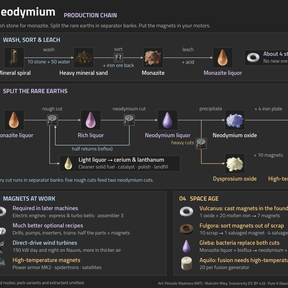
How the chain works
- Stone washing in the mineral spiral: stone and water to heavy mineral sand.
- Sand sorting: sand to monazite, with some iron ore back.
- Monazite leach with sulfuric acid: monazite to monazite liquor.
- Separation in separator banks, with extractant made from petroleum gas and acid:
- the rough cut splits the liquor into a neodymium-rich part and a light part;
- the neodymium cut splits the rich part again, and half of it goes back to the rough cut as monazite liquor.
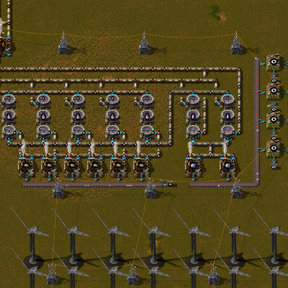
Five rough-cut banks feed two neodymium-cut banks.
5. Neodymium oxide, then magnets: 1 oxide and 4 iron plate make 5 magnets. That is about 4 stone per magnet.
6. Light oxide from the light liquor: the cerium and lanthanum.
Buildings
- Mineral spiral (4×4): washes stone. One spiral supplies about five magnets per second.
- Separator bank (3×8): runs every separation step.
- Magnetic separator (3×3, Magnetic separation research): gets a fifth more iron from ore, sorts sand, and with Space Age sorts magnets from Fulgora's scrap. Every operation takes one magnet and returns it with 98% probability: loop the return and supply replacements. Assemblers sort sand and electromagnetic plants sort scrap without operating magnets. The feed belt animates while working. Iron-rich sand sorting trades 4 washed sand for 3 iron ore, giving up the monazite; with Caesium, X-ray sorters recover copper from the same sand instead.
- Direct-drive wind turbine (5×5): 150 kW on Nauvis, day and night, no fuel. Output follows the planet's air pressure, up to 4 times Nauvis, and the turbine's quality. It can be turned off in the startup settings.
What needs magnets
Only machines you research after Neodymium processing, so nothing you already use gets more expensive:
- electric engines, express belts, and assembler 3;
- with Space Age, turbo belts and stack inserters.
Power armor MK2, spidertrons, satellites and fusion generators need high-temperature magnets.
Earlier machines keep their normal recipes, and after the Magnet motors research each gets an optional magnet recipe with reduced material costs:
- mining drills;
- pumpjacks and pumps; pumps keep one engine per pump and save the separate steel plate;
- offshore pumps;
- fast inserters;
- locomotives (Electric traction research), with half the engine units.
Pumps and fast inserters share one magnet across two outputs; offshore
pumps share one across three. The other ingredients and crafting time scale with
the batch.
Cerium and lanthanum
The light rare-earth stream supplies precision optics: lanthanum oxide, polishing powder and stone or the pack's glass/silica make lenses for industrial inspection. Cerium separation unlocks them with blue science; production science consumes one optics per three packs. Other uses remain optional:
- Treated solid fuel: same energy as solid fuel, half the pollution.
- Tailings landfill: landfill from less stone plus light oxide.
- Polishing powder: more wafers or crystals, in packs that have them.
- Cerium separation (blue science) splits the light liquor into ceria and lanthanum oxide:
- catalytic oil cracking, where the catalyst mostly comes back;
- rocket fuel with half the light oil;
- a stronger catalyst from lanthanum;
- metal-hydride accumulators in packs with nickel.
Dysprosium
The Heavy rare earths research (up to yellow science) adds two more separation steps that take dysprosium out of the neodymium liquor. One dysprosium oxide comes from the liquor of about 200 magnets. Ten magnets and one dysprosium oxide make ten high-temperature magnets.
Space Age
- Vulcanus: leach calcite and geyser acid into rare-earth liquor, then cast 1 oxide and 20 molten iron into 7 magnets in the foundry. Light oxide saves a quarter of the ore and molten iron in tungsten plates. Wind turbines give 600 kW.
- Fulgora: sort magnets out of scrap and remake them in the electromagnetic plant. The recycler needs no magnets, so the route starts locally. Wind turbines can't be built there.
- Gleba: bioleach monazite with spoilage and water, then separate it with bioflux in the biochamber. This avoids sulfuric acid and extractant. Wind turbines give 300 kW.
- Space platforms: sinter imported oxides in vacuum for 6 magnets per oxide and half the dysprosium per high-temperature magnet. Iron can come from asteroids.
- Aquilo: fusion generators still need imported high-temperature magnets. Wind turbines can't be built there or on space platforms.
- The electromagnetic plant makes both magnet types, the foundry smelts iron concentrate and the cryogenic plant runs the chemistry recipes. The original machines stay available.
- Infinite Magnet productivity adds 10% per level to magnets, casting, scrap recovery and orbital sintering. It costs red, green, blue, space and electromagnetic science.
- Spirals and magnetic separators accept quality modules. Recipes returning their own inputs reject quality. An in-game tip explains the sources, and salvaged magnets list Fulgora as their import planet.
- With Phosphorus, plain extractant stays available beside the ash recipe.
Space Exploration
- Magnet sintering in orbit, with a higher yield.
- An ion-exchange dysprosium step using cryonite beads.
- Magnets in spaceship consoles, space telescopes, meteor defence and the fluid burner generator.
Planet mods
- Moshine: Refine mined neodymium into neodymium oxide.
- Muluna: Its carbon electric engine needs a neodymium magnet too.
- Maraxsis: The air is too dense for wind turbines.
Build a magnet industry
With the matching BZ, Trikop, Timeken and Planetfall/Ashier materials, your separator hall grows into a magnet industry. Precipitate rare-earth carbonates, cast magnet-alloy billets in BZ foundries and coat magnets with nickel. Nylon insulation feeds the motor line, while stainless vessels, flow controls and power regulators connect the workshop to the rest of your factory.
Your optical factories get a regular appetite for polishing powder, too. Stone and water are the beginning of a much larger network of belts and pipes.
Fluffy-only games keep their existing recipes, machines and progression, with or without Space Age.
Compatibility
Neodymium adjusts to the recipes other mods have already set up. Each integration turns on only when its mod is installed. Construction materials stay within Neodymium processing's existing science tier.
| Mod | What changes |
|---|---|
| Brevven's BZ mods | Hydrochloric-acid leach; zircon and titanium from sand sorting; lead-lined separator banks; aluminium and carbon-fibre turbines; polished sapphire and silicon wafers; Pt/Pd catalyst recipes with rare earths. |
| Timeken | Leach with sodium hydroxide; magnets sintered under argon (6 per oxide); glass-fibre turbine blades; lanthanum hexaboride electron gun. |
| Planetfall / Ashier | The Neodymium motor: the pack's motor with a magnet; the inputs of two motors plus one magnet make three. It replaces the plain motor in later recipes. Nitric-acid leach; bearings in the turbine. |
| AAI Industry (in Space Exploration, and with trikop's bismanol) | The same Neodymium motor. Bismanol motors stay in the early recipes. |
| Manganese + Bismuth (trikop) | Without AAI, drills, pumpjacks, pumps and fast inserters get their cheaper recipe with bismanol (two per magnet) instead of neodymium magnets. The magnetic separator is lined with mangalloy instead of steel. |
| Krastorio 2 | Some monazite from rare-metal enrichment; sand instead of stone; K2 steel beams in the buildings. |
| MDbob electronics | Polished silicon wafers. |
| Tellurium | Electric engines take Tellurium's copper and a magnet; polished tellurium crystals; copper-alloy contacts in separator-bank drives. |
| Magnesium | Magnesia in the leach for 20% more liquor; low density structures with rare-earth magnesium alloy. |
| Phosphorus | Phosphoric acid from the leach; extractant from phosphorus ash; tributyl phosphate in the separation steps. |
| Gallium | High-temperature magnets use gallium and half the dysprosium; rare earths from Gallium's purified ash. |
| Cadmium | Plated hardware in mineral spirals and separator banks; the bank's eight hardware replace its five iron gears. Nickel-metal-hydride batteries with lanthanum instead of cadmium (packs with nickel). |
| Caesium | Atomic clocks take 2 neodymium magnets (state-selection magnets); the magnetic separator sorts pegmatite ore with a quarter more pollucite. |
| Antimony | Antimony in separator-bank agitator bearings. Early neodymium magnets drive Antimony's air coolers. Antimony trioxide is required in the existing rare-earth-alloyed low density structure recipe. |
| Molybdenum | The rare-earth cracking catalyst cracks gas oil. Ceria goes into kerosene rocket fuel and high-temperature magnets into the gas turbine. Lanthanum oxide makes 25 superalloy instead of 20. With Gallium, the magnet crystal puller takes 5 molybdenum steel. |
In Fluffy-only games, machines from Cadmium, Gallium and Phosphorus also get optional magnet recipes. External material packs instead use native motors in the required construction bills where their supply is available.
Construction materials add their research prerequisites within Neodymium processing's existing science tier, without a research cycle. The original recovery and scrubbing machines remain available to start the material supply.
Getting started
- Research Neodymium processing (after sulfur processing).
- Build a mineral spiral next to stone and water, and sort the sand in an assembler.
- Leach the monazite with sulfuric acid, and make extractant from petroleum gas and acid.
- Feed five rough-cut banks into two neodymium-cut banks. Pipe the monazite liquor from the neodymium cut back into the rough-cut input.
- Make neodymium oxide and press magnets with iron plate. Turn the light liquor into light oxide.
- Use the light oxide, for example for treated solid fuel. Otherwise it backs up and stops the separator banks.
You can add Neodymium to an existing save. If you already researched something that now needs magnets, Neodymium processing is researched for you, and everything you built keeps working.
Ratios, settings and more details are in the FAQ.
Credits
Neodymium is by fluffy_penguin, alongside Cadmium, Tellurium, Magnesium, Phosphorus, Gallium, Caesium, Antimony and Molybdenum. Thanks to Brevven, trikop, the Planetfall/Ashier and Timeken collections, Krastorio 2 and Space Exploration, and their maintainers, for the chains this mod connects to.
Artwork is adapted from:
- Periodic Madness by MrSmoothieHuman1 (MIT): mineral, oxide and magnet icons, and the separator tanks.
- Unused Renders by Malcolm Riley (CC BY 4.0): icons.
- Sosciencity Graphics by tirisabella, Johanna Spieker and _traum (CC BY 4.0): the magnetic separator.
- Wind Turbines relaunched by TexugoMaldito, wavetrex and xyzzycgn (MIT): the wind turbine.
- Bery0za's Pure It by Bery0za (Apache 2.0): the mineral spiral.
The artwork is resized, recoloured or re-sheeted; no endorsement is implied. Some icons reference Factorio's own artwork. Code and original artwork are MIT; third-party artwork keeps its own license. Credits and licenses are included in the mod.
Mk1 energy shields use two neodymium magnets for field-generator assemblies, at the existing science tier. Mk2 inherits the magnets through its Mk1 shields. Shield capacity, recharge and power use are unchanged. Existing assemblers need magnets after updating; the exact recipe bypass is energy-shield-equipment.