
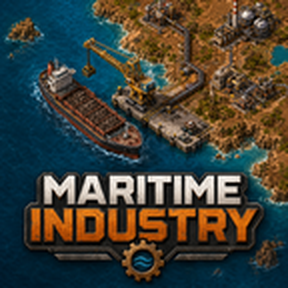
Maritime Industry
Maritime Industry expands Cargo Ships into a complete industrial shipping and port progression for Factorio 2.1.
Build coastal infrastructure, shipyards and specialised terminals, progress from small coastal vessels to deep-draft ocean shipping, develop offshore petroleum infrastructure, and automate large industrial ports with berth control and harbour traffic management.
Maritime Progression
Maritime Industry introduces a progression from early coastal transport through increasingly specialised shipping infrastructure:
Marine Engineering
Small vessel construction and the first dedicated maritime components.
Automated Water Transport
Cargo Ships ports, waterways and automated shipping.
Shipbuilding
Dedicated slipways, fabrication facilities and commercial dry docks.
Industrial Ports
Purpose-built cargo and tanker infrastructure for larger commercial vessels.
Deep-Draft Port Engineering
Dredging, deep-draft quay construction and infrastructure for major ocean-going ships.
Advanced Port Operations
Berth automation, harbour monitoring and controlled ship admission.
Maritime Traffic Control
Anchorages, harbour entry signals, chain signals and congestion management.
Shipyards
Ships are no longer simply another hand-crafted vehicle.
Maritime Industry adds dedicated shipbuilding infrastructure including:
• Small Vessel Slipway
• Shipyard Fabrication Hall
• Commercial Dry Dock
• Marine Hull Plate
• Prefabricated Hull Section
• Marine Propulsion Unit
• Ship Control System
• Marine Piping System
Small vessels are built at the slipway while large commercial vessels require a full dry dock.
Commercial Dry Docks must be constructed as part of a real coastal port.
Commercial Shipping
Maritime Industry expands Cargo Ships with several vessel classes designed for different roles.
Coastal and Industrial Shipping
Smaller vessels remain useful for compact ports, short routes and lower-volume island logistics.
Panamax Bulk Carrier
A large deep-draft dry-bulk vessel designed for high-volume ore, coal and other bulk-material routes.
Panamax vessels require deep-draft infrastructure and are slower and heavier than conventional cargo ships in exchange for substantially greater capacity.
Ocean Container Ship
A high-capacity deep-draft container vessel intended for major hub-to-hub routes.
Smaller feeder vessels remain useful for distributing cargo between the main port and smaller islands.
VLCC Crude Tanker
A very large crude carrier designed for moving enormous quantities of petroleum between offshore production regions and major refinery ports.
VLCC terminals use dedicated heavy crude-transfer equipment and deep-draft tanker berths.
Deep-Draft Ports
Large ocean-going ships cannot operate through ordinary shallow port infrastructure.
Deep-Draft Port Engineering adds:
• Deepwater Dredging Sections
• Deep-Draft Quay Edge
• Deep-Draft Berths
• Deep-Draft Container Berths
• Deep-Draft Tanker Berths
• Heavy ship-to-shore equipment
Panamax Bulk Carriers, Ocean Container Ships and VLCCs require genuine deepwater approaches.
Existing smaller vessels remain suitable for ordinary coastal routes.
Advanced Ports & Automation
Version 0.9 introduces an industrial port-control layer.
Berth Controller
Place a Berth Controller near a Maritime berth to monitor and manage it.
Controllers provide circuit information for berth state, reservations, incoming ships and cargo.
Managed berths use native Factorio train-stop limits to admit one ship reservation at a time.
If you enable Factorio's own circuit-controlled train limit, Maritime automatically yields control.
Port Control Tower
The Port Control Tower monitors the surrounding harbour and provides consolidated circuit telemetry including:
• total berths
• managed berths
• occupied berths
• available berth capacity
• incoming ships
• ships waiting at anchorages
• port congestion
• holding capacity
• Port Entry Open
• Port Hold
Harbour Anchorage
Anchorages provide proper scheduled holding locations outside busy terminals.
They default to one ship and can be customised using normal Factorio train-stop controls.
Harbour Traffic Control
Harbour Entry Signals can be connected to a Port Control Tower.
When the managed harbour has no remaining admission capacity, the tower raises Port Hold and the entry signal closes.
When capacity returns, the entrance reopens automatically.
Harbour Chain Signals provide native Cargo Ships reservation behaviour around junctions and berth approaches.
Maritime Industry deliberately leaves ship schedules under player control. It does not rewrite schedules or train groups.
Heavy Bulk Terminals
Panamax terminals gain a dedicated Heavy Bulk Ship Loader/Reclaimer.
The equipment provides substantially higher throughput and reach than ordinary terminal handling equipment and must be constructed alongside genuine deepwater infrastructure.
Rotate it to reverse the transfer direction.
Offshore Industry
Cargo Ships: Oil Rig integrates directly into Maritime Industry progression.
Offshore oil is intended to become an important petroleum source on Maritime Archipelago maps.
Maritime Industry also corrects offshore wells that generate too close together for practical Oil Rig placement while preserving the combined resource amount.
Maritime Archipelago
The Maritime Archipelago map preset is designed around sea transport.
Starting islands receive safeguards for essential early resources while distant resources encourage maritime expansion.
The map is designed around:
• limited starter-island resources
• richer distant deposits
• offshore petroleum
• island-to-island logistics
• progressively larger port infrastructure
Existing Saves
Existing 0.8.x saves are supported.
Version 0.9.0 includes migration support for the new heavy bulk terminal equipment.
Existing ship schedules are not rewritten.
Player-configured train limits and harbour circuit settings are preserved.
Compatibility
Factorio: 2.1.20+
Required:
• Cargo Ships 2.1.8+
• Cargo Ships: Oil Rig
• Cargo Ships: Floating Electric Pole
• Forgeworks Core 0.3.2+
Space Age: Optional
Forgeworks Discord
Join the Forgeworks Modding community for releases, support, bug reports, suggestions, development updates and testing builds.
Discord: https://discord.gg/HwAXSv5E5d