
Proliferation
A machine faction that builds. Inspired by the Replicators from Stargate, some features are strong hints of that.
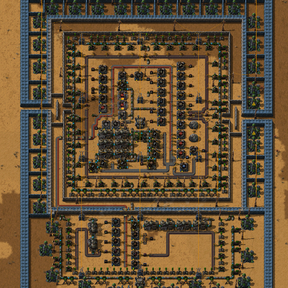
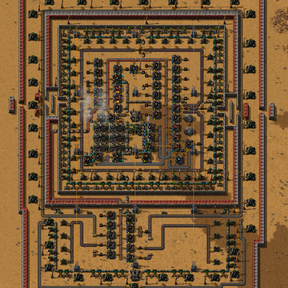
The Replicators function differently from standard enemies. They land on a matter node, put a pumpjack on it, and run an actual factory: extractors, chemical plants, assemblers, labs, belts, power, walls and turrets, all of it working the way yours does. The threat is of a different kind than regular spawners, as they use an actual economy to produce both their bases and themselves.
The mod is still in Beta, mostly because it may need balancing. First two base stages are a decent challenge for a new player. But leave them to grow and they turn into an actual threat. The threat becomes even more deadly if you have Space Age. Art is still WIP, not my strong suit, but I'll get it sorted out eventually.
What a base does
It mines matter and turns it into alloy, then components, then its own science pack, and then it researches its own technology tree out of that pack. What that also implies is that if you let too many bases live, all of them will research at once, potentially getting the infinite research they have (in their separate tech tree) to a high level, that actually makes them a threat. I tried to avoid using timers and script-based things, so most things happen naturally, down to actually building the waves.
Each technology that gets finished (or at least most of them) unlocks a build stage. Construction robots inside the base stamp the new buildings and revive them, and repair whatever you (or the biters!) damaged on your last visit.
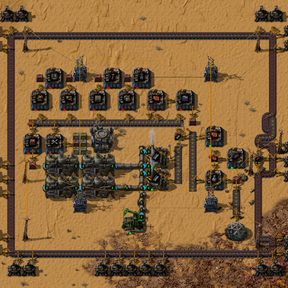
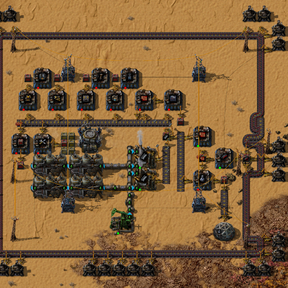
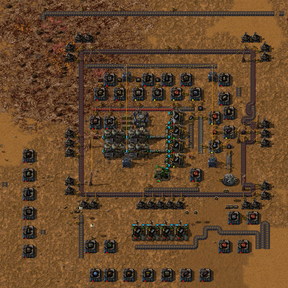
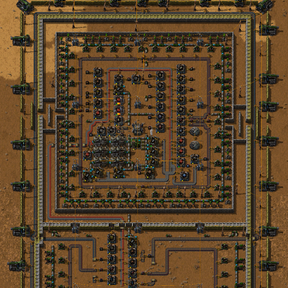
Four stages: a bare production line, then a real factory, then a defended one, then a walled compound that can take you out with its railguns before you even see it. There's also something more starting with v0.34.0! See the next section.
There are three kinds of base now, rolled when the base lands: a railgun base, a tesla base and a rocket base. They grow through the same four stages of the same core, and at the last stage each one stands its own armament over it, with its own wall. Below that stage you tell them apart by what they do rather than by how they look: a railgun base would rather found a new base than fight you, a tesla base comes for you, and a rocket base goes hunting the biters.
A base also rolls how rich it is. Most land on a single matter node; some land on two or three, rarely four, and every node past the first carries a pod: a small factory of its own on its own node, with its own extractor, generator, turrets, roboport and lab. Rich bases research faster and field more walkers, and they take longer to clear. Pods are new and still a proof of concept, one design standing on three sides of the core; expect them to change.
Once the base has the resources and the tech, it builds walking machines (aka the replicators, but please bear with me till I figure out the art) and holds them in a deployer until its garrison is full. The walkers walk straight through their own base's walls, turrets and machines, the way a spidertron walks through yours, so a walled compound is no cage for them; they cannot walk through yours, or through water, cliffs or nests, and you cannot walk through theirs. Once a walker has cleared the ground around its deployer it stands still until something comes close or the wave leaves, so an idle garrison costs your frame rate nothing. The garrison cap is currently fixed per stage and grows alongside it. When it's full, the garrison marches. A wave picks an objective, and a wave that survives long enough lands on a matter node of its own and starts again. The objective is one of 3 things: build a new base, attack the nearest player structure, attack the nearest nest (Replicators are an enemy to all organic matter!)
A wave that beats one of your buildings down does not finish it. Only their walkers take buildings; their turrets destroy what they shoot, as they always did. At thirty percent of its health or below, if the Replicators have an equivalent (and they have one for nearly everything: assemblers, chemical plants, pumpjacks, chests, belts, inserters, poles, solar panels, accumulators, pipes, walls and every turret they have a match for), the building becomes theirs, at the health it had left. A captured gun turret keeps your ammunition and fires it at you. A captured laser turret stays on your grid and drinks your power until you cut the wire, which is the way to deal with a captured pocket: break the line, then shoot. They never take the lab, the roboport or the roboport's own robots, and a building they have no match for, a big pole, a splitter, anything another mod adds, just dies as it always did. A captured machine that stands idle, or a captured chest, comes apart into walkers five to fifteen minutes later, one walker per walker's worth of health it has left, plus one; kill it first and it drops their loot instead. For a chest, every item inside counts as a point of health, so a full chest of plates is a mine with a fuse, and the fuse is the time you have to reach it. Turrets, walls, poles and the rest of the pocket's infrastructure never come apart; they are theirs until you take them down.
They also eat. A wave that passes within reach of your belts, or of anything lying on the ground, breaks off to feed, and every ten plates or ore it eats stands one more walker up where it is eating. Gears, circuits, cable, batteries and plastic cost half again as much, anything else two and a half times, and things from other mods three times. A wave met at the wall stays the size it was; a wave that reaches the smelter columns comes back bigger. When the food runs out it goes back to what it was doing, and a wave that at least doubled while it fed founds a new base on the spot, or just past the edge of the starting area if it fed inside it. A chest they destroy is eaten by the nearest wave, if one is close. Whatever a fight leaves lying on the ground is food too, the plates and circuits their dead buildings drop included, so clean up after a fight or it comes back as walkers. Your belts and chests are what a wave wants now, and the defence is not letting it reach them.
A walker that dies sometimes leaves a small fragment behind, about one death in a thousand. It shows up on the map, one hit destroys it, and your turrets shoot it if it lies in their range. Left alone for five to fifteen minutes it grows. Near the middle of the map it turns into one to five walkers. Farther out it turns into walkers half the time, a small outpost four times in ten, and a whole new base one time in ten. An outpost is a small post with a few turrets, the machines to build walkers, and one tank of matter that never refills. It comes with its first five walkers already built, and after that its walkers gather at the post five at a time and then leave together as a wave, and once the tank runs dry the outpost goes dark: it just stands there, poorly defended, until you get around to it. Destroying its tank pays research. A wave hunting you goes for the nearest thing of yours it can reach.
The endless techs they have at their disposal are: turret damage, rate of fire and walker strength. Add hardening, which does end but takes a long while, and the armour they used to have from the first hour is now something they work up to. Either way they become real threats sooner than later.
The replicator planet, Hala! (Yes, it's missing the second L, because it's trying to give it to you ;) )
Starting with version 0.34.0, the Replicators have their home planet in the game. Fair warning, though: it's far from an easy target! The bases on Nauvis were just the scouting party, but Hala features actual replicator cities. Be warned, they are a serious challenge! The City itself starts as something just above the power of a stage 4 base for someone that doesn't have space age, but with a far greater economy, let's call that stage 5. The next 5 stages are it getting a direct upgrade, by adding another wing to the core. The design is inspired from the actual Ancient/Replicator cities from the show (well, as much as one can make that in Factorio without making them too powerful or too empty). The wings unlock better tech and mechanisms for each other: the railgun wings adds railgun defenses and walls to all other wings, the Tesla wings adds, well, i'll let you guess. The liquimetal wing is in charge of the army, and spawns the actual Humanoid replicators (still have spitter skin for now). And the economy wing supercharges unit spawns by boosting the economy and making more ammo for the other sections. Missiles? At this point I'd say they are just slowing everything down. Unless you try to swarm the city, in which case they do have a precise role!
The humanoid replicators are actually named First->Fifth, and will soon feature a small story that started its roots in the space update and they fire powerful energy weapons, that can easily take down your repair fleet. And they do something else as well: they feed the walkers around them. It's the same as if they eat iron plates, and will duplicate while in combat if you don't finish them fast enough. That is... if you survive that long.
Taking out one of the towers permanently shuts down that wing, so being tactical can be to your advantage. Unless you don't build a defense strong enough to handle the attacks from the other 8 bases that are probably in range of your tiny planet-side base...
Taking out a city rewards you with 5 full ZPMs, several advanced cores and a new resource called "liquimetal" (name makes sense now, right?). It still might need some balancing, but the planet itself is fully endgame, post Aquilo, so you should be strong enough by now.
And the planet (or enough space farming) will reward you with a new weapon and vehicle: the Puddle Jumper and the Drone. If you know Stargate, you'll love these, they are as fun as it sounds. The drones feel a bit OP, so by default, they deal anti-replicator damage, which makes them useless to anything else, but that can be changed in the configs.
What you do about it
A fresh Replicator shrugs off about a third of what you have and a tenth of a bullet. Left alone, hardening carries that to ninety percent of everything and a quarter of a bullet, and at that point lasers and grenades are close to useless against them. Their walkers are the same story in health: a fresh one has a small biter's fifteen, and walker plating, which their labs take in turns with hardening, carries that to the seven hundred on the tooltip. Their turrets and their walkers deal Nano damage, which nothing in the world resists, except one smart engineer.
You can also just look at them. Control+Shift+R opens a window on the faction, and so does the radar button on the shortcut bar if you'd rather click than remember a key. How many bases they have and of which kind, how many pods and walkers stand, how far the bases have grown against the stage their research allows, how many waves are out and how many walkers are riding in them, what they are researching and how fast, how far their endless technologies have run, what their armour has hardened to and which damage types it has learned to shrug off: it is all in there. Where a wave is going is not, and you still find that out when it arrives. Post v0.34.0:Scanning requires an actual building now and it provides limited information based on its tier, with even the exact point targeted by a wave.
The bases are designed specifically with weaknesses. Whether you do a strategic strike and take out their roboport, then slowly whittle away at the defenses until they fail, or take out the pumpjack, or just go in guns blazing in a buffed out tank, there are many ways to take them out.
Each kind of base has a hole in its armour and one thing it is proof against. A railgun base's wall and railguns take nothing from bullets and give way to explosives; a tesla base is proof against electric damage and burns; a rocket base shrugs off explosions and melts under lasers, the one place a laser wall works. Those type walls and turrets resist everything else five points harder than the plain profile at every level of hardening, bullets included, so a gun turret line is not the way through a stage-four compound; the plain Replicator wall, machines and walkers on the rest of it harden along with the rest of the faction.
About the pumpjack: a base cannot make a new one. It is born with three spares in a storage chest, and only a pod can craft more. A base dies when it cannot recover: when every roboport it has is gone, or when its extractor is gone with the spares spent and no pod alive to make another. What it leaves is yours to loot, and it stays dead.
Bases appear as the map generates, at a distance from spawn, rather than arriving on a schedule. Explore and you find them. They are uncommon, with several spawning restrictions, such as never spawning near water or resource patches, and will clear their entire area of biters, trees and cliffs, which is totally done in order to get the matter to build the initial base, and not as a mechanism I actually needed in order to prevent some unforeseen scenarios during testing, #trustmebro.
What you get for it
All their buildings have a chance to drop loot. Most of it is a decent boost for a starting economy, but the labs contain their unique research, which you can use to get their tech for yourself. With Space Age, you also get some off-planet bonuses, nothing critical, but enough to get you a head start on resources that you can't get on Nauvis normally. And you can farm them, since the bots will repair what you destroy... eventually...
But that's not all, you also get the matter node, where you can put your own pumpjack and get matter for yourself... well, let's say your pumpjack is not as refined as theirs, but there are solutions for that! Never underestimate your engineering spirit!
Space Age
Space age is optional. With it installed the Replicators' last stage also stands railgun, rocket and tesla turrets and manufactures the ammunition for them, and five more techs open up, each costing a planet's own science as well as looted data:
- Vulcanus: the bond disruptor. If you watched Stargate, you know what this turret does.
- Fulgora: the disintegration ray, a tesla turret rebuilt around a Replicator emitter. It chains, and the ground it lands on burns.
- Gleba: a spidertron rebuilt in Replicator alloy. Five rocket launchers, more room inside, faster legs. I mean, this was to be expected, right?
- Aquilo: the chaos missile, which puts Replicators on the ground where it lands, on their own force, hostile to everyone including you. And nano artillery, which is the best shell in the game against a nest and one of the worst against a Replicator base. I dare you to clear a stage 4 base only with Nano shells!
While one of your platforms travels between planets or waits in orbit, the Replicators can fire an asteroid at it. Shoot it down before it reaches you and it leaves a Replicator asteroid chunk behind, which a crusher turns into alloy and a component. Let it land and a Replicator ship comes down against your hull: a small outpost with its own tank of matter that runs on your ship's own power and sends walkers at you until the tank runs dry. A medium, big or huge one lands with a boarding party already standing on it, 10, 20 or 40 walkers, that goes for your hub at once, and whatever its bay builds after that goes straight for your ship too. Leave one standing too long and its walkers can bring down an undefended hub and cost you the ship. An alert on the map points at the asteroid while it is on its way, and at the Replicator ship once it lands, or at your hub if the Replicator ship broke up against it. A huge asteroid wears a huge asteroid's armour, so gun turrets and rockets barely scratch it and a railgun is what brings it down. Replicator asteroids are a very light grey, so you can tell one from an ordinary asteroid at a glance. It never happens over Nauvis or on a route to or from Nauvis.
The redesigned Replicator ships carry more than walkers. Medium, big and huge ones also bring along Replicator cargo tanks, each landed full of thruster fuel or thruster oxidizer, nine thousand in a tank aboard a medium one and twenty thousand aboard a big or huge one, yours to pump out once it is down. The big and huge ones carry Replicator beacons too, loaded with speed modules that really speed up their machines. Destroy a beacon and it always gives up an advanced Replicator core, which Zero-point energy below turns into Replicator modules, the Liquimetal Processing Facility, zero-point flasks and the ZPM generator. Each of its modules drops half the time, and those modules work in your own machines, speeding them up twice as much as a speed module 2 for the same cost in power and quality. The huge one runs on a ZPM reactor that powers the Replicator ship and, because a ship is one power network, your whole ship too, at up to fifty megawatts while it stands. It lands holding a Zero Point Module charged somewhere between five and fifty percent, low charges the common case, and destroying it drops the module with whatever charge is left, or nothing at all if it had already run dry.
Zero-point energy
The advanced Replicator cores and the ZPMs you take off Replicator ships have a use. A technology after Aquilo turns a tier 2 module and a core into a Replicator module, twice as good at its job. Past that, Zero-point energy (ten thousand of every science pack but promethium) unlocks the Liquimetal Processing Facility, which turns a ZPM and three cores into a zero-point flask worth as much research as the ZPM held. Research the ZPM generator with those flasks and a full ZPM's 10 TJ becomes up to 1 GW of power, more at a better quality, drawn only as fast as you use it. ZPMs only come from huge Replicator ships, and huge ones only fly toward the shattered planet.
The Star
Taking down a Replicator city on Hala (or just surgically striking down its central tower) allows you to finally understand the strange signals coming from the core of the Star. You should probably investigate it. The whole mechanic was inspired by how Destiny recharges its power, but applied to ZPMs (and yes, I know, that's probably not how zero-point energy works, but the trade-off is you get to go inside the Star, so bear with me).
You know how Aquilo freezes your machines? The Star does the opposite to your ship. First, your plastic parts start melting. Then, copper, iron, and, finally, tungsten. From that point on, the temperature stops rising and the damage stays the same (we do need to keep this as a game mechanic, not just instant death, right?). You do get sensors, though, so you can actually see how bad it is, and shields, so that it's not so bad, but shields will only buy you time, at the cost of huge amounts of energy. An already filled ZPM might come in handy. Fusion might work as well if you don't want to use the ZPM itself. But there's another thing to be aware of: you can't have perfect charging. Every charger working heats its shield bubble (or the unprotected ship, but if you get to that point and don't invest in a shield, that's on you, mate) a little faster. You can also use the heat sensor's signals to tell the ship's hub when to leave and when to return, effectively allowing you to automate and charge as many ZPMs as possible without worrying about the heat. Heat shield bubbles (hexagons) that are next to each other or that overlap can combine into a single one, averaging out the temperature.
Settings
Two tool settings, both off by default, twenty-three more for how tough the Replicators are, a few map settings, one for the drones' damage, and three that each player sets for themselves.
Layout authoring mode unlocks the faction's own buildings and recipes so their base blueprints can be built by hand. It is a tool for working on the mod, you can technically use it to tweak the base layout, or, technically, add more stages, but you need to know how the mod works first.
Diagnostic commands adds seven admin-only console commands that report what the faction is doing: /proliferation-queue, /proliferation-drain, /proliferation-research, /proliferation-units, /proliferation-waves, /proliferation-seed and /proliferation-board. Three of them can also make something that was going to happen happen sooner, one of those can put a base on the map, one drops a fragment where you stand, and one fires a Replicator asteroid at the ship you stand on, letting you pick which side it comes from. Pretty neat if you want a status or to make your life harder.
Nothing else about the game changes.
Map settings (Settings, Mod settings, Map tab): a spawn weight per kind of base, which is how often a new base comes up as that kind relative to the others. Set all of them to zero and natural spawning stops. The original layout from earlier versions ships at weight zero: it is still in the mod for saves that have one standing, and you can turn it back on. There is also a weight for the rare four-node base, a base density and a garrison multiplier. Map settings live in the save, so a save started before a version that changed a default keeps its own values.
How tough they are is twenty-three more settings. The resistance numbers, the hardening step, the cost multiplier, the walker drop and the three walker health numbers are startup settings and need a restart to change; adaptive armour and its two numbers sit in the Map tab and can be changed while a game is running. Captures, their threshold and the two feeding settings sit in the Map tab too, and so do the two fragment settings, the three boarding settings and the final burst.
Replicator resistance: starting value is how much of every damage type but bullets and the disruptor a fresh Replicator shrugs off, thirty percent by default.
Replicator resistance: maximum is as far as hardening can carry that, ninety percent by default, and it is also the number their tooltips show.
Replicator resistance to bullets: starting value is how much of a bullet a fresh Replicator shrugs off, ten percent by default, and a low one hands their bases to the nests.
Replicator resistance to bullets: maximum is where hardening stops for bullets, a quarter by default.
Replicator hardening: percent per level is how much each level adds to both resistances, five by default, which puts twelve levels between the starting values and the maximums.
Walker health: starting value is the health a fresh walker has, fifteen by default, a small biter's.
Walker health: maximum is as far as their plating research can carry that, seven hundred by default, and it is also what a walker's tooltip and health bar show.
Walker plating: health per level is how much each level adds, sixty by default, which puts twelve levels between the starting value and the maximum, the same count as hardening, and their labs take the two in turns.
Replicator research cost multiplier multiplies the science every Replicator technology costs, the stage ones and the endless ones alike, so two means they take twice as long to grow and to harden.
Adaptive armour is off by default, and turning it on makes every hit of a damage type the Replicators take raise their resistance to that type, across the whole faction.
Adaptive armour: percent per hit is what one hit adds, a tenth of a percent by default.
Adaptive armour: maximum bonus is the ceiling on what adaptive armour alone can add, thirty percent by default, on top of whatever hardening has reached.
Walkers drop nano rounds is off by default; with it on, a fallen walker sometimes leaves a round or two on the ground.
Replicators capture buildings is on by default; with it off, their attacks destroy what they hit, as they did before.
Capture threshold: percent of health is the share of a building's health a hit has to leave it at or below for the Replicators to take it, thirty by default.
Replicators feed and replicate is on by default; with it off, a wave never breaks off to eat, a chest they destroy feeds nobody, and a captured chest comes apart on its own health alone.
Feeding: plates per walker is how many plates or ore make one new walker, ten by default. Everything else they eat is priced from it.
Replicators leave fragments is on by default; with it off, no walker leaves a fragment and none already lying grows.
Fragments: chance per dead walker is how likely a dead walker is to leave one, a tenth of a percent by default.
Replicators board ships is on by default; with it off, no asteroid is ever fired at a ship.
Boarding: Replicator ships per hundred asteroids is how many of the asteroids your ship meets turn out to be Replicator ships, 0.21 by default, about one in five hundred; zero turns boardings off without turning off the rest.
Boarding: quality Replicator ships is off by default. With it on, each Replicator asteroid comes at a quality, any quality from normal up to the best one in your game equally likely, and the Replicator ship it lands is built at that quality: every building, the walkers it lands with and the walkers its bay builds after. What its buildings drop comes at that quality too, a ZPM included, which keeps its charge. It may be imbalanced, since the Replicator ships get tougher and the loot gets better. Bases and outposts on the ground are never affected.
Final burst is on by default. A Replicator ship that has lost its matter or its turrets comes apart into walkers thirty minutes later, over a short while, up to five times the walkers it landed with. With it off, a Replicator ship stays where it landed until you destroy it.
Drone damage is a startup setting, anti-nano by default, which only the Replicators take, so a drone is useless against anything else. Explosion or physical turn the drone on every enemy, biters and demolishers included. It is a lot of fun, and it will trivialize the endgame.
Three settings are each player's own, in the Per player tab:
Replicator attack alerts, on by default, puts an alert on your map where a Replicator wave coming for you is heading, on any planet where you have a tier V scanner.
Drones hunt buildings, on by default, sends a drone that still has damage to spare on to the Replicators' buildings once no walker, humanoid or turret is left in its reach. Turn it off and your drones only ever go for their fighters.
Star glare is how bright the Star is drawn around a ship inside it: full by default, reduced dims it, off hides it. The shields, the motes and the hull temperature always show.
Compatibility
Every prototype this mod defines carries the proliferation- prefix, so nothing here collides with an overhaul mod's own names, and the faction is its own force rather than a change to the biters. I tested with the mods I play with, some interesting interaction happened, some bugs were squashed, both literally and figuratively, but nothing truly serious. Since this is my 5th mod, I generally learned what to expect, but, if you find something that's not supposed to be there, or that doesn't work as intended, please let me know.
Mods that upgrade or replace turrets without checking whose they are (turret experience, quality on kills, that sort of thing) will act on Replicator turrets too. Nothing breaks: the faction rebuilds a lost turret as its own plain one. The swapped-out items land in the base's chests, which is a strange thing to find but a harmless one.
A resistance another mod writes onto a Replicator prototype is left standing where it is lower than the profile, and overruled downward where it is higher: the correction only ever deals what a hit still owes and never heals, so a mod that makes them tougher than they have earned is corrected back down and a mod that makes them softer is obeyed. A Replicator that the correction finishes dies inside the damage event, so another mod's handler for that same hit finds an entity that is no longer valid.
The only vanilla prototypes it edits are resistance lists, and only by appending. Armour gets the same resistance to Nano that it already had to fire, so a decision you made about heavy armour still counts against this faction. Biters, worms and spawners get a negative one, so Nano hurts them half again as much as it would anything else. And everything in the world that is not a Replicator is made immune to the disruptor beam, which is what keeps it a tool with one job.
Author
Cody T. Newman.