
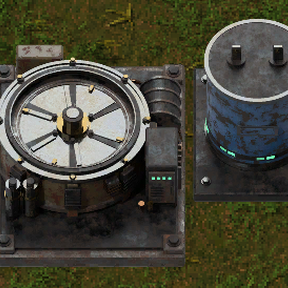
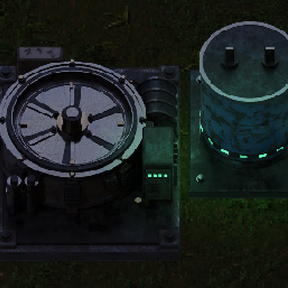
An energy reserve is only useful if it can deliver power fast enough. Industrial Flywheels is built around that distinction: expensive, compact machinery for factories where storage space and sudden demand have become part of the design problem.
Each upgrade uses the previous flywheel as a component, so your early investment becomes part of the next generation of storage. First and second flywheels are available in the base game, Space Age adds two more tiers.
The cryogenic flywheel offers three operating modes. Capacity holds a large reserve for a sustained shortage, Speed delivers a much smaller reserve at very high power, and Balanced sits between them. Charge power remains 150 MW in every mode. Switching to a lower-capacity mode requires the stored energy to fit the new capacity.
Expand a storage site with separate 2×2 capacitor blocks. Each block stores 50 MJ of its own at normal quality and charges at up to 4 MW. Linked flywheels can draw that reserve when connected to the same electrical network.
Every block in a flywheel's linking area also adds 25% of that tier's nominal capacity and halves its maximum discharge power. This increment uses the tier's base capacity, before cryogenic mode multipliers: each block adds 750 MJ to a cryogenic flywheel in any mode. Charging power is unchanged. Several blocks therefore trade discharge power for more storage, place them according to the role of the reserve.
Linking range extends 2 tiles beyond a mechanical flywheel, 4 beyond a vacuum flywheel, and 5 beyond either advanced tier.
Each tier has its own rotor speed, which falls as the stored energy runs down. Charged flywheels keep spinning between demand spikes, empty ones stop. Native accumulator circuit output reports charge level for controlling backup generation. Quality increases capacity through the game's accumulator mechanics and improves flywheel energy retention. Rotor animation can be disabled in mod settings.
Self-discharge is enabled by default. A full, isolated normal-quality flywheel runs down in 4, 6, 10 or 20 minutes for tiers 1–4 respectively. Higher-quality flywheels retain their charge longer. Losses continue while connected to a powered network, so maintaining a full reserve also consumes electricity.
The self-discharge system also covers capacitor blocks and ordinary accumulators - ordinary accumulators default to an adjustable eight-minute discharge time. Optional support covers selected modded accumulators.
Damaged flywheels warn at half health or below with a flashing indicator, an audible alarm and a red circuit signal. Destroying a flywheel at 10% charge or above causes a rotor burst. Its reach and damage depend on the tier and charge level, and nearby charged flywheels can cause a chain reaction. Reserve layout and maintenance matter as much as capacity.
English, Russian, Polish and Simplified Chinese translations are included. Enjoy!