
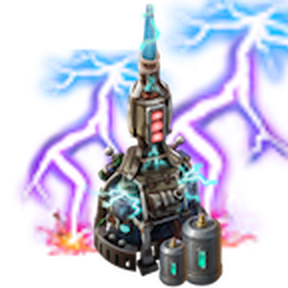
Storm Ionizer
Fulgora's storm only fires at night, and only where it feels like it. This mod lets you schedule it.
TL;DR
- The Storm Ionizer is a lightning collector with a launcher on top: it fires charges into the cloud deck and calls lightning down on demand, day or night.
- Loaded by hand or by inserter. One charge per second, 1-4 lightning bolts within twelve tiles, redirected to the best attractor in range like any natural strike.
- Two charges, crafted in Electromagnetic plant only — Ionization Charge (1 lightning bolt, pure Fulgora) and Resonance Charge (4 lightning bolts, wants tungsten and carbon fibre).
- It sits below rods and collectors in the priority ladder, so its own bolts arc over to the neighbours you surround it with.
- 400 MW to 1.6 GW sustained per tower into normal collectors — against roughly 26 MW for a collector on the natural night storm. Legendary collectors are worth two and a half times as much.
- No circuit connector. Wire the inserter to an accumulator instead and the storm only runs when your network is short.
- Use-it-or-lose-it: a bolt dumps 1000 MJ in an instant, so accumulators are mandatory — more so than for natural lightning.
- Fulgora only. Requires Space Age.
Recommended alongside — built to run together, none of them needs the others:
- Fulgorite Harvesting — farms Fulgora's lightning glass for holmium. An ionizer next to a fulgural tower cuts a harvest from fifteen minutes to about one — and produces no power at all while doing it.
- Fulgorite Mining — a lodemast mineralizes fulgorite ore into the ground around it, and a Big Mining Drill digs it up. Recycle fulgorite into holmium ore and stone.
- EM Holmium Charging — a holmium chain that never enters a fluid, so quality survives all the way to the plate.
The scheduled storm
Fulgora's atmosphere is permanently charged. Magnetic fields, eight hundred hectopascal of pressure, a cloud deck that never discharges unless something forces it to. At night the cooling is enough for channels to open on their own. During the day the charge just sits there, doing nothing.
The Fulgorans did not harvest the storm. They scheduled it.
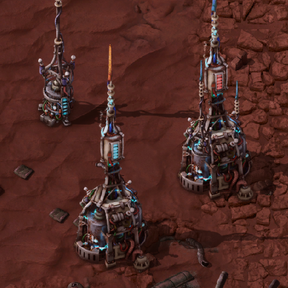
Among the ruins stand the remains of ionizer spires — collectors with a launcher assembly bolted on top. They fired canisters of holmium-doped electrolyte aerosol into the cloud deck; the aerosol ionized a conductive channel, and the atmosphere did the rest. Power on command, independent of the time of day.
When the civilisation collapsed the spires went silent and the storm fell back into its natural, night-only rhythm. What is left of the canister racks turns up in the scrap heaps, burnt out, unrecognisable, and quietly recycled into iron gears by engineers who never knew what they were holding.
You rebuild them.
What it does
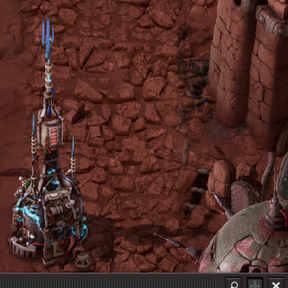
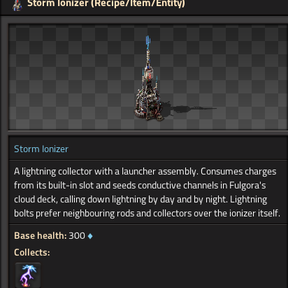
The Storm Ionizer is a lightning collector with a launcher assembly. It is derived from the vanilla collector and keeps all of its attractor stats.
It has a built-in magazine: two slots, pre-filtered to the two charge types. Click the tower to open it, or point an inserter at it from any side; it accepts from all four tiles of its footprint.
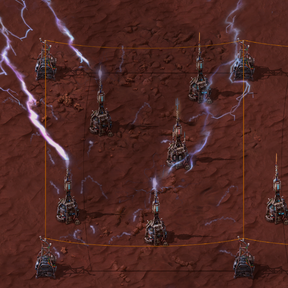
Once per second, every ionizer spends one charge and calls down lightning at a random point within twelve tiles of itself. Each lightning bolt carries its own small random delay, so a field of ionizers produces a staggered, natural-looking storm. The game then redirects each lightning bolt to the best lightning attractor in range, exactly as it does with natural lightning.
Lightning works day and night. That is the whole point.
It feeds its neighbours
The ionizer sits below rods and collectors in Fulgora's lightning priority ladder. Its own lightning bolts therefore arc over to whatever attractor stands nearby rather than striking the spire itself — which looks far better, and lets you surround one ionizer with a ring of collectors.
A lone ionizer still catches its own lightning bolts, so nothing is wasted if you build one on its own.
The charges
Both charges are made exclusively in the Electromagnetic plant.
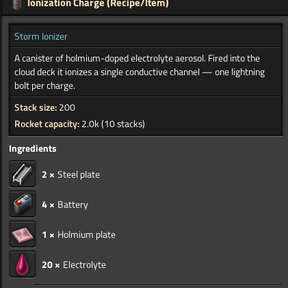
Ionization Charge — 1 lightning bolt
1 Holmium plate · 4 Batteries · 2 Steel plates · 20 Electrolyte → 4 charges
A canister of holmium-doped electrolyte aerosol. Fired into the cloud deck it ionizes a single conductive channel.
Built entirely from what Fulgora already gives you. Batteries and steel are recycler surplus — the recipe is as much a scrap sink as it is a power source.
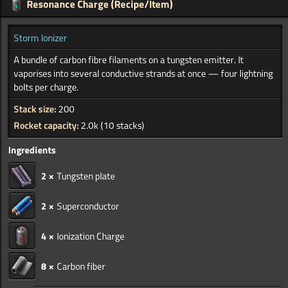
Resonance Charge — 4 lightning bolts
4 Ionization charges · 2 Tungsten plates · 8 Carbon fibre · 2 Superconductors → 2 charges
A bundle of carbon fibre filaments on a tungsten emitter. It vaporises into several conductive strands at once, opening four channels instead of one.
Tungsten from Vulcanus, carbon fibre from Gleba — two materials Fulgora never had. The Fulgorans could not have built this one; it is not a reconstruction but an improvement. Both imports are light: a single rocket carries enough for roughly 200 GJ worth of charges.
Either charge stacks to 200 and ships 2000 per rocket, so one rocket of resonance charges is worth 8000 lightning bolts.
How much power is that?
A lightning bolt carries 1000 MJ. How much of it survives depends on what catches it, and quality matters a great deal here:
| Attractor | Normal | Legendary |
|---|---|---|
| Lightning rod | 200 MJ | 500 MJ |
| Lightning collector | 400 MJ | 1000 MJ |
So the same charge is worth two and a half times as much if a legendary collector catches it. Quality on your collectors is a direct multiplier on everything the mod produces.
Taking a normal collector as the baseline:
| Charge | Lightning bolts | Energy delivered | Sustained output per ionizer |
|---|---|---|---|
| Ionization Charge | 1 | 400 MJ | 400 MW |
| Resonance Charge | 4 | 1.6 GJ | 1.6 GW |
The right-hand column is the ceiling for a single ionizer running at one charge per second. In practice you are limited by how fast you can make charges, not by how many towers you have — one well-fed ionizer replaces a great many.
For comparison: a single lightning collector harvesting Fulgora's natural night storm averages roughly 26 MW over the day-night cycle.
Lightning bolts are use-it-or-lose-it. A strike dumps its energy into the attractor's buffer in an instant, and whatever your network does not take is gone. This is the same mechanic that makes accumulators mandatory for natural lightning on Fulgora — it applies here too, only more so, because you are producing strikes far faster than the sky does.
Spending charges only when you need them
The ionizer has no circuit connector, and neither does its magazine. You cannot wire the tower itself, read its contents or switch it off.
You can wire the inserter that loads it, though, and that turns out to be enough.
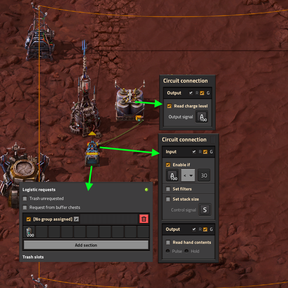
Connect the inserter to an accumulator. An accumulator on a circuit network outputs its charge as a percentage, so all you need is an enable condition on the inserter:
Enabled when accumulator charge <
30
Now the tower is only fed when your network is actually running short. Above the threshold the magazine drains, the ionizer falls silent and goes on working as an ordinary lightning collector — which it still is. Below it, the inserter resumes and the storm comes back on demand.
The one drawback is aesthetic. You have built a machine that summons lightning out of a clear sky, and you will now only ever get to watch it when something has gone wrong with your power.
UPS
Short version: the script is cheap, the lightning is not.
What the mod does per tick. Ionizers are bucketed by unit number, and each tick handles one sixtieth of them — so a thousand ionizers cost about seventeen inventory checks per tick rather than a thousand of them landing on one unlucky tick every second. Lightning bolt scheduling caches each tower's position and surface instead of re-reading them.
What the engine does. Every lightning bolt is a real lightning entity with procedural geometry, forks, ground streamers, a shader and a light, and it lives for 36 ticks. That, not the Lua, is what will eventually cost you frames. At fifty ionizers on resonance charges you are creating two hundred lightning bolts per second and roughly a hundred and twenty of them are on screen at any moment
One design decision that matters here. Lightning bolts land within twelve tiles of the tower, well inside the 25 tile attraction range, so in practice they always hit an attractor. That is not only a balancing choice: a lightning strike that hits an attractor plays a single hit animation, while one that hits the ground spawns around seventy particles. At two hundred lightning bolts per second that difference is fourteen thousand particles per second you never pay for.
Technologies
- Storm Ionization — after Lightning Collector. Unlocks the ionizer and the ionization charge.
- Resonance Charges — after Tungsten Steel and Carbon Fibre. Unlocks the resonance charge.
Building recipe
1 Lightning collector · 10 Supercapacitors · 10 Superconductors · 20 Holmium plates · 100 Electrolyte
Buildable and placeable on Fulgora only — the atmosphere has to be able to carry a lightning bolt. It ships 20 per rocket, the same as the lightning collector it is built from.
Recommended mods
These Mods and Storm Ionizer are built to run together. None of them needs the others.
Farms the fulgurite lying around Fulgora: plant a seed crystal, ground lightning into it until it has grown, break the glass open for the holmium inside.
It gives the ionizer a second job. Everything above assumes the lightning ends up in a collector and turns into power — a fulgural tower is a customer that wants the strike itself, not the electricity. Left to Fulgora's own night storm a field takes fifteen to twenty minutes to ripen. One ionizer standing next to a tower brings that down to about a minute.
The two need no configuration to work together. The tower pulls lightning from twenty tiles away, the ionizer scatters its bolts within twelve of itself, so putting them near each other is the whole setup.
One thing to expect, and it is the opposite of everything on this page: an ionizer feeding a tower produces no power at all. The tower outranks every attractor on the planet, so it takes every bolt and buries all but one per cent of it. That is the intended arrangement: the ionizer stops making power and starts making crystals grow.
A lodemast mineralizes fulgorite ore into the ground around it, and a Big Mining Drill digs it up. Recycle fulgorite into holmium ore and stone.
A parallel holmium chain that never lets the metal enter a fluid. Ore is crushed to powder, loaded onto iron plates by ion exchange in an Electromagnetic plant, and thermally stripped in a Foundry — the iron cycles back and is never consumed.
This one does nothing for the ionizer. It is the third link in the chain, and it picks up where Fulgorite Harvesting leaves off.
The harvester grows its crystals from seed, and a quality seed grows a quality crystal that recycles into quality holmium ore. Vanilla's route onward from ore runs through Holmium Solution — and fluids cannot carry quality. Whatever you grew comes out as ordinary plates, and the entire effort is thrown away at the last step. EM Holmium Charging is the solid-state route that carries it through.
That is what makes the three a set: The ionizer schedules the storm. The harvester turns the storm into holmium. This one keeps the quality it grew.
All vanilla holmium recipes stay untouched; the solution path still works for everything that does not care about quality.
Details worth knowing
- The slots come pre-filtered, one per charge type, so a freshly built tower cannot be fed the wrong thing by accident. Clear or change the filters if you want to — that is your call, the ionizer only cares what it finds inside.
- A tower holding both spends its resonance charges first, and only falls back to ionization charges when the stronger ones run out.
- Quality charges do nothing extra. A legendary ionization charge is worth exactly one lightning bolt, the same as a normal one — the filters accept every quality alike. Quality pays off on the collectors that catch the bolt, not on the charge that caused it.
- The ionizers contents show as an icon on the tower in alt mode, so you can see at a glance which of your ionizers have run dry.
- Mining an ionizer by hand returns the charges still inside it.
- Deconstructing one drops them on the ground, where your bots pick them up along with everything else.
- Destroying one loses its contents.
- Charges are consumed one per second per tower, whatever the stack size — the slot is a buffer, not a throughput limit. A full stack of 200 charges is a little over three minutes of autonomy.
Compatibility
Requires Space Age.
AI
Mod concept & design by Morlot.
Implementation developed with the help of Claude (AI assistant by Anthropic).