
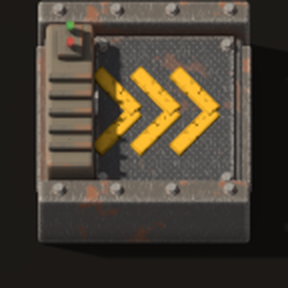
Moves whole stacks between chests, cargo wagons, assembling machines and furnaces without belts – up to 20 stacks at once. One building instead of loader + belt + unloader. Built for UPS.
Mods introducing new content into the game.
Version: 0.5.1
Date: 2026-10-23
  Features:
    - Tips and tricks: a new Storage Optimizer category explains placing, whole-stack transfers, wagons and
      machines, tiers, filters and the circuit network.
Version: 0.5.0
Date: 2026-10-23
  Compatibility:
    - Updated for Factorio 2.1. Factorio 2.0 players keep version 0.4.2.
    - Fixed a crash on game load with Pyanodon 3.1: the recipes and technologies of the tiers now get the same
      helper methods that other mods attach to existing recipes.
    - Existing saves keep all buildings, settings and researched technologies.
Version: 0.4.2
Date: 2026-10-18
  Compatibility:
    - Belts from mods with their own research branches no longer lock faster tiers behind unrelated
      technologies (e.g. Ultimate Belts Space Age with Planetaris: Arig/Hyarion, or Ultimate Belts behind
      the turbo belt). Each tier is now crafted from the fastest slower tier you are guaranteed to have
      first: its belt is an ingredient of the new belt, or its technology is a prerequisite. Tiers form a
      tree that follows the mods' research; the upgrade planner follows the branch available first.
    - Existing saves keep all buildings and researched technologies; only recipes and prerequisites of
      the affected tiers change.
Version: 0.4.1
Date: 2026-10-17
  Compatibility:
    - Mods with several belts of the same speed (e.g. glowing belts from Tenebris Prime) no longer lock the
      whole tier chain behind the late technology of one of them. For each speed the tier chain uses the
      belt available first; the other belts give side variants crafted from that tier, outside the upgrade
      planner chain.
Version: 0.4.0
Date: 2026-10-08
  Features:
    - Own window with the same layout as the native inserter window, showing only what the building
      really uses: status, live preview, energy, filters (quality picked in the slot), stack size, stacks
      per transfer (slider and field) and leftovers. Inserter options the building ignored (read hand
      contents, override stack size, spoil priority) are gone.
    - Circuit connection panel next to the window: enable/disable condition, set filters, and set stack
      size / stack count from a control signal with its current value shown. Logistic network panel
      when in range of a logistic network.
    - "Move leftovers too": when the source lacks a full transfer or the target has no room for it, the
      building moves as much as possible, so chests and wagons get emptied completely. Off by default.
      A partial transfer pays the base cost plus the matching share of the extra stacks.
  Balancing:
    - A transfer costs 50 kJ + 5 kJ for each additional stack (was 20 kJ + 5 kJ).
    - The yellow tier no longer waits for the bulk inserter technology (it needs the red belt), so it came
      at the same time as the red tier. In vanilla it now needs only red science (fast inserter and steel);
      its recipe uses a fast inserter instead of a bulk inserter, which moved to the red tier recipe.
  Changes:
    - The side panels next to the inserter window are removed (also from existing saves).
Version: 0.3.0
Date: 2026-10-06
  Features:
    - Cargo wagons as source or target: place the optimizer next to the track to load or unload a train
      waiting at a station. A wagon counts only while the train stands still; a stopping train wakes
      the optimizers around it.
    - Infinity chest (and infinity cargo wagon) as source or target.
Version: 0.2.0
Date: 2026-10-02
  Changes:
    - Every tier has its own technology "Storage optimizer (<belt>)". In vanilla the first tier comes after
      the bulk inserter technology (it used to come with the fast inserter).
    - Existing saves: tier recipes stay locked until the new technology is researched.
  Balancing:
    - Recipes are more expensive. Up to yellow belt speed: bulk inserter, 5 steel, 10 electronic circuits;
      red belt speed: 10 advanced circuits, 10 steel; faster belts: 5 processing units, 10 steel.
      Each tier also needs the previous tier and 2 of its belts.
    - Technology cost is 1.5× its most expensive prerequisite, with the same science packs.
  Compatibility:
    - Technology prerequisites are derived from the belt and from every recipe ingredient, so a tier is never
      unlocked before you can craft its ingredients – also in reshuffled tech trees of overhaul mods.
      Tested with Pyanodon's modpack and Bob's mods.
    - Ingredients a mod removes are replaced by simpler ones (e.g. bulk inserter → fast inserter).
    - Ingredient level follows the belt speed, not the tier number, so mods with extra slow belts
      (Bob's basic belt) do not make tiers more expensive.
  Bugfixes:
    - With Space Age, recycling recipes no longer made a belt or an ingredient count as available from the start.
Version: 0.1.0
Date: 2026-10-01
  Features:
    - One building that moves whole stacks between chests, warehouses and machines without belts.
    - Tiers are generated automatically from every belt in the game (vanilla, Space Age and belt mods);
      yellow tier makes one transfer per second, faster belts are proportionally faster.
    - Stack size: Auto (the item's stack) or any custom amount, also from the circuit network.
    - Stacks per transfer: 1–20 stacks at once (configurable limit), also from the circuit network.
    - 5 item filters with whitelist/blacklist and quality comparison, filters from the circuit network.
    - Enable/disable by circuit condition.
    - Stacks per transfer from the circuit network with a selectable control signal and its live value (panel option).
    - Default control signals are the plain letters S (stack size) and N (stacks per transfer), any signal can be chosen.
    - Assembling machines and furnaces: as a target the input is filled, as a source the products are taken (fuel is not handled).
    - Stack size, stacks per transfer and its circuit control are kept in blueprints, copy-paste and when replacing a tier.
    - Quality, spoilage and item data are preserved.
    - Own graphics in the style of belts and splitters, arrows coloured by tier, wire terminal for circuit wires.
    - Own status in the entity window (Working / Waiting / No power …) and source → target indicators.
  Optimizations:
    - The building is never updated by the engine and the script touches it only once per transfer interval.
    - Power is paid per transfer: 20 kJ + 5 kJ for each additional stack (bigger transfers are cheaper per item);
      the energy buffer holds two of the most expensive transfers; idle buildings use no power.