
Mods introducing new content into the game.
Version: 2.1.1
Date: 2026-10-19
  Bugfixes:
    - Fixed that replicator islands didnt spawn properly when added to a save that already had Fulgora.
Version: 2.1.0
Date: 2026-10-18
  Major Features:
    - Initial release.
  Features:
    - Drop ships wait on the shore while their raiders forage, and can be destroyed there to strand them. Landed raiders walk to their targets together as a group instead of in a line.
    - A raid's ships fly out together as a fleet, each come down on a spot of their own instead of on top of each other, and keep the damage they took in flight. Their raiders climb out one by one round the hull, and walk under landed ships instead of round them.
    - Replicator islands on Fulgora: some of the moated vault islands far from the landing site are the replicators', bigger than Fulgora's own, with their own ground and buildings and none of Fulgora's scrap or ruins. A replicator core sits at the centre of each, with crawler and carrier spawners, forges and repair pylons around it, a different mix on each island and shown in the map preview, and spires and monoliths to blow up. Their coasts have cliffs of replicator blocks. The "Replicator nests" map generation control sets how many.
    - Electromagnetic interference: Fulgora's own pollution, given off by the machines that pollute elsewhere. Replicator islands sleep until it reaches them, then wake for good and start raiding.
    - Every 4th night, each awake nest with a built-on island within 400 tiles raids the nearest one: its replicators steal from the belts there and carry it home. They don't set out to attack anything, but they'll break through what's in their way, and fight back when attacked.
    - Replicator carriers crack chests open: one works at a chest for a few seconds, with an alert on it, then spills its most valuable stacks on the ground for the crawlers to pick up. Kill the carrier first and the chest stays shut. The chest itself is never harmed. A map setting picks belts only, chests, or chests and logistic chests.
    - Killed raiders drop what they were carrying, and replicator scrap.
    - Replicators are never struck by Fulgora's lightning, except the replicator core: its spires draw the storms, which feed it rather than hurt it.
    - Shooting or blowing up a crawler or carrier below half health splits it, and half its blocks survive. Blocks ignore attackers and make for each other: four that meet reassemble into a crawler, which joins the raid if it's on one; the rest fall apart after a minute. Lasers and electricity kill them cleanly.
    - Replicators are built of holmium-rich blocks: replicator scrap recycles on its own into holmium ore (15%, fifteen times Fulgora scrap), iron plates and electronic circuits. Unlocked by Replicator analysis.
    - Replicator islands are strong but static: each of their many spawners keeps a brood of replicators, hatching new ones to replace those killed, and repair pylons mend everything nearby. What's destroyed stays destroyed, so knocking down spawners weakens an island for good. Destroying the core brings the whole island down, spreading out from the core, its raiders and their ships with it.
    - Replicator buildings are made of replicators: destroy a spawner, forge, turret, spire or monolith and replicators pour out of it to go for whoever did it.
    - Every replicator core sits on a patch of replicator scrap, shown on the map. It grows with everything the nest steals, and can be mined once the core is destroyed.
    - Replicators can't swim, so raiders merge into drop ships and fly over the oil. A ship lands at the edge of the island nearest its nest, never in the middle of the base, and breaks apart into the raiders. To fly home with what they took they come back together where they landed. Turrets can shoot ships down in flight, apart from flamethrowers, and those aboard fall with it. Raiders who miss their ship go berserk and attack anything near them. Small raids come in a scout that holds a handful of replicators, bigger ones in drop ships.
    - Nests bear a grudge against whoever kills their replicators, far more for their buildings and ships. Push one too far and it means war: its raiders come as a mothership and go for your turrets before they loot. It calms down after a few raid nights of peace.
    - Replicator islands swarm with replicators from the start, guarded by replicator turrets. Attack anything on an island and its swarm comes for you. Turrets shoot at intruders, and drop replicator scrap when destroyed.
    - Map settings: raids on or off, nights per raid, raid range, raid intensity, chest theft, and a cap on replicators per surface. A per-player setting turns off raid alerts.
  Graphics:
    - Everything of the replicators' is built of the classic replicator block: a slab with a notched tab out of each end and two grooves curving across it, laid so each row interlocks with the next.
    - Replicators are long-legged spiders of bright steel blocks with a raised head, their front legs reaching out ahead and their back legs out to the sides, holmium glowing pink in the seams of their blocks and lighting them up at night. They skitter along at a trot, lifting their feet high, and rear up to eat or strike with their front hooks.
    - Replicator carriers are bigger cousins of the crawlers, with an extra pair of hind legs and a bulbous backpack of blocks for the hoard, holmium glowing inside it. They rear back and slam their front legs down on what they attack, and work at a chest they crack open the same way.
    - When a carrier cracks a chest open, the loot flies out of it pile by pile, tumbling through the air to land round the chest.
    - Replicator blocks are scuttling chunks of a dozen blocks.
    - Replicators shatter when they die, in a spark and a spray of blocks, and leave a heap of their blocks.
    - Replicator carrier spawners are spider ships of blocks squatting over the nest, a glowing holmium eye on top. They breathe, the eye's pupil dilating.
    - Replicator turrets are mounds of bright blocks round a glowing socket. They raise a stalk, wind up and throw a lump of blocks that trails sparks.
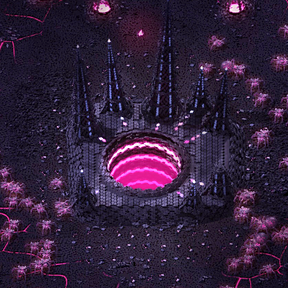
    - The replicator core is a cluster of towering spires round a shaft sinking deep underground, glowing rings fading into the depths. When lightning strikes it, arcs leap between the spires and a white surge runs down them, along the conduits and down the shaft to its heart.
    - Crawler spawners are hatcheries: a caged pool of glowing holmium, where crawlers gather from blocks climbing up out of it.
    - Forges are closed alien buds of plated petals twisting up to a crown of claws round a holmium crystal. Pulses of holmium run up the seams between the petals to the crystal, which flares, then the mouth at its foot, where it etches blocks, flashes, etched blocks lying on the tray in front.
    - Repair pylons are twisted obelisks, pulses of holmium running up them to a crystal with a ring of blocks orbiting it. Their mending beams are strands of holmium twisting round each other.
    - Hive spires, monoliths and block stacks are built of the replicators' blocks, holmium glowing in their seams. Some are toppled, leaning or cracked.
    - Everything of the replicators' that glows lights up what's round it, so a replicator island at night is a lit camp.
    - Replicator islands have their own ground of small blocks, seen at the same angle as everything else: plating with a wandering grain, patches of blocks laid in fans and of loose rubble, and seams split by glowing holmium veins. Each comes in 4 variants that mix seamlessly. Rubble rims the coast.
    - Replicator islands are strewn with mess: broken bits and loose blocks, heaps, toppled stacks and fallen slabs of wall, holmium crystals breaking up through the ground and glowing at night, lightning scorches and dried holmium stains.
    - Replicator cliffs are walls of replicator blocks with a ledge along the top, a talus of fallen blocks at the foot and holmium veins glowing in them.
    - Replicator scrap patches are heaps of replicator blocks, broken ones showing the pink holmium inside. The holmium glows faintly at night.
    - Drop ships are six-legged ships of blocks with a holmium visor, navigation lights and a bank of engines that only burn in flight. They turn smoothly (32 headings) to face where they're going as they lift off, folding their legs up, and crash to the ground when shot down, leaving their stern section and engines in the wreck.
    - Scout ships are lean darts with one engine and two legs a side. Motherships are hulking assault carriers, armoured low-poly scarabs: big flat plates under a layer of heavy armour blocks, a toothed head with a double visor, twin-barrelled turrets, vents and conduits, holmium glowing down the split between their wing cases, four engines, bays down their flanks that swing open when they land, and six heavy armoured legs with pistons and clawed feet.
    - Ships form as their raiders merge in, blocks streaming from each one into the hull as it fades in, and break apart in a burst of blocks that stream out to the raiders.
    - Carriers cracking a chest throw sparks from where their claws bite, and the chest bursts open in a flash and a spray of torn metal.
    - Crawlers and carriers that split throw out a spray of blocks, and blocks that merge click together in a ring of light.
    - Replicator scrap and Replicator analysis have their own icons.
  Sounds:
    - Replicators whir and purr like servos, and their steel feet clack as they skitter about, the bigger ones slower, lower and heavier. They whine up to strike, and their motors run down as they fall apart.