The Cave - No Space Age


A standalone Base-game edition of The Cave for Factorio 2.0. This edition does not require or use the Space Age expansion. Dig, explore, loot, and survive in a vast underground cave with mixed resources, darkness, Train Interiors, Cave Collapse, Uranium Caves, Fortified Vaults, Underground Belt/Pipe Reach research, markets, coins, and configurable progression. Space Age planets, official belt stacking, quality, spoilage, freezing, and other expansion-only systems are intentionally excluded. Start a new game; saves from the Space Age edition are not supported.

Content
3 days ago
2.0
123
Enemies Environment Mining

g mineral scaling and depth 2 thoughts

3 days ago

I've played for a bit and I really enjoy mining to find minerals. I think the base game would be improved with something like this. However, I have a few thoughts.
1) I don't think the minerals scale up fast enough. Setting up mining outposts gets tedious after a while.
2) I don't understand the difference between depth 1 and 2. It's not obvious to me.
3) Out of curiosity, Do the minerals generate on scanning? I revealed the map with cheat codes and saw nothing.

3 days ago

Thank you for the detailed feedback. I’m glad you are enjoying the mining and exploration system.

The Cave deliberately separates ore patch size from depth-based richness:

  1. Resource scaling

The “Resource Level” setting controls the physical width and coverage of normal ore veins. Level 1 uses a 1× width multiplier, Level 2 uses 2×, and this continues up to Level 8 at 8×. The default is Level 2.

Depth does not make the veins physically wider. Instead, it increases the amount of ore contained in each tile. With the default Mixed Resource Patches enabled, the current ranges are:

  • Easy: 250–625 ore per tile
  • Medium: 625–875
  • Hard: 875–1,250
  • Nightmare: 1,250–2,000

Your point about repeatedly building mining outposts becoming tedious later in the game is fair. I would like to monitor more long-running games before changing the balance, but I will specifically review late-game ore longevity and the number of outposts players need.

  1. Resource Level versus Depth

If you mean the difference between Resource Level 1 and Level 2, Level 2 doubles the vein-width multiplier, but it does not double the amount of ore in every tile.

If you mean cave depth, the current system has four distance-based zones:

  • Easy: 0–299 tiles from the centre
  • Medium: 300–699
  • Hard: 700–999
  • Nightmare: 1,000+ tiles

These zones increase ore richness, enemy danger and rewards. Your question shows that the distinction between Resource Level and cave Depth is not currently explained clearly enough, so thank you for pointing that out.

  1. Scanning and map-reveal cheats

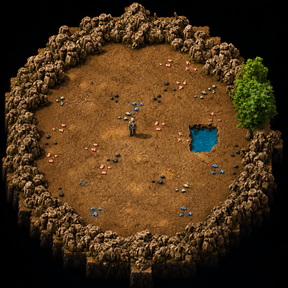
Ore does not generate simply from scanning or charting the map. The location of every vein is calculated deterministically from the map seed and coordinates, but the actual resource entities only materialise when the covering cave rock is physically opened by digging or cavern generation.

Therefore, revealing the map with cheat commands and seeing no ore is expected behaviour. Scanning alone cannot reveal the hidden deposits.

If possible, please let me know which Resource Level you selected, approximately how far you had travelled from the centre, and whether Mixed Resource Patches was enabled. That would help me evaluate the late-game scaling more accurately.

3 days ago

If you mean the difference between Resource Level 1 and Level 2, Level 2 doubles the vein-width multiplier, but it does not double the amount of ore in every tile.

That would explain why I felt depth 1 and 2 were the same. They are, if it's the scaling that increases. It felt a little defeating "what's the point of depth 2?" to discover it the same as 1.

Therefore, revealing the map with cheat commands and seeing no ore is expected behaviour. Scanning alone cannot reveal the hidden deposits.

Oh, that makes sense, but it messed with me, as I'll explain in a second.

If possible, please let me know which Resource Level you selected, approximately how far you had travelled from the centre, and whether Mixed Resource Patches was enabled. That would help me evaluate the late-game scaling more accurately.

Whatever the default is. I didn't get much farther. I tend to evaluate mods if I like where they're going with cheats, then start over and try them for real. The way ore is generated here kinda breaks that methodology.

3 days ago

Thank you — that explains exactly where the confusion came from.

The default is Resource Level 2, with Mixed Resource Patches enabled.

One important clarification is that Resource Level 1 and Level 2 are not progression stages that you reach while exploring. They are startup resource-density presets. Level 1 is the deliberately sparse option, while Level 2 doubles the width multiplier used to determine which tiles belong to a vein. Both levels still use the same ore-per-tile range while the player remains within the same cave depth zone.

So they are not technically identical, but I completely understand why they felt identical during a short test. If you inspect only a few ore tiles, their richness can look the same, and because undiscovered veins do not exist as resource entities until the rock is opened, revealing the map cannot show the difference in total vein coverage.

Actual depth progression is separate: Easy, Medium, Hard and Nightmare increase richness, danger and rewards as you travel farther from the centre.

Your testing method also explains the second part. Revealing the map is normally a useful way to evaluate a mod before committing to a full playthrough, but The Cave’s hidden, dig-time resource generation makes that method ineffective. The system is behaving as designed, but the fact that it is difficult to understand and quickly evaluate is still valid feedback.

I am not going to make an immediate balance change based on one short test, but I will keep this feedback in mind when reviewing the Resource Level wording, how its effect is communicated, and whether late-game deposits provide enough longevity. Thank you for explaining how you approached the test.

New response