
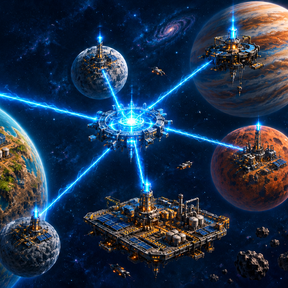
Planet Power Link
Share electricity between planets and space platforms. Build a huge power station on one planet and feed every other planet from it.
Planet Power Link adds a transmitter and a receiver. Transmitters take spare power from the planet they sit on and put it into a shared pool. Receivers take power out of the pool and feed it to their planet when it runs short. Any planet or platform can have either, and everything with the same network ID shares the same pool.
It is made for Factorio 2.0 (tested on 2.0.77). Space Age is optional, but you will want it to have other planets to connect.
This mod was written from scratch for 2.0. It is not a port of, and contains no code from, the Space Power Transmitter mod, which needs Factorio 2.1.
Features
- Transmitters and receivers. Two 4×4 buildings. Click one and a switch turns it into the other, in place.
- A shared pool. Every building adds storage to its network's pool (100 GJ by default). Power in and out is measured exactly, so the numbers you see are real.
- Network IDs and names. Run several separate pools, such as a main grid and a military base, and give each a name.
- An info window on every building. Shows what this building is doing, what this planet can pull from the pool, the whole network's totals, and a per-planet table.
- A top-of-screen button. Opens an overview of every network without having to find and click a building.
- Reserve and trend. See how long the pool lasts if no power comes in, and whether it is filling, draining or steady.
- Gentle on your power plant. Transmitters only take power while the pool has room, so once the pool is full your generators stop burning fuel on it.
- Available from the start. There is no technology to research. The cost is the barrier, not a research tree.
- Cerys support. Buildable on Cerys even though that mod bans all accumulators there (can be switched off).
How it works
Each building is an accumulator on its own planet's grid. Factorio cannot move electricity between surfaces directly, so a script moves energy between those accumulators and a central pool every tick.
- A transmitter can only charge. It soaks up whatever its planet has to spare and never gives power back to its own grid.
- A receiver can only discharge. It feeds its planet's grid when generators and local batteries cannot cover demand, and never takes power out of its own grid.
- Each building adds 100 GJ to the pool and can move up to 1 GW. Both numbers are settings.
- Each building costs a small upkeep (1 MW by default) from the pool.
So to bring power to Muluna: put a transmitter on Nauvis, put a receiver on Muluna, and give them the same network ID. That's it.
The windows
Click any building to open its window, from top to bottom:
- This building: a Transmitter / Receiver switch.
- Network ID and name. Buildings with the same ID share a pool.
- This building's flow: what this one building is sending or receiving right now.
- On this planet: for planets with receivers, how much they could pull from the pool right now (receivers × 1 GW, limited by what is stored) and how much they are pulling. For planets with transmitters, how much they are sending against their maximum.
- Whole network: total sent into the pool, total delivered, the pool's fill bar, the reserve ("lasts 1 h 20 min if no power comes in") and the trend ("filling at 400 MW, full in 26 min").
- Planet table: each planet or platform with its number of transmitters and receivers and the power sent and received.
The button at the top opens the same information for every network at once. /ppl-status prints a short text summary in chat.
Recipe
One item, the Planet power link, places a transmitter.
| Ingredient | Amount |
|---|---|
| Steel plate | 100 |
| Copper plate | 100 |
| Accumulator | 20 |
| Advanced circuit | 20 |
| Processing unit | 20 |
| Low density structure | 10 |
| Uranium fuel cell | 10 |
| Uranium-235 | 10 |
Craft time is 180 seconds. It cannot be handcrafted and needs an assembling machine 2 or better. Every ingredient comes from Nauvis resources, so you never need another planet to build it. The recipe is unlocked from the start, but the ingredients put it in the mid-to-late game, behind nuclear power.
Want it cheaper or dearer? The ingredient list is a few lines in data.lua.
Settings
| Setting | Default | When it applies |
|---|---|---|
| Pool size per node (GJ) | 100 | Startup (needs a restart) |
| Max transfer per node (MW) | 1000 | Startup (needs a restart) |
| Allow on Cerys | On | Startup (needs a restart) |
| Upkeep per node (MW) | 1 | Any time (0 makes nodes free) |
| Update interval (ticks) | 1 | Any time (higher is lighter on UPS) |
Tips for fitting it into your base
- Give transmitters their own branch. Transmitters take whatever is spare, so while a new pool fills, your plant may run much harder than your factory needs. Put them behind a power switch that closes only when your base's own accumulators are above, say, 90%. Your factory is then always served first.
- Or use a dedicated export plant. Feed the transmitters from their own generators so your main base is not affected at all.
- Count your receivers. Each moves up to 1 GW, so a planet that needs 3 GW at peak needs at least 3 receivers. Add a spare.
- Connect receivers to your main grid. A receiver only feeds the network it is connected to.
- Keep local accumulators. The pool is great for long shortages; local batteries still handle short spikes best.
- Solar planets. Put transmitters where the sun is strong and receivers where nights are long.
Compatibility
- Factorio: 2.0. Space Age optional.
- Cerys (Moon of Fulgora): The Cerys mod blocks every accumulator on Cerys. Our buildings are exempt from that rule by default; turn off Allow on Cerys to keep Cerys's original rule.
- Adding to an existing save: safe. The mod only adds new buildings, a recipe and a script.
- Upgrading from versions before 0.5.0: existing buildings load as transmitters. Their stored energy is cleared, and the pool starts empty.
- Removing the mod: the buildings disappear. Nothing else in your save is changed.
Known limits
- Factorio does not let a mod read a planet grid's maximum production, so the windows show what the pool can supply, not what the planet's own grid could make.
- Flow numbers are an average of the last second, so they jump when demand changes quickly.
- Blueprints keep the building type but reset the network ID to 1.
- The buildings have no circuit connector.
- Multiplayer has not been tested.
- Space platforms are supported (the mod works on any surface), but have had less testing than planets.
Feedback
Found a bug, or want a feature? Please post in the discussion tab. Ideas under consideration include send and receive limits, planet priorities, alerts, a history graph, map labels and a circuit-readable monitor building.
Changelog
See the Changelog tab, or changelog.md, for every version.