
AI disclosure: this mod was made with the help of AI (Claude by Anthropic).
Hydrocarbon Industry
Oil refining and natural gas the way a real refinery does it: crude cuts, hydrotreaters running on hydrogen, a gas plant, natural gas fields and frozen methane hydrate. No new buildings.
Vanilla advanced oil processing turns crude oil into three oils in one step. Here the oil refinery only does the first cut. Chemical plants split the cuts further, hydrotreaters take the sulfur out with hydrogen, and the sour gas from both crude oil and natural gas meets in one gas plant that makes sulfur, methane and petroleum gas. Natural gas fields and methane hydrate give the hydrogen the refinery needs. Everything runs in the oil refinery, chemical plant, pumpjack and mining drill you already have.
Features
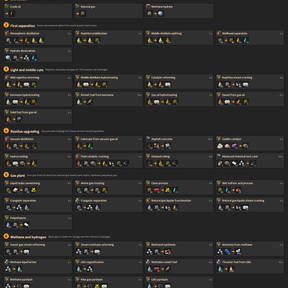
- Atmospheric distillation in the oil refinery replaces advanced oil processing: crude oil and steam become wild naphtha, middle distillate and heavy oil.
- Stabilize wild naphtha into naphtha and sour gas; split middle distillate into kerosene and gas oil.
- Or skip the splitting: reform wild naphtha or hydrotreat middle distillate straight into light oil.
- Every cut has its own road.
| Cut | Becomes |
|---|---|
| Naphtha | light oil and hydrogen by catalytic reforming, or petroleum gas by steam cracking |
| Kerosene | light oil by hydrotreating, or rocket fuel on its own |
| Gas oil | light oil by hydrotreating, solid fuel, or K2 fuel as diesel |
| Heavy oil | vacuum distillation, hydrocracking |
- Residue upgrading. Vacuum distillation splits heavy oil into vacuum gas oil and vacuum residue.
- Fluid catalytic cracking (FCC) turns vacuum gas oil into light oil and petroleum gas over a zeolite catalyst that is used up, not cycled.
- Hydrocracking turns heavy oil into a lot of light oil, for a lot of hydrogen.
- Delayed coking squeezes gas oil out of the residue and leaves K2's coke.
- Vacuum gas oil makes twice the lubricant of heavy oil; vacuum residue makes asphalt concrete.
- Gas plant. Sour gas from the refinery, the crackers and the gas fields all goes to one place.
- Sweeten it with iron early, or with amine treating later.
- The Claus process turns the acid gas into sulfur; the wet sulfuric acid process makes sulfuric acid instead.
- Cryogenic separation splits sweet gas into methane and natural gas liquids (NGL); the cryogenic plant does it better.
- NGL fractionates into petroleum gas and light oil, or cracks with steam into gas and hydrogen.
- Hydrogen is the bottleneck. Treaters and crackers eat it. Reforming makes a little, sweet gas reforming more, and steam methane reforming the most.
- Natural gas fields on Nauvis and on Gleba, where it is biogenic gas from the swamps (a recoloured lithium brine vent). Pumpjacks extract raw natural gas; wellhead separation gives sour gas, condensate and water.
- Methane hydrate, "fire ice", on its own ice islands on Aquilo, one of them next to the starting island. Mined with steam; it falls apart into ice after five minutes, so process it where you mine it.
- Liquefied natural gas. One unit of LNG holds three of methane, so barrels and wagons carry three times as much.
- Methane pyrolysis. Methane, raw gas or LNG split into hydrogen and solid carbon (Space Age's carbon), with no carbon dioxide.
- Ammonia from methane: methane and nitrogen in one step, a quarter more ammonia than reforming to hydrogen first.
- Refining productivity. Endless research, +10% per level for atmospheric distillation, vacuum distillation, hydrocracking, FCC and delayed coking.
- Advanced chemical tech card. The mod's own tech card, built like Krastorio 2's: 5 blank cards, 5 zeolite catalyst, 10 plastic and 50 methane give 5 cards. Every research after it takes the card.
- Polyethylene. Plastic straight from NGL and steam: 3 bars per crafting, no coal. Space Age's plastic productivity research applies to it.
- Space.
- Rocket fuel from kerosene.
- LNG thruster fuel on space platforms: ship LNG up in barrels and burn it like today's methane engines.
- Methalox rocket fuel from LNG and K2's oxygen.
Balance
Light oil equivalents from 100 crude oil, with vanilla cracking ratios (1 heavy oil = 0.75, 1 petroleum gas = 1.5):
| Route | vs. vanilla advanced oil processing | Hydrogen |
|---|---|---|
| Refinery + simple treating, heavy oil kept | 93% | self-sufficient with sweet gas reforming |
| Vacuum + FCC + coker + gas plant | 110%, plus methane, coke and sulfur | surplus |
| Hydrocracking + gas plant | 112% | short: needs extra hydrogen (methane reforming, a gas field, or K2 electrolysis) |
The early chain costs a little; the full chain pays back, and your hydrogen supply decides how far hydrocracking can go.
Research
- Advanced oil processing: atmospheric distillation, splitting, reforming, hydrotreating, simple sweetening, sweet gas reforming.
- Gas processing, Natural gas, Vacuum distillation, Fluid catalytic cracking, Delayed coking, Methane hydrate, Liquefied natural gas, Methane pyrolysis, Polyethylene, LNG thruster fuel, Methalox, Refining productivity (endless, with the utility science pack).
- The further down the chain, the dearer: the early research takes three packs, FCC, coking and polyethylene add the advanced chemical tech card and the production pack, LNG the utility pack, methalox and LNG thruster fuel the advanced tech card and space science. Methane hydrate takes every planet's pack, refining productivity the matter tech card as well.
- Ingredients borrowed from K2 and AluminiumX pull in their research as a prerequisite when needed.
Good to know
- Every new item and fluid has at least two uses.
- Fuel gases (methane, sweet gas, raw natural gas, LNG) have fuel values and burn in Krastorio 2's gas power station and Alternative Steam's boilers.
- The Fulgora heavy oil ocean feeds vacuum distillation, FCC and the coker like Nauvis crude does.
- Basic oil processing stays for small early setups.
- On Aquilo the mining drill freezes without heating, like every other building there.
Requirements and compatibility
- Factorio 2.0 and 2.1.
- Required: Space Age, Krastorio 2 Spaced Out and AluminiumX.
- K2's hydrogen, oxygen, nitrogen, ammonia, biomethanol, coke and fuel are used instead of own versions.
- AluminiumX: the zeolite catalyst is made like the real one, from alumina, sand and sodium hydroxide in a chemical plant.
- Alternative Steam (optional): its boilers burn the fuel gases.
- The tech card's art is recoloured from Krastorio 2's chemical tech card, under its LGPLv3 licence.
- Not compatible with Molybdenum, Angel's Petrochem and Pyanodon's Petroleum Handling, which rework the same chain.
Settings
- Atmospheric distillation replaces advanced oil processing (startup, on by default). Turn it off to keep the vanilla recipe too.
- Log changes (startup): writes every change to other mods' research and the chosen materials to factorio-current.log.
Languages
- English
- Magyar (Hungarian)
Feedback
Bug reports, balance ideas and mod compatibility requests are very welcome in the Discussion tab.