
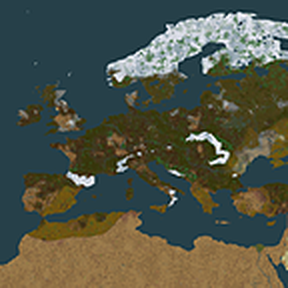
Play on a real map of Earth. Three maps of the real world (Europe, the Old World, the Atlantic) with real coastlines, rivers, mountain ranges and ore fields, in eight sizes. You start at a real city. Runs on the base game, and Alien Biomes is optional.
Mods introducing new content into the game.
Version: 1.2.0
Date: 2026-11-12
  Features:
    - Lean ore, a new startup option, on by default. Ordinary ore patches hold about 500 thousand
      ore within 1,000 tiles of the spawn and at most 5 million anywhere. These amounts are at the
      default ore sliders and follow each ore's size and richness sliders. The starting patches
      stay the base game's. On new worlds.
  Changes:
    - Ore hotspots start small near the spawn and grow to their full size from 1,000 to 3,000
      tiles out, their extra nests with them. Both distances follow the Starting area slider. With
      Lean ore a hotspot within 1,000 tiles is one field of up to 1 million and none stands within
      150 tiles of the spawn. With Lean ore off it holds no more than the base game's large patch
      at its distance. On new worlds.
    - Full ore hotspots hold up to 50 million at map scale 6, 71 million at 12 and 100 million at
      24 with Lean ore, at the default ore sliders. With Lean ore off they hold their 1.1.0 size
      times 1.4 at scale 12 and twice at scale 24. On new worlds.
    - Oil hotspots on land follow the same rules as the ore hotspots, with wells as far apart as
      the base game's. They no longer grow with the square of the map scale. Offshore oil fields
      keep their rule. On new worlds.
    - With Lean ore, hotspot fields that touch share one field instead of stacking into one
      oversized field. On new worlds.
    - Worlds made with earlier versions keep loading unchanged, their ore included.
Version: 1.1.0
Date: 2026-11-10
  Features:
    - The Moscow zone keeps the snow it covers, on new worlds beside Alien Biomes. At Chaos the
      north snow of the North snow setting and the snowy western end of the Caucasus by the Kerch
      Strait stay snow, the range with its grey rim, and the zone meets them through heat ground,
      black ash and grey rock, with grey rock between the snow fields and dead trees on the snow.
      At Corrupted the blue and purple ground stops wherever the world lays snow, and the range
      keeps its grey rim.
  Changes:
    - Worlds made with earlier versions keep loading unchanged, their Moscow zone included. The new
      terrain applies to new worlds.
Version: 1.0.0
Date: 2026-11-10
  Features:
    - Great forests have their own ground: on new worlds beside Alien Biomes, the ground inside a
      great forest turns to forest ground and the trees fill in, in stands broken by glades. Older
      worlds keep their forests.
    - River deltas: on new Atlantic and Old World worlds the Nile, Amazon, Niger, Indus, Mississippi,
      Orinoco and Lena deltas fan out into shallow side channels you can walk through, on wet green
      ground, also in a desert. Older worlds keep their river mouths.
    - Deserts in the Middle East: on new worlds beside Alien Biomes, Arabia, the Syrian desert,
      Mesopotamia and the Iranian plateau draw the pale cream sand, broken by patches of older
      ground, while the Sahara, Sinai, the Negev and the Levant coast keep their tan sand. The
      ranges keep their snow and grey rim. Older worlds keep their ground.
    - Patagonia as a dry steppe: on new Atlantic worlds beside Alien Biomes, the plains east of the
      Andes from 30 S to Tierra del Fuego draw dry grass and dirt instead of sand. The Andes keep
      their snow and grey rim. Older worlds keep their ground.
  Changes:
    - The mod is titled Terra Nauvis: Earth Maps, with a shorter description. The mod ID, every
      setting name and the log and chat prefix stay as they were.
    - With Destroyed Europe on, the snowy ranges inside the zone keep their snow and grey rim on new
      worlds, and the heat ground starts outside the rim.
    - With Destroyed Europe on, the ranges the zone encloses, such as the Alps and the northern
      Apennines, carry dead trees where living ones stood, on new worlds. The Pyrenees and the
      ranges outside the zone keep their living trees.
    - Koppen biomes was an experiment in 0.4.0 and is shelved: the setting is hidden and off, new
      worlds use the 0.3.2 climate, and worlds made with it on keep it.
    - Fewer settings: Canals, Exact coastlines, Great forests and Ore hotspot size are now always at
      their defaults (on, on, on and Normal) and no longer show in the mod settings. Worlds made with
      another value keep it.
    - Worlds made with 0.3.x and 0.4.0 keep loading unchanged; the new terrain applies to new worlds.
Version: 0.4.0
Date: 2026-11-08
  Features:
    - Koppen climate biomes, on by default: every tile's ground, trees and decoratives follow the
      Koppen-Geiger climate computed for its place on Earth, so deserts, grasslands, forests, taiga
      and polar ground each read as themselves, with Alien Biomes or on the base game. Turn Koppen
      biomes off in the mod settings to keep the plain Earth climate.
    - One-click world creation: pick a Terra Nauvis preset at the top of the new-game screen and the
      whole world is configured, with no second choice in the Map type dropdown. The Map type entries
      stay as an advanced path and keep older saves loading.
  Changes:
    - The Atlantic world past scale 6, on new worlds made from a preset: islands the coast fit missed
      are drawn from the reference map and coasts fray at tile scale, with fewer straight runs and
      right angles, matching the Old World. Scales 1 to 6 keep their coasts.
    - The chaos zones (Destroyed Europe, and the Moscow zone at Chaos): the grey rocky transition
      reaches the zone edge, the black-ash edge frays instead of running straight, and the cold fringe
      no longer shows snow specks or marsh.
  Bugfixes:
    - Worlds made with 0.3.x keep loading unchanged.
Version: 0.3.2
Date: 2026-11-03
  Changes:
    - Old World past scale 6, on new worlds made from a Terra Nauvis preset: islands the coast fit
      missed (Okinawa, the Visayas, the Solomons, Yapen, the Kurils, Shark Bay and more) are drawn
      from the reference map, the Sognefjord is open from the sea to its inner arms, and the Aral is
      two basins again without the square island. Scales 1 to 6 keep their coasts.
    - Old World past scale 6, on new worlds: coasts fray at tile scale, with fewer straight runs and
      right angles, and a world made from the Map type entry alone now gets the same coasts as one
      made from the preset.
    - Old World past scale 6, on new worlds: the Volga's Samara Bend draws as a bend instead of a
      hook. Every other river keeps its course.
    - Chaos zones on new worlds (Destroyed Europe, and the Moscow zone at Chaos): the zone fades
      from heat ground through black ash into a grey rocky strip, with no red grass or dry dirt
      band and no patches of outside ground inside the zone under High North snow. Its edges fray
      at tile level and bend every few dozen tiles, so no edge runs straight for a hundred tiles
      any more, and the Moscow zone's own edge frays as Destroyed Europe's does.
    - Worlds made on 0.3.1 keep loading unchanged; the new terrain applies to new worlds.
Version: 0.3.1
Date: 2026-11-03
  Features:
    - The new setting North snow, Medium by default, sets how far south the snow of northern
      Eurasia reaches on new worlds: Low keeps the 0.3.0 line, Medium takes it to about 61 to 64 N
      and High to about 57 to 60 N. Iceland, Greenland and the Americas keep the 0.3.0 line. The
      grey square in western Russia near the Valdai Hills is gone.
    - The new setting Moscow zone, Normal by default, needs Alien Biomes. Chaos turns the region
      from the Baltic states and southern Finland to the Volga bend and the Black Sea into a
      wasteland like Destroyed Europe's that fades through ordered bands into normal ground;
      Corrupted turns it into Alien Biomes' blue and purple lands like Blue corrupted UK, running
      straight into the north snow.
  Changes:
    - Atlantic: Frankfurt and Moscow join the spawn cities. Pick them in Spawn city: Atlantic; a
      random spawn still picks among the other 50, so a random world keeps its city.
    - Old World at scales 12 and 24, on new worlds made from a Terra Nauvis preset: coasts follow
      the detailed fit again, regrown in Croatia (Krk, Cres, Hvar, Brac and the other islands), at
      Europe's small islands and at Crozon. Scales 1 to 6 keep their coasts.
    - Hotspots on new worlds: Marmara, Portland, Sumbawa, Aswan and Collahuasi stand on land, the
      small stone discs hold their design total and Shuitou moved inland.
    - Destroyed Europe on new worlds fades into ordinary ground through ordered, ragged bands: dry
      dirt, scorched red grass and black ash, then heat ground from heat 1 inward; at the Pyrenees
      it runs up to the massif's snow.
    - Blue corrupted now covers the United Kingdom only on new worlds, and the setting is named
      Blue corrupted UK; Australia keeps its own climate.
    - Worlds made on 0.3.0 keep loading unchanged; the new terrain and settings apply to new worlds.
Version: 0.3.0
Date: 2026-11-01
  Changes:
    - At map scale 12 on new Old World and Atlantic worlds, rivers bend more finely, so banks run
      straight for shorter stretches, and the ends of river fords wander instead of crossing in a
      straight line.
    - New worlds use the next geography version of each map.
    - Biter bases on new worlds stand scattered instead of in even rows, with about 60 percent of
      the spawners. Nests keep off hotspot ore.
    - Ordinary ore patches on new worlds are vanilla's own again, in size, shape and richness for
      their distance from the spawn, and keep out of ore hotspots. Presets set the ore sliders to 1.
      Past about 1,000 tiles from the spawn they grow richer at half vanilla's pace, and from about
      4,000 tiles they stop growing.
    - An ore hotspot on new worlds holds three to six times a large ordinary patch at its distance,
      at most about 100 million, about 1.75 times as rich per tile as vanilla's ordinary ore, in
      more bodies for a stronger field. Far out it is two to two and a half times as rich per tile
      as the ordinary ore round it, so far fields spread over a district of large bodies instead of
      a few small rich ones. The map's ore size and richness sliders reach hotspots, and the Ore
      hotspot size setting adds or removes bodies.
    - The new setting Regional scarcity, Medium by default, makes ordinary ore patches on new worlds
      rarer outside the regions where each resource is found on Earth, from about 1,500 tiles from
      the spawn at scale 12: whole patches drop out, uranium and oil most, stone least, and the
      patches that remain keep their size. The start and the hotspots stay the same.
    - A start with less than nine tenths of vanilla's average coal gets topped up to that average.
    - Trees thin out on hotspot ore, and hotspot field outlines wander. Batu Hijau's copper keeps
      off Lombok.
    - With Exact coastlines, coasts at scales 1 and 2 on new Old World and Atlantic worlds follow a
      smoothed, wandering line instead of the map's square pixels: small square islets and slabs go
      under, and straight runs are shorter.
    - River banks at scales 1 and 2 take a wider noise, so each bank wanders on its own instead of
      running parallel to the other.
    - The spawn lake on new Old World and Atlantic worlds takes one more warp at scales 1 and 2, so
      its shore bends more.
    - The snow line runs north of Russia's main lowland, and a spawn in the cold north starts in a
      clearing off the snow.
    - Palms grow on warm Mediterranean shores. With Destroyed Europe on, palms outside the zone keep
      to the same rules as with it off.
    - With Space Age, the plants and decoratives Terra Nauvis re-lists keep the tiles of the other
      planets that place them.
    - Alien Biomes' blue and purple trees, plants and ground stay inside the Blue corrupted zone on
      new worlds; outside it their tiles take green, brown or orange counterparts.
    - Trees and plants beside hotspot ore thin out only where ore lies, not on the band a field's
      wandering outline leaves bare.
    - With Destroyed Europe on, great forests inside the zone stand as dead forests on new worlds.
    - With Blue corrupted UK and Australia on, Alien Biomes' green and olive plants no longer grow
      inside the blue zone on new worlds.
    - Marsh pools on new worlds fray along their edges, so their shores run straight for shorter
      stretches.
    - Inland lakes leave no tiny water specks of one to a few tiles on the open land between them.
    - With Destroyed Europe or Blue corrupted on beside Alien Biomes, the zone's own ground absorbs
      pollution like grass and the zone's dead trees absorb like living trees, so pollution no longer
      spreads further there. Saves made before take it too.
    - With Destroyed Europe on beside Alien Biomes, biter and worm creep and the light brown mud
      decals and dry plants inside the zone take a dark ember red; with Blue corrupted on, a
      blue-purple. Creep of new nests on the zones' ground takes it on saves made before too.
    - With Destroyed Europe on beside Alien Biomes, the zone's heat bands and sands walk at full
      speed and slow vehicles no more than sand does. With Space Age, tree farms can plant on the
      zones' ground. Saves made before take both.
    - The tooltips of the optional layers give each one's map generation cost at Old World scale 12.
    - With Space Age and Alien Biomes, tree farms can plant on the base game's grass, dirt, sand and
      desert ground that Earth maps put back beside Alien Biomes.
    - With Destroyed Europe on beside Alien Biomes, the zone's ground on new worlds is mostly
      cracked volcanic heat ground with lava pools, without the light grey and red sand patches; the
      Alps inside it take that heat ground instead of brown dirt, and its dead great forests stand
      half as dense.
    - Destroyed Europe on new worlds takes in Jutland and the north German coast while the Danish
      islands stay out, reaches the foothills of the Pyrenees, and takes in Veneto, Friuli and
      western Istria. The band between its heat ground and ordinary land varies in width and breaks
      in places.
    - The grey rims along snow lines, on mountain ranges and in the cold north, are narrow and
      ragged on new worlds and break in places, instead of wide grey bands. Desert ranges such as
      the Atlas and the Zagros carry no snow.
    - Biomes on new worlds are about 1.5 times larger: the presets open the Moisture and Terrain
      type sliders, and Alien Biomes' temperature sliders, at 150 percent scale.
    - Deserts on new worlds meet grass across a narrower, broken band of dirt. The Namib is a
      desert; Sicily, Greece and Cyprus take grass and dirt instead of sand; the Pacific coast of
      North America, southern Chile, Japan, Korea and eastern Madagascar are greener.
    - The snow line across northern Europe and Siberia on new worlds runs at the tree line, about 64
      to 70 N, with green taiga south of it.
    - New worlds have savanna and dry scrub in East Africa, the Karoo, the Cerrado and the Caatinga,
      a greener Pampas and northern Australia, and grass and scrub in California and central Chile
      instead of sand.
    - Great forests grow in Borneo, Sumatra, New Guinea, the Pacific Northwest, the Appalachians and
      Valdivia, and marshes spread in the Sundarbans, the Inner Niger Delta and the Mekong delta, on
      new worlds of the maps that hold them.
    - New worlds have ten more mountain ranges with cliff ridges, snow and rock fields on the maps
      that hold them: the Taurus, the Talysh, the Alborz, the Ethiopian Highlands, the Tian Shan,
      the Altai, the Gobi Altai, the Great Dividing Range, the Sierra Nevada and the Cascades.
      Cliffs on every range stand as walls with short breaks, so straight cliff runs are shorter,
      the Alps, the Pyrenees and the Zagros included.
    - Each map keeps only its 0.3.0 geography version, so the game starts about 4.5 seconds faster
      with a large mod pack. Worlds made on versions before 0.3.0 no longer load.
    - Ground seams on new worlds fray finely, so grass, dirt, sand and snow meet along ragged edges
      instead of long smooth lines, and inside Destroyed Europe the heat ground frays against its
      rock.
    - With Destroyed Europe on, the zone's light grey sand and red dirt patches are gone on new
      worlds: they break into heat ground and black ash.
    - Inland lakes on new worlds no longer fold into L shapes, and fewer small water specks sit
      beside them.
    - At scale 12 on new Old World and Atlantic worlds, rivers meander, so their banks no longer run
      straight for hundreds of tiles, and the ends of fords are rougher.
    - New Old World worlds at scales 12 and 24 generate faster: their coast fit costs about 28
      percent less, and the Thames and Cotentin shores are cleaned up.
    - Ore hotspots on new worlds have rougher outlines, and each field's design total is capped by
      its strength, at about 46 to 73 million.
    - The first range table's unused ridge bodies are gone, so the game starts a little faster with
      a large mod pack.
    - The README describes 0.3.0, with a new map render and in-game shots.
    - The Ore hotspot amount setting is now called Ore hotspot size, and its values read Small,
      Normal, Large and Huge instead of 50, 100, 200 and 400 percent; the values themselves are
      unchanged.
    - The snow on the old ranges of new worlds frays at its edges like the new ranges' snow, so
      southern Norway's massif loses its long straight eastern edge.
Version: 0.2.0
Date: 2026-11-01
  Features:
    - New worlds hold about a hundred more ore hotspots, from a sourced list of the world's great
      deposits: the Pilbara, Shanxi, Kalimantan, Grasberg, Olympic Dam and many more.
    - A wide hotspot is now a district of many ore bodies across its footprint, not one blob in an
      empty disc, and its size and richness follow the real deposit's rank.
    - Map scales 12 and 24 join 1 to 6. At scale 24 Old World is 215,112 x 140,328 tiles and rivers
      cap at 48 and 36 tiles wide.
    - Grasberg, Kalimantan and South Sumatra stand wider than a regular patch at low scales, and
      Batu Hijau and Sumatra's Rokan and Pendopo oil fields join them.
    - Biter nests at a hotspot stand in irregular clusters with gaps, off its oil wells and, from
      scale 6 up, mostly off its ore.
    - The new setting Blue corrupted UK and Australia, off by default, needs Alien Biomes. It turns
      the UK and Australia into mauve grass mixed with blue grass, purple grass and purple dirt, with
      the violet, white and blue trees and plants that grow there.
  Changes:
    - Spawn lakes on new Old World and Atlantic worlds have softer shores, with fewer straight
      sides and right-angle corners.
    - New Old World and Atlantic worlds have sharper coasts, most of all outside Europe, in the
      new-game preview and in play.
    - Coasts that Exact coastlines writes on new worlds have shores and water sides, follow the
      reference without pixel steps, and leave the spawn lake alone.
    - Rivers on new Old World and Atlantic worlds follow their real courses further upstream, and
      Atlantic's great rivers run unbroken to the sea at every scale.
    - Ridges on new worlds are wandering lines of cliffs instead of two parallel walls: no boxes at
      low scales, and mountain ranges show their cliff faces.
    - Destroyed Europe on new worlds covers the whole heart of Europe, the spawn included, and runs
      to the shore on every coast, Brittany and Calais among them. Its middle is cracked basalt with
      lava pools, volcanic rock and dead trees, with patches of black and grey rock. A broad barrier
      of black ash, red rock and scorched red grass stands where it meets ordinary land. Its trees
      are dead, with no palms, and no blue plants grow there.
    - Beside Alien Biomes, new worlds lift Moscow's grey plains, soften the flat ground at
      Frankfurt, Prague and Aachen, scatter the ropes of forest, and fray the seams between snow
      tiles.
    - New worlds turn Russia and the far north of the world to snow and ice, with a band of grey
      wasteland leading in. Snow pines grow there. Without Alien Biomes the same ground is a frozen
      tile of Terra Nauvis's own.
    - Snow and grey rock on new worlds' ranges form whole massifs at every scale.
    - Palms on new worlds stay south of about 35.5 degrees north on warm, low ground: none in Europe,
      on cold ground or on a range.
    - Five hotspots moved onto their real ground on new worlds: the Kuzbass, Nord-Pas-de-Calais,
      Hassi Messaoud, Arlit and Anshan.
    - Worlds already made keep their terrain, ridges, zone and hotspots.
Version: 0.1.2
Date: 2026-10-31
  Bugfixes:
    - Removing or disabling Terra Nauvis in a played world and adding it back no longer rewrites
      land near the spawn or destroys buildings there. Version 0.1.1 did this on Atlantic and Old
      World worlds with Exact coastlines on. What it already destroyed does not come back.
    - The same steps no longer add start ore to a played world.
    - A start whose spawn tile lies in a river now gets the start ore guarantee. Before, such a
      start placed no ore patch, as at London on Atlantic at map scale 3. This applies to new
      worlds.
Version: 0.1.1
Date: 2026-10-30
  Bugfixes:
    - The game no longer fails to load when an Alien Biomes tile group that Terra Nauvis adopts is
      disabled.
    - The start ore guarantee counts land after Exact coastlines has written it, so a river cannot
      cut a start off from an ore it counted. This applies to new worlds.
    - The Exact coastlines drift line no longer says a Map type world follows the setting.
  Changes:
    - Corrected the Atlantic preset, tooltips and README where they overclaimed.
Version: 0.1.0
Date: 2026-10-30
  Features:
    - First release: three Earth maps for Nauvis, Terra Nauvis: Europe, Atlantic and Old World, as
      map-gen presets and Map types at map scales 1 to 6.
    - Regular ore on Terra Nauvis presets forms natural mineral fields: lobed outlines with satellite
      pockets, a few large fields among many small ones, gathered in provinces, with rich pockets
      instead of a rich centre.
    - Ore hotspots startup setting (default on): historic ore fields at their real sites, with about
      three times the base game's biter nests inside them, and offshore oil fields on deep water
      where the Oil Rig mod is installed.
    - Ore hotspot amount startup setting: 50, 100, 200 or 400 percent. Hotspots ignore the map's ore
      sliders, stay inside their discs at their real sites, and ordinary ore stays out of them.
    - Map scale startup setting: 1 to 6 tiles per reference pixel, default 6; each value's label
      gives the world size of every map at that scale. A world made from a Terra Nauvis preset keeps
      the scale it was created with; a world that uses a Terra Nauvis map type alone follows the
      setting at every load, so changing it moves the terrain of that world's new chunks.
    - Map-gen preset Terra Nauvis: Europe, listed right after Default: Europe's real coastline in an
      endless deep ocean. A world made from the preset keeps the scale it was created with.
    - Map type Terra Nauvis: Europe in the Terrain tab: Europe's coast and spawn on its own, with a
      one-time notice that the preset adds the rest and that a changed scale or spawn city setting
      moves such a world's new chunks. A later version does not move it: only those settings, Canals,
      Inland lakes and Ore hotspots do.
    - The water slider leaves a Terra Nauvis: Europe world unchanged, cliffs and land included.
    - Map-gen presets Terra Nauvis: Atlantic and Terra Nauvis: Old World, listed after Terra Nauvis:
      Europe: the Atlantic world and the Old World with their real coastlines in an endless deep
      ocean, each from its own fit.
    - Map types Terra Nauvis: Atlantic and Terra Nauvis: Old World in the Terrain tab, each with the
      one-time notice pointing to its own preset.
    - Spawn city startup settings for Atlantic (Random, the default, or one of 50 cities) and Old
      World (Random or one of 33: EarthMaps' 30 with Prague at the real city, plus Frankfurt, Aachen
      and Moscow): the map moves so the city sits at the spawn, with a lake nearby and the starting
      ore on the city's own land, as on Europe.
    - A start gets iron, copper, coal and stone on the land it can walk to, room allowing: where the start area
      holds less than half of a normal start's amount of an ore on that land (an island or
      peninsula start, such as Stockholm or Athens), a patch of it is placed on that land when the
      world is created. With RSO the check runs on RSO's own start, unless RSO's Ore in starting
      area setting is off.
    - A loud message when a save names a map expression this version lacks, and an info line when
      the scale or spawn city setting no longer matches a save.
    - Spawn city startup setting for Europe: Random (the default) or one of 40 cities. The map moves
      so the city sits at the spawn, with land around it, a lake nearby, the starting ore and the
      enemy-free start of the base game; the intro names the city and the world size.
    - Inland lakes startup setting, off by default: sparse random lakes across the land, kept off
      coasts and out of the start area. Off leaves the lake at the spawn city, the rivers and the
      real lakes of the map; a world made from a preset keeps its value for life.
    - A warning at the start, and to each player who joins, when RSO is active.
    - A world that uses a Terra Nauvis map type alone gets the same start as a preset world: the
      intro names its spawn city and world size, and with RSO active it gets the RSO warning.
    - Other planets' surfaces never take the Terra Nauvis map, and adding the mod to a world made
      without it leaves every surface of that world as it was, apart from the grey cliff art beside
      Alien Biomes.
    - Rivers, straits and canals on every map at every scale: rivers grow with the map scale and
      carry a walkable shallow ford every 60 reference pixels; Gibraltar, Dover and the Great Belt
      are two-way straits; the Canals startup setting (default on) opens Kiel, Corinth, Suez and
      Panama, and with it off every isthmus stays closed. At map scale 6 ships can sail every carved
      river to the sea; from scale 3 Atlantic carves only Europe's 22.
    - Earth climate on every Terra Nauvis preset: the far north frozen, Scandinavia and Russia cold,
      temperate Europe, and hot deserts where EarthMaps paints sand (the Sahara, Arabia, Central
      Asia, the American south-west, the Kalahari, Australia and the southern Andes). With Alien
      Biomes its tiles and trees follow this climate, temperate land keeps the vanilla tiles with
      six adopted Alien Biomes tiles mixed in, and palms read climate alone; without Alien Biomes
      the vanilla tiles follow it and the far north turns to dry, dead ground. Every climate zone is
      a patchwork of several tiles that changes with the map seed, and the moisture and terrain type
      sliders (with Alien Biomes also its temperature sliders) move it.
    - Marshes: the Pripet Marshes, the Danube, Po, Rhone and Volga deltas, the Wadden Sea, the
      Vasyugan Swamp, the Sudd, the Okavango, the Mesopotamian Marshes, the Everglades and the
      Pantanal carry walkable mud pools and shallow water along their open water, with Alien Biomes'
      wetland grass and trees when it is installed and vanilla's lush grass between the pools
      without it.
    - The sea deepens a few tiles offshore at every map scale, with a beach strip along the coast.
    - Great forests startup setting (default on): the great forests of Earth (9 on Europe, 14 on Old
      World, 16 on Atlantic), from the Black Forest
      and the Scandinavian taiga to the Congo and the Amazon, hold about twice the trees of the land
      around them, while trees still follow the climate.
    - With Alien Biomes, the base game's trees, rocks, decals and plants grow again on the vanilla
      ground of Terra Nauvis worlds, beside Alien Biomes' own.
    - Ridges startup setting, on by default: messy bands of cliffs along the map's mountain ranges
      (9 on Europe, 13 on Old World, 16 on Atlantic), the only
      cliffs on a Terra Nauvis map. A ridge wanders round its range, runs wider where the real
      mountain is taller, breaks into runs of many lengths and frays out at its ends, with passes
      at the historic crossings, a gap at least every 400 km and no cliffs across the starting
      area. The cliffs sliders do not change them, and a world started with cliffs at none gets
      its ridges back beyond the starting area. Beside Alien Biomes cliffs use its grey stone art,
      which sits on its ground as vanilla's orange brown does not, on every Nauvis world.
    - Mountain ranges read as highlands: big rocks thicken round each range, clear of its passes and
      of every start, the ground leans to dry dirt, and beside Alien Biomes the tops of tall ranges
      turn to grey ground and snow.
    - Where a map's edge cuts through land (North Africa, Russia and Anatolia on Europe, Chukotka on
      the Atlantic and Old World maps), the land ends in bays and headlands that change with the map
      seed, instead of a straight cut.
    - Destroyed Europe startup setting (default off, needs Alien Biomes): from France to Warsaw and
      from the North Sea across Switzerland and Austria to Ljubljana and down Italy to about Rome,
      the heart of Europe becomes Alien Biomes' lava, black ash, red rock and scorched red grass in
      mixed patches, its outline different on every map seed and red on the map view; Britain,
      Denmark, the Kiel Canal and the Carpathians stay outside, and the start area stays normal. A
      random spawn city never lands inside the zone. Without Alien Biomes nothing changes, and the
      game warns at the start and each player who joins.
    - Exact coastlines startup setting (default on): on Atlantic and Old World each new chunk's coast
      follows the reference on every continent alike, except beside rivers, straits and canals, in
      the map's edge band and within 24 tiles of the spawn, so fjords, bays, the sea's narrow
      channels and islets the noise cannot hold come back as rounded natural shores. The map
      preview still shows the noise coast; land made from sea takes the trees and ground cover of
      the land beside it.
    - City markers map setting (default off, changeable in a running game): the map view names every
      city of a Terra Nauvis world's map where it lies; switching it off removes them.
  Changes:
    - Rivers wander: they meander off their polylines, their banks stop being parallel, they widen
      toward the mouth and taper at the source, and the square turning basins became natural pools.
    - Rivers scale down with the map: at small map scales they are a few tiles wide, too thin for
      boats, and only the largest scale carries boats along every carved river.
    - The start lake and the Inland lakes setting's lakes have irregular shores, and inland lakes vary
      in size.
  Compatibility:
    - With Alien Biomes enabled every Terra Nauvis preset is offered: the palms read the
      climate alone, never the coast. A world made from a preset without Alien Biomes does the same
      once Alien Biomes is added.
    - Beside Alien Biomes a Terra Nauvis map generates faster around vanilla land: Alien Biomes'
      decoratives and trees no longer search their whole tile lists on every vanilla land tile. They
      no longer grow where vanilla land may lie, which removes about 0.3 percent of the decoratives
      in temperate regions and thins them along the edges of the temperate band, by about 7
      percent; no tile moves.
    - Beside Alien Biomes the ground follows Earth's biomes: deep green rainforests, golden deserts,
      pale sand and gravel across Central Asia, dry yellow steppes, cold grey Tibet, pale tundra and
      a white Greenland. Temperate Europe keeps its ground.
    - Beside Alien Biomes a Terra Nauvis map generates faster: Alien Biomes' land tiles share twelve
      noise fields instead of reading one each. The patches look the same and fall in new places.